Squat to Vertical Jump Calculator
Estimate jump height from squat strength, compare your current ratio with your target, and map the squat needed for a bigger pop.
📌Presets
Each preset loads realistic squat, jump, and training values before you calculate.
⚙Calculator
Jump power snapshot
Enter your squat, bodyweight, and jump goal to see the estimated carryover.
📊Performance Metrics
📑Reference Tables
| BW ratio | Jump | Level | Read |
|---|---|---|---|
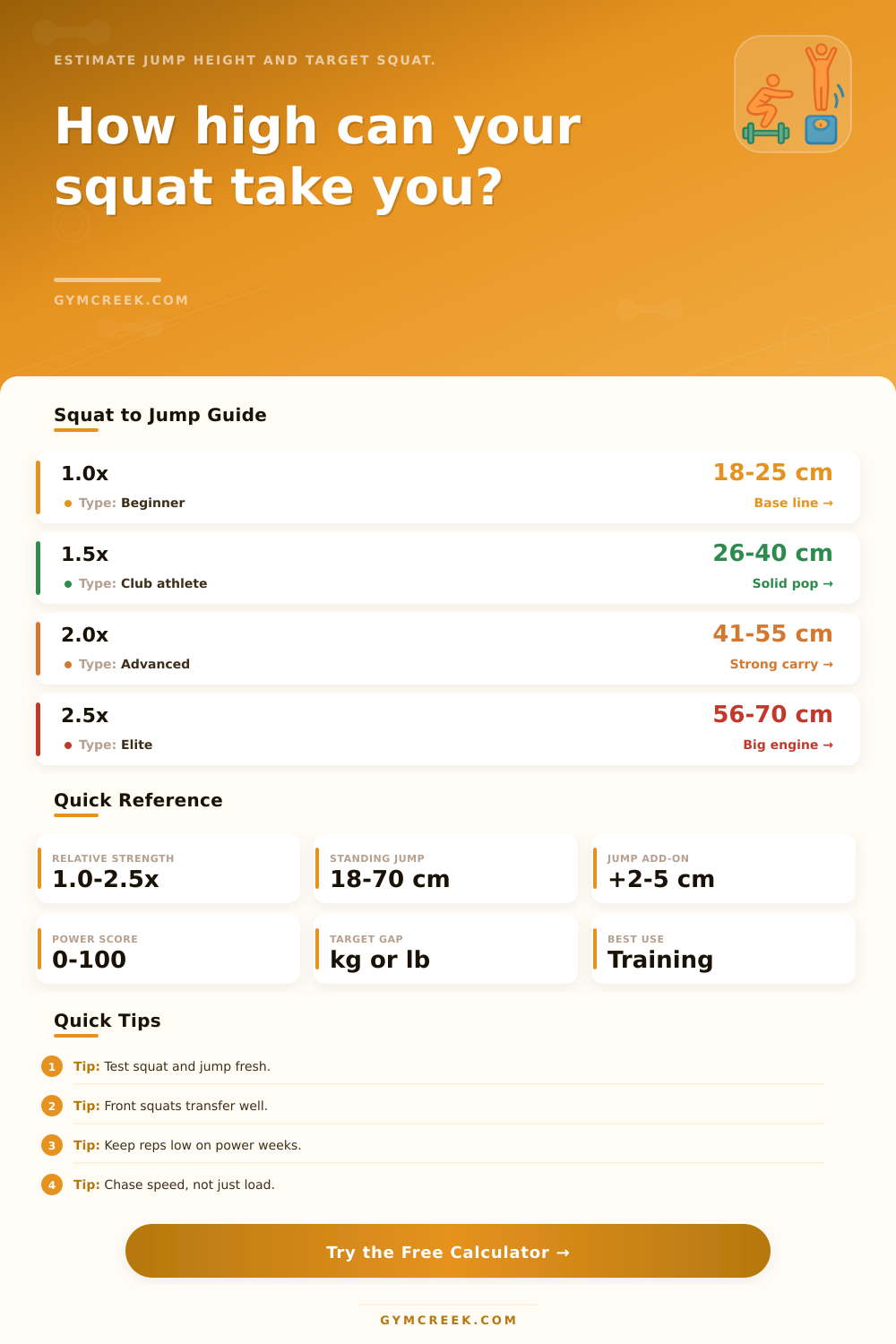
| 1.0x | 18-25 cm | Beginner | Base line |
| 1.5x | 26-40 cm | Club athlete | Solid pop |
| 2.0x | 41-55 cm | Advanced | Strong carry |
| 2.5x | 56-70 cm | Elite | Big engine |
| Jump test | Men | Women | Use |
|---|---|---|---|
| Standing | 35-45 cm | 28-38 cm | Pure power |
| CMJ | 40-50 cm | 32-42 cm | Test day |
| Approach | 50-65 cm | 42-55 cm | Court/sport |
| Elite | 65+ cm | 55+ cm | Peak output |
| Squat style | Transfer | Bias | Note |
|---|---|---|---|
| Front | High | Upright | Best carry |
| High-bar | Good | Balanced | All-round |
| Safety-bar | Fair | Stable | Joint save |
| Low-bar | Low | Load first | Less direct |
| Goal | Ratio | Target | Train |
|---|---|---|---|
| Rebuild | 1.25x | 20-30 cm | Base |
| Convert | 1.5x | 30-40 cm | Speed |
| Peak | 2.0x | 40-55 cm | Fresh |
| Elite | 2.25x | 55+ cm | Max |
💡Tips
Squat strength and jump height are two different measurement of an athlete’s physical capabilities. However, the strength an athlete can produce when squatting can be used to provide an estimation of an individual’s jump height. It is possible for an individual to be able to squat a heavy amount of weight yet jump a relatively short distance.
The strength required to squat and the explosive power required to jump are two different physical requirements of an athlete. By understanding how these two variables relate to one another, an athlete can improve there physical performance. The amount of weight an individual can squat in relation to they’re body weight has a direct impact upon the individual’s jump height.
How Squat Strength Affects Jump Height
For instance, an individual who can squat 1.75 times their body weight may have a jump height of around the mid-30s in centimeters if the individual is in their twenties. However, various other factors can play into this relationship. For instance, an individual with higher body fat percentages will typicaly have lower jump heights due to the extra weight that must be jumped.
Another factor is training fatigue; an individual who is fatigued will typically exhibit lower jump heights due to the physical inability of the nervous system to produce the amount of power required to jump high. An individual’s squat style can also have an impact upon jump height. For instance, an individual who utilize front squats will typicaly have a better transfer of strength from squat to jump height compared to an individual who utilizes low-bar squatting styles.
Low-bar squatting styles focus more upon the activation of the posterior chain muscles of the body, yet do not translate as efficient into jumping abilities. In addition to body composition and squat style, an individual’s age can also have an impact upon jump height. As an individual ages, the bodies connective tissues stiffen and the fast-twitch muscle fibers of the body become more difficult to activate.
Another factor that may impact jump height is an individual’s training age. Individuals who have trained for a longer period of time has more developed neuromuscular systems that allow their body’s strength to be translated into jumping abilities. An individual’s gender and body composition can also have an impact upon their jump height.
Women typicaly exhibit higher relative power scores for the same strength ratios as men. This is attributed to the fact that women has different leverage and body density than men. Additionally, jump height models can account for body fat percentages to account for the impact of excess body weight.
Finally, an individual’s body height may have some impact upon their jump height abilities. Individuals with longer limbs may be able to jump more high due to increased reach. However, they may also find it more difficult to jump as high due to the extra distance their body has to move.
The type of jump that an individual may perform may also have an impact upon the measurement of squat strength. For instance, vertical jumps requires an individual to jump straight upwards without the use of a dynamic warm-up and the stretch reflex. A countermovement jump allows an individual to drop their body quickly before jumping to increase their jump height.
An approach jump uses the momentum of the body to jump to achieve a higher jump height then a squat jump or vertical jump. Depending upon an individual’s goals for athletic performance, an individual can adjust their training program to better increase the transfer of squat strength to jump height. For instance, if jump height is an individual’s goal, then the individual should focus more upon jump speed than strength.
Additionally, conversion phases can be used to allow an individual to gain both strength and jumping velocity. Rebuild phases allow an individual to focus upon increasing their base strength levels prior to increasing their jump height to elite levels. Power scores provide an individual with an indication of their jump strength and can be used to track their improvements in jump height.
Individuals should avoid some mistakes when performing squat and jump tests. For instance, never performing jump and squat tests when fatigued will ensure that the body’s maximum capabilities is measured. An individual should also avoid ignoring their squat style as it will impact their jumping abilities.
Finally, individuals should avoid focusing on building squat strength ratios without also focusing upon increasing the speed with which the bar is drop during squats as this will have a greater impact upon jump height than strength alone. Squat strength may act as a limit to how high an individual can jump. However, various other factors impact jump height.
These factors include an individual’s body fat percentage, age, training age, gender, squat style, and the type of jump that is performed. By understanding these factors, an individual can adjust their training to increase the jump height of an athlete based off their squat strength.