Sled Push Calories Burned Calculator
Estimate workout calories from bodyweight, sled load, distance, pace, rest, incline, and surface resistance. Compare sprint, conditioning, and strength sessions.
📌Presets
Each preset loads a realistic sled session and syncs the unit labels before you calculate.
⚙Calculator Inputs
Sled push calorie snapshot
Enter a workout setup to calculate the burn estimate.
📊Quick Metrics
📑Reference Tables
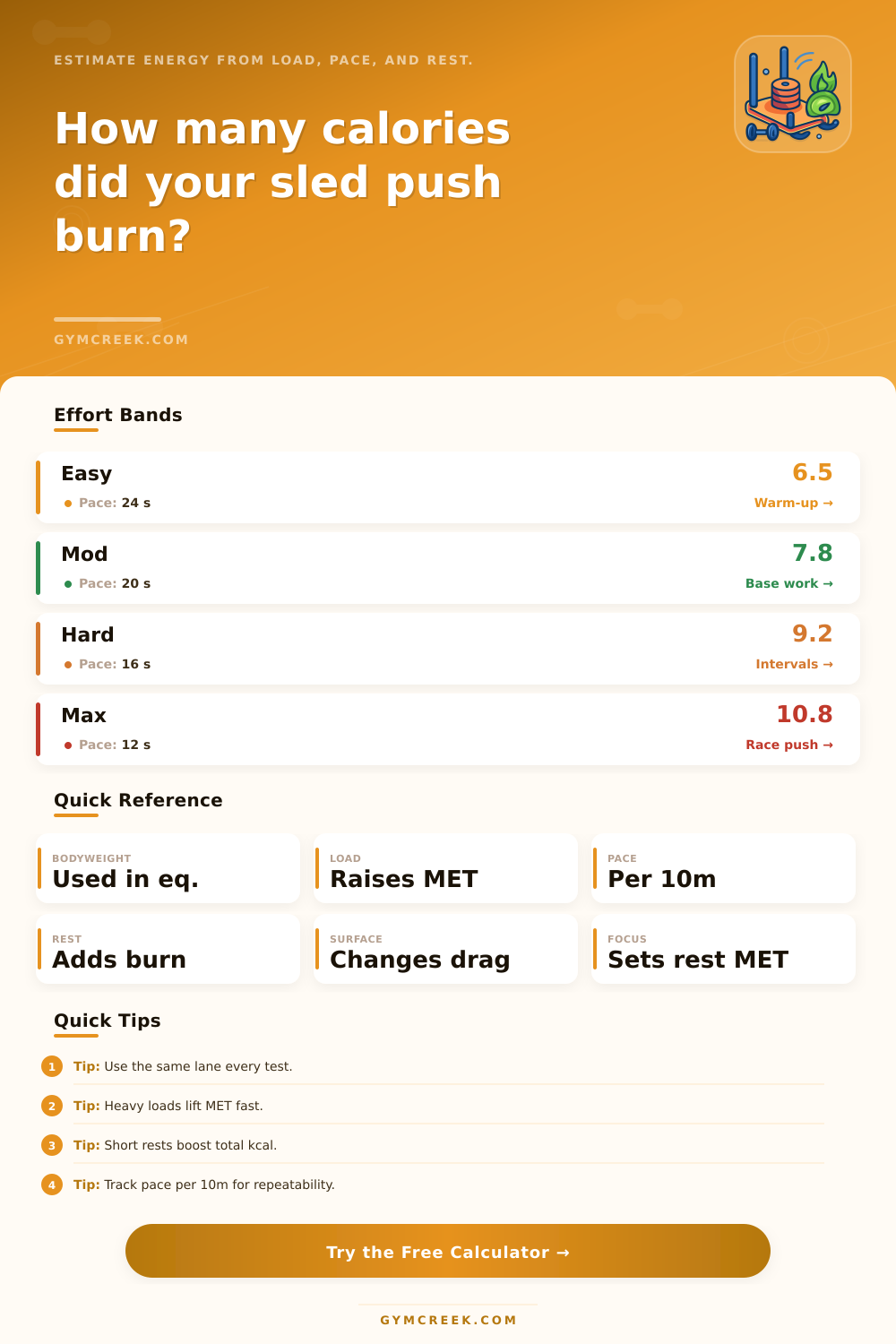
| Band | MET | Pace | Read |
|---|---|---|---|
| Recovery | 5.5 | 24-30 s | Warm-up |
| Easy | 6.5 | 22-26 s | Base work |
| Hard | 9.2 | 15-20 s | Intervals |
| Max | 10.8 | 12-16 s | Race push |
| Surface | Factor | Feel | Use |
|---|---|---|---|
| Turf | 1.00 | Standard | Baseline |
| Rubber | 1.04 | Slight drag | Gym lane |
| Grass | 1.08 | Sticky | Field work |
| Lane | 0.97 | Smoother | Speed day |
| Setup | Distance | Rest | Read |
|---|---|---|---|
| Density block | 10 m x 12 | 30 s | High burn |
| Conditioning | 15 m x 8 | 60 s | Steady |
| Sport repeat | 20 m x 6 | 120 s | Fast |
| Finisher | 12 m x 10 | 45 s | Short |
| Formula | Input | Effect | Note |
|---|---|---|---|
| MET kcal | BW x min | Total kcal | Main estimate |
| Load factor | Load / BW | Higher MET | Heavy sleds |
| Pace factor | Sec / 10m | Faster pace | Higher burn |
| Rest MET | Focus | Rest burn | Session style |
💡Tips
Sled pushes are a form of exercise that requires an individual to push a weighted sled across a surface. Sled pushes burn calories. The number of calories that burns during a sled push depends upon several variables.
These variables include the weight of the sled, the speed at which the individual perform the push, and the type of surface that is used to perform those sled pushes. Each of these variables will be discussed in relation to its impact upon the number of calories that are burned during a sled push exercise. The weight of the sled is one of the primary variables that impact the number of calories that can be burned during sled pushes.
What Changes How Many Calories You Burn in Sled Pushes
As the weight of the sled increase, the metabolic demand upon the individual increases as well. If an individual doubles the weight of the sled, for instance, it is difficult for the body to completely double its metabolic demand requirement to move that sled. The ratio of the weight of the sled to the weight of the individual is referred to as the load ratio.
Any load ratio that is 0.7 times the body weight or more will create fatigue in the body. Consequently, it is possible to use the load ratio as a means of measuring an individual’s accomplishments in their training efforts. The other primary variable to consider is the speed at which an individual performs their sled push.
If an individual performs a sled push at a high speed for a short period of time, the heart rate of that individual will be more higher than if they performed a sled push at a moderate speed for a longer period of time. High speeds will utilize the fast-twitch muscle fibers of the body, while heavy sled pushes that take place at slow rates will build the strength of those same fast-twitch fibers. Thus, the speed at which an individual performs their sled pushes will impact the total number of calories that are burned during that exercise.
Another variable that can impact the number of calories burned during sled push exercises is the type of surface upon which the pushes are performed. Turf, for instance, will have a baseline resistance to the movement of the sled. Grass, however, provides more resistance than turf, and can increase the calories that an individual must burn by approximately 8%.
Finally, rubber tracks will provide less resistance than grass or turf, but allow an individual to push their sled at a higher rate of speed. Each of these different types of surfaces will alter the number of calories that are burned during the exercise. The length of the rest periods between each sled push will impact the total calories that are burned during a workout session.
If an individual shortens the length of the rest periods, the average metabolic rate of the individual will increase. Thus, an individual will burn more calories per minute with shorter rest periods, but may become exhausted after those shorter periods. If an individual desires to burn calories at a high rate to lose body fat, an individual may utilize short rest periods.
However, if an individual desires to build strength, longer rest periods will allow their muscles to rebuild ATP levels. An individual can measure the intensity of the sled pushes by utilizing effort bands. A recovery pace is 24-30 seconds to travel 10 meters, and serves as a warm-up for an individual.
An easy pace builds the base for an individual’s endurance, a moderate pace can be used for conditioning, a hard pace can be utilized for interval training, and a max effort pace can be used to simulate race simulations. Each of these effort bands can be adjusted according to the individual’s goals. It is important to ensure that any data collected from performing sled push exercises are accurate.
One of the mistakes that could be made is in failing to maintain repeatability of the exercise. An individual should always use the same lane, shoes, and sled plates for maximum accuracy. An individual may burn alot of calories in a short period of time, but if they use different types of turf, for instance, their time will fluctuate.
The second common mistake is to focus on the total number of calories that are burned. Instead, the individual should focus upon burning a certain number of calories per minute or per 10 meters of distance with each sled push. If an individual takes long periods of rest between each sled push, the total number of calories may burn at a high rate, but the individual may be burning fewer calories per minute.
Finally, sled pushes can be used to accomplish different fitness goals. For instance, if an individual desires to increase their work capacity, they may utilize sled push efforts at a moderate pace but utilize short periods of rest between each push. If an individual desires to increase their power output, however, they may utilize heavy sled pushes but take longer periods of rest to accomplish their goal.
Thus, by tracking the effort that an individual puts into the sled pushes, and by adjusting each of the variables discussed, an individual can increase the precision of their training program.