INOL Calculator
Estimate session fatigue, weekly load, and target intensity with an INOL snapshot built for practical strength programming.
📌Presets
Each preset loads a realistic barbell scenario, updates the unit labels, and recalculates INOL instantly.
⚙Calculator
INOL snapshot
Enter your max, working load, reps, and sets to estimate session and weekly INOL.
📊INOL Metrics Grid
📑Reference Tables
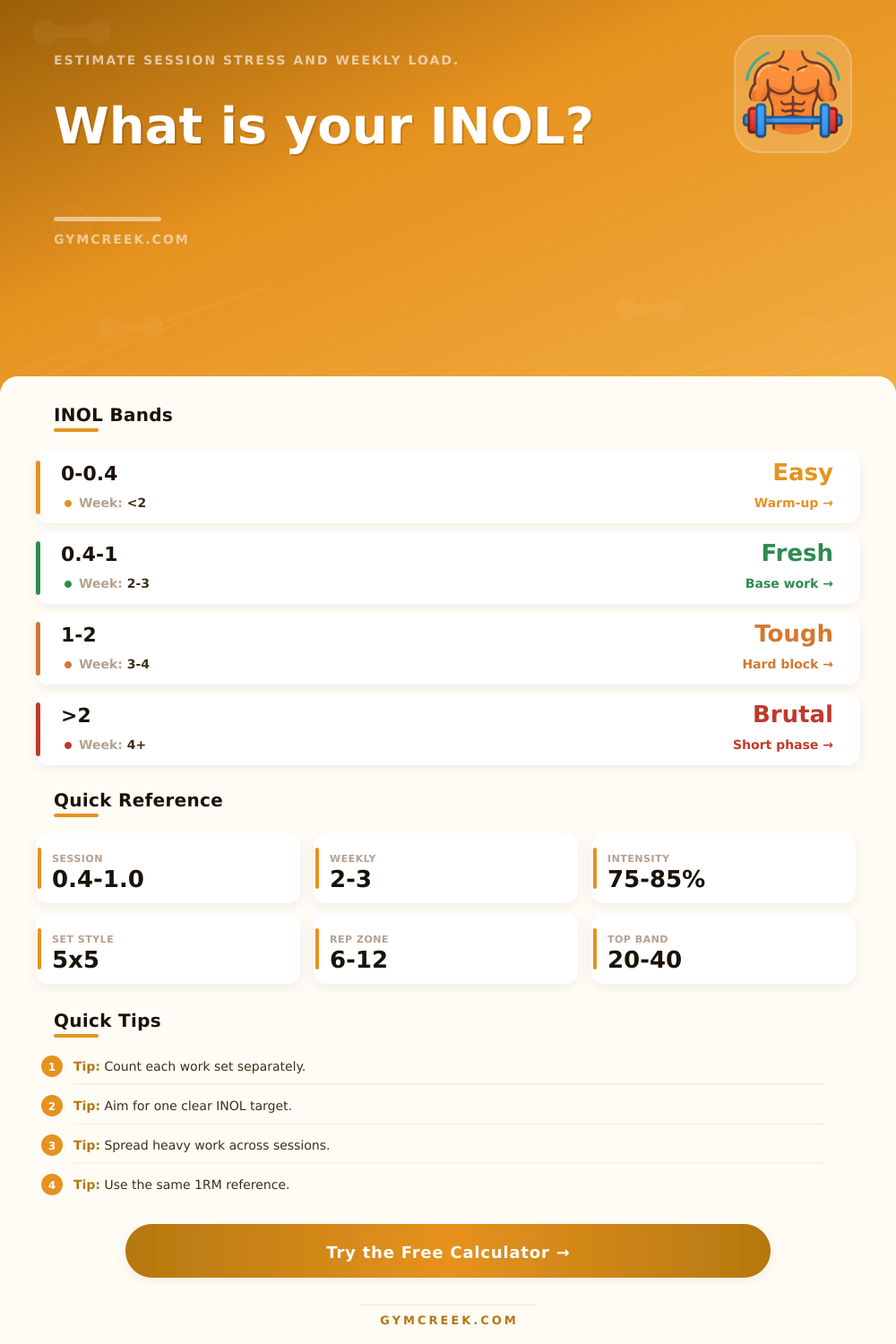
Single-session INOL guide
Use the session score to judge whether the exercise is fresh, heavy, or too fatiguing for the day.
| INOL | Class | Weekly | Use |
|---|---|---|---|
| <0.4 | Easy | <2 | Warm-up |
| 0.4-1.0 | Fresh | 2-3 | Base work |
| 1.0-2.0 | Tough | 3-4 | Hard block |
| >2.0 | Brutal | 4+ | Short phase |
Intensity examples
The same percentage can feel very different once reps climb, which is why INOL balances both signals.
| %1RM | 5 reps | 8 reps | Cue |
|---|---|---|---|
| 70% | 0.17 | 0.27 | Smooth |
| 75% | 0.20 | 0.32 | Base |
| 80% | 0.25 | 0.40 | Common |
| 85% | 0.33 | 0.53 | Hard |
Goal targets
Pick the block that matches your intent, then var the target band guide the load and weekly spread.
| Goal | Mid INOL | Week | Cue |
|---|---|---|---|
| Strength | 0.50 | 2-3 | Stay fresh |
| Hypertrophy | 0.90 | 2-4 | Build volume |
| Volume | 1.20 | 3-4 | Push work |
| Deload | 0.18 | <2 | Back off |
Set style multipliers
Rep style changes the stress of the same load, so the calculator adjusts the percentage before scoring.
| Style | Factor | Feel | Note |
|---|---|---|---|
| Standard | 1.00 | Neutral | Base set |
| Paused | 1.04 | Heavier | More control |
| Touch-go | 0.98 | Faster | Less reset |
| Tempo | 1.06 | Slower | More stress |
💡Tips
Track the same lift the same way each week.
Use weekly INOL to spot overload early.
Individualized Normalized Load, or INOL for short, are a measurement of training stress. An individual can calculate INOL by taking the number of repetitions performed and dividing by a percentage of one-rep max left in reserve. For example, if an individual perform five repetitions at 80 percent of their one-rep max, the INOL for that set will be approximately 0.25.
By multiplying the INOL value by the number of sets performed and the training frequency, an individual can calculate their total weekly INOL value. This value indicate to the individual whether their training program is productive or if it is cause fatigue. Unlike the total volume or tonnage performed by an individual, INOL values accounts for the individual’s one-rep max strength.
What is INOL and How to Use It
Thus, individuals of any strength can be compared using this metric; for example, an individual who can bench 300 pound can compare their performance to an individual who can deadlift 500 pounds. According to the total INOL value for a training session, there is different levels of intensity for an individual’s training. If the INOL value for a training session is below 0.4, the training is considered easy.
Easy sessions are typically performed as warm-ups or to rebuild strength after a deload. The total weekly INOL value for an individual should remain below 2 to avoid excessive strain on the body. For values between 0.4 and 1.0 for each training session, the intensity of that workout are considered fresh.
Workouts of this level is ideal for building an individual’s strength base when the total weekly INOL value reach 2 to 3. For INOL values between 1.0 and 2.0 for each training session, the workouts is considered tough. These workouts are used during training blocks when an individual trains more intense to reach a total weekly INOL value of 3 to 4.
For training sessions that have an INOL value of 2.0 or above, the intensity of the workouts is considered brutal. These types of workouts should only be performed for short period as an INOL value of 4 or more performed weekly can lead to burnout of the individuals muscle. There are different types of training programs for various INOL values.
For example, a strength block can use an INOL value of 0.5 for each training session to reach a total weekly value of 2 to 3. A person using a hypertrophy block might target an Individualized Normalized Load of 0.9 per session to allow the individual to reach a weekly Individualized Normalized Load of 2 to 4. A person using a volume block might target an Individualized Normalized Load of 1.2 per session to allow the individual to reach a weekly Individualized Normalized Load of 3 to 4.
During a deload period, however, it is important to reduce the Individualized Normalized Load to 0.18 or less per session so that the individual’s weekly load is under 2. By reducing the Individualized Normalized Load during a deload period, the recovery period that they require to effectively recover from the increased load during that individuals training program will be provided to the joints and the nervous system of the individual. Some training variables will increase the Individualized Normalized Load score for an individual.
Variables like paused repetitions or tempo sets can increase the Individualized Normalized Load by 4 to 6 percent because those variables increase the time that the muscle is exposed to tension. Performing an AMRAP (as many reps as possible) set can increase the Individualized Normalized Load by 8 percent because performing reps near failure will extract more fatigue from the body. Additionally, any set that has a higher rate of perceived exertion (RPE) and lower repetitions in reserve will increase the effective load of the exercise.
Finally, any individual that is experiencing fatigue from other training sessions will experience an increased load place upon the body. There are some errors that should of been avoided when using the Individualized Normalized Load calculations for an individual’s training program. For instance, using different values for one-rep max for the same exercise will lead to incorrect calculations; all calculation should use the same one-rep max value.
Additionally, warm-up sets should not be counted as work sets; counting them as work sets will inflate the Individualized Normalized Load value. Finally, heavy training should be spread across multiple training sessions so that the Individualized Normalized Load reflect each individuals fatigue caused by a specific exercise. Despite the usefulness of Individualized Normalized Load calculations for individual strength and conditioning programs, the tool is not a perfect one.
Factors like sleep or technique can increase the loads placed upon the body even if the Individualized Normalized Load score indicate that the loads are within an acceptable range. Individualized Normalized Load is most useful in the determination of loads for barbell exercises like squats and deadlifts; the one-rep max for these exercises are the most stable of the strength exercises. Finally, the Individualized Normalized Load should be used in conjunction with the bodys physical sensation to determine whether an individual should increase or decrease their training program.