Cycling Critical Power Calculator
Estimate CP, W', race pace, and surge tolerance from your best maximal efforts.
📌Presets
Each preset loads a race profile and fills all four effort points.
⚙Critical Power Fit
Cycling critical power snapshot
Enter four maximal efforts to fit CP, W', and surge tolerance.
📊Cycling Metrics Grid
📑Reference Tables
| Duration | Fit Bias | CP Impact | Best Use |
|---|---|---|---|
| 30s-2m | Sprint bias | Raises W' | CX, crit |
| 3-6m | VO2 bias | Lifts CP | Attack |
| 8-15m | CP anchor | Best fit | TT, road |
| 20-60m | Threshold | Low bias | Endure |
| W/kg | Band | Race Read | Use |
|---|---|---|---|
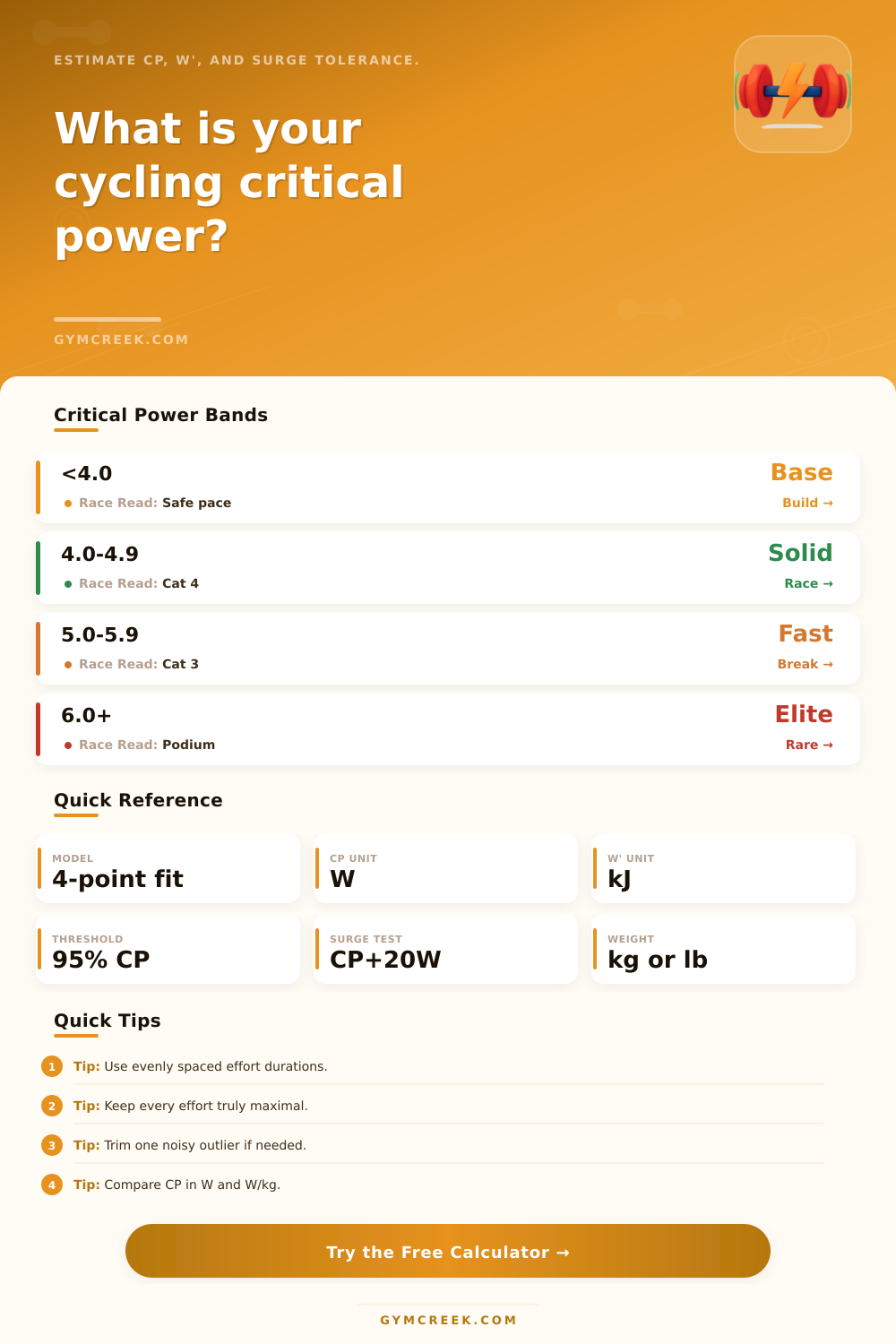
| <4.0 | Base | Safe pace | Build |
| 4.0-4.9 | Solid | Cat 4 | Race |
| 5.0-5.9 | Fast | Cat 3 | Break |
| 6.0+ | Elite | Podium | Rare |
| Profile | Shape | Signal | Best For |
|---|---|---|---|
| Crit | Punchy | High surges | Repeat |
| TT | Steady | Low drift | Hold |
| CX | Spiky | Hard starts | Recover |
| Gravel | Durable | Long drag | Endure |
| Check | Good | Warning | Fix |
|---|---|---|---|
| R² | .98+ | Loose mix | Retest |
| RMSE | Low | High drift | Trim |
| CP | Stable | Odd value | Check |
| W' | Positive | Negative | Refit |
💡Tips
Critical power is a measurement of how much power a persons can produce for a specific amount of time. Critical power help a person understand the difference between the power that can be sustained and the power used in short bursts. Critical power is the difference between aerobic power and anaerobic power.
If a person produce more power than the critical power level, then they will eventually deplete there store of energy (W’). Conversely, if a person can produce less power than the critical power level, then they can maintain that rate of production for a long period of time, or use that power to recover from exerting more power than that rate. To determine the critical power of an athlete, a person must perform several effort of maximal power. A person must perform four efforts of different duration, such as 30 seconds to 20 minutes.
What is critical power and how to find it
Shorter efforts will calculate W’, and longer efforts will calculate the critical power level. These efforts must be performed at a maximal intensity, otherwise the critical power level will be incorrect. Additionally, these efforts should be performed under a same conditions.
Variables like the wind, the type of equipment used, and other factors may impact the results if they arent controlled. Data from these efforts can be represented in a model that create two different values. Critical power will display in watts, and W’ will be represented in kilojoules.
Critical power will show how much power a person can sustain, and W’ will show the amount of anaerobic energy a person can produce for surges in speed. These values can be used to calculate how long a person can produce a certain amount of power above the critical power level. Relative critical power is the critical power level represented in watts per kilogram of body weight.
Relative critical power is used to determine how fast a person can ride in relation to their body mass. A relative critical power under 4 watts per kilogram indicate a person who is focusing on building their base power. A relative critical power of 6 watts per kilogram or more indicate an elite rider.
Because a person calculates relative critical power as a rate in relation to body weight, the relative critical power will change if a persons body weight change. If a person gain weight, their relative critical power will decrease. If a person lose weight, their relative critical power will increase.
The length of the power efforts will impact the accuracy of the critical power model. Efforts that are between 30 seconds and two minutes will allow for the calculation of W’, and will be helpful for those who ride criteriums. Efforts that are between three and six minutes will allow calculation of VO2 max, and will help to increase a persons critical power.
Efforts between eight and 15 minutes will best allow determination of a persons critical power level, and will be of use to time trialists. A combination of each of these efforts will allow for the most best determination of a persons critical power levels, but any data points that are outliers will be removed. Pacing during a race will be more effective if a person use critical power to make decisions.
A person can use critical power to determine how to best conserve W’ for later portion of the race. The person can use their W’ to produce power surge during the race. Once their W’ energy store is depleted, they wont be able to produce power above their critical power level.
Thus, critical power is a map of the energy that a person has for different types of movement during a race. Using critical power will allow a person to avoid exhaustion during a race.