Powerlifting Total Calculator
Sum squat, bench, and deadlift, compare the result to bodyweight and class targets, and read a meet-day snapshot in one place.
📌Presets
Each preset fills realistic meet numbers and updates the unit labels before you calculate.
⚙Total Calculator
Powerlifting total snapshot
Enter your lifts and bodyweight to see the total, ratio, class gap, and goal progress.
📊Total Metrics Grid
📑Reference Tables
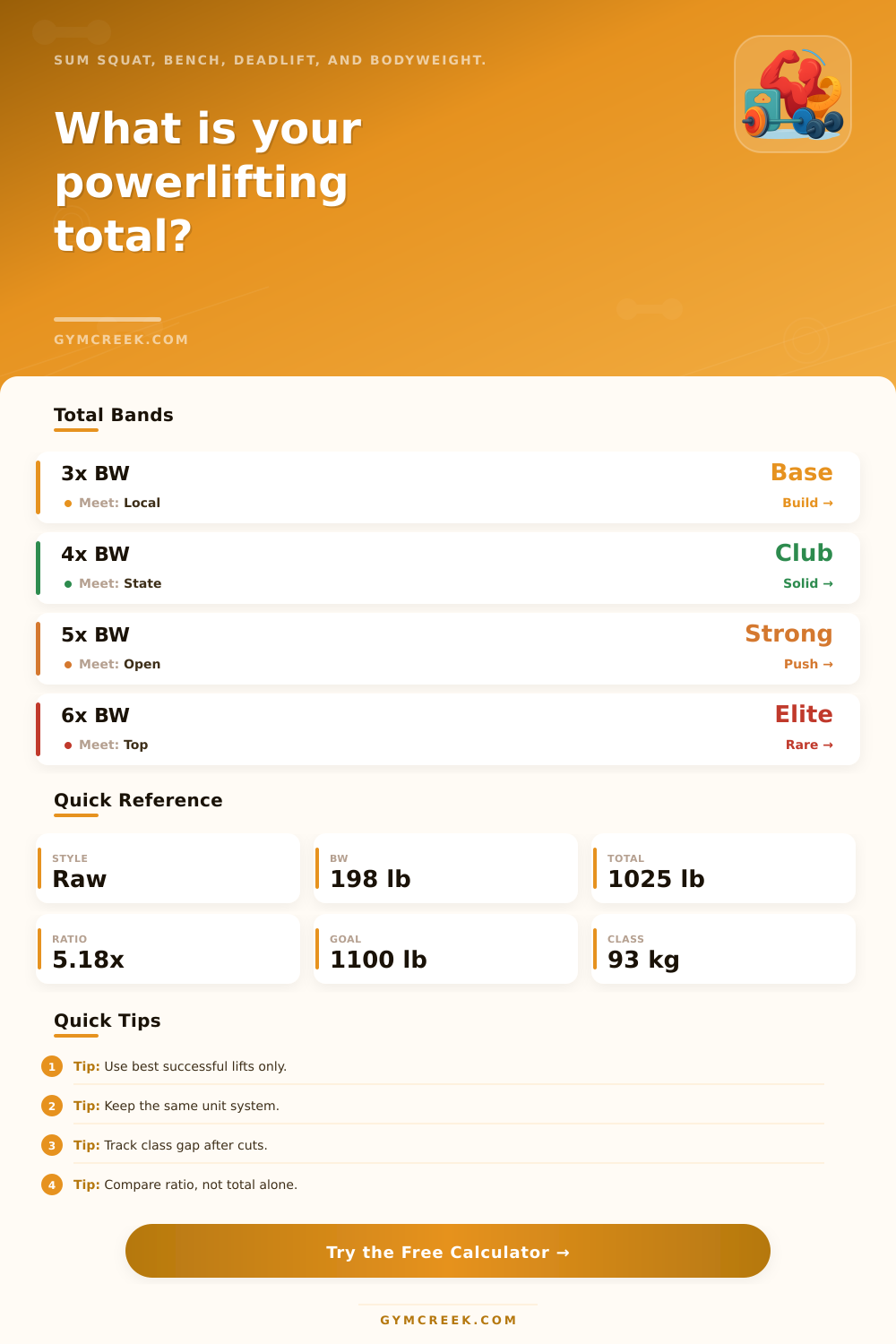
| Ratio | Band | Meet | Use |
|---|---|---|---|
| Under 3x | Base | Local | Build |
| 3x-4x | Club | State | Solid |
| 4x-5x | Strong | Open | Push |
| 5x+ | Elite | Top | Rare |
| Class | kg | lb | Use |
|---|---|---|---|
| 52 kg | 52 | 114.6 | Light |
| 63 kg | 63 | 138.9 | Cut |
| 83 kg | 83 | 182.9 | Middle |
| 93 kg | 93 | 205.0 | Open |
| Shape | Squat | Bench | Dead |
|---|---|---|---|
| Squat-led | 42%+ | <28% | 30%+ |
| Balanced | 35-42% | 25-33% | 33-40% |
| Bench-led | <35% | 33%+ | <35% |
| Pull-led | <38% | <28% | 42%+ |
| Gap | Read | Pace | Note |
|---|---|---|---|
| 0-50 | Close | 1-2 wks | Tighten |
| 50-100 | Near | 2-4 wks | Hold |
| 100-200 | Work | 4-8 wks | Train |
| 200+ | Long | 8+ wks | Plan |
💡Tips
Powerlifting consist of three specific lift: the squat, the bench press, and the deadlift. To determine the total for a powerlifter, the weight of each of these three lifts are measured and the lifter adds the three values together to determine the total strength of the lifter. That total, however, must be compared to the body weight of the powerlifter to determine there true strength.
The higher such a total is for a lifter with a low body weight compared to a powerlifter with a high total and high body weight indicate that the total strength of the lifter with the lower body weight is more significant. Thus, the ratio of the total strength to the body weight of the powerlifter are used to determine the relative strength of that individual. Such a ratio would allow for the comparison of two powerlifters of different weight, for example, comparing a powerlifter that weighs 150 pounds to another that weighs 300 pounds.
How to Find Your Powerlifting Total and Strength by Body Weight
The lifter calculates the total for a powerlifter by using the weights of each of the three lifts that the powerlifter successfully performed in the last few competitions. Only weights that the judge signal for the completion of the lift should be used; weights lifted during attempts or personal records at the gym should not be used. The body weight of the powerlifter should also be weighed at the time of the weigh-in.
If the powerlifter reduced their body weight by removing water, that weight should be accounted for. In either case, total strength and body weight can be measured in either pounds or kilogram. Strength band for powerlifting are determined by the ratio of total strength to body weight.
A strength band of less than three times the body weight indicate that the powerlifter is within the base builder category, which often include new powerlifters. A strength band between four and five times the body weight indicates that the powerlifter is of club level strength. Strength bands between five times the body weight indicates that the powerlifter is a strong lifter who can compete in the open division.
Strength bands of more than five times the body weight indicate that the powerlifter is within the elite category. These strength bands are established according to the statistical curves of all powerlifters within all competition meets. An ideal lifter will have a balance among their strength in each of the three lift.
For example, an ideal powerlifter will have a squat strength between 35 and 42 percent of their total strength, a bench press strength between 25 and 33 percent of their total strength, and their deadlift will be the remaining percentage of their total strength. If an individual’s deadlift strength is 42 percent or more of their total strength, they are considered to have a specialist strength in the deadlift but may have a weakness in their squat or bench press strength. Within powerlifting, there are different weight class.
These weight classes are established according to the body weight of each lifter. If an individual weighs more than the limit for a certain weight class, they must compete within a higher weight class. Because competitors in higher weight classes will weigh more than the competitors in a lower weight class, it is more difficult for the lifter to compete against others of their own weight class.
The weight of each lifter should be tracked after they have rehydrated, as their body weight can change according to the amount of water they contain in their body. Additionally, their total strength can help to plan their upcoming meets. For example, if their total strength is high, they may need to take a deload week to allow their muscles to rest and recover.
Alternatively, if they evaluate their average strength for their three lifts, it will be possible to determine if their strength is balanced or if their strength within each lift differs. The same can be said for comparing their highest lift to their lowest lift. The platform at the powerlifting competitions is different than the lifting environments at the gym.
For instance, a squat performed on the platform may be rejected if the lifter does not perform the lift deep enough. Similarly, a bench press may be rejected if the lockout on the bench press machine are not stable during the lift. Additionally, a deadlift may fail if the lifter slip on the bar during the lift.
Thus, powerlifters should practice their lifts with conservative weights to establish confidence in their ability to complete a competition lift. If they attempt to use heavy weight for their first few lifts, they may find that they failed their lifts during competition. Some of the most common mistake made by powerlifters when preparing for a competition include ignoring the balance of their lifts, focusing on total strength rather than the ratio of total strength to body weight, and forgetting the mental aspect of the lifts.
For example, if an individual ignores the strength of their lifts, they may find that even if they are strong in their squat, their bench press may become a weakness in their total strength. The second most common mistake is to focus only on total strength rather than the ratio of their total strength to their body weight; focusing on total strength ignores the fact that a powerlifter who can lift massive amounts of weight but has a high body weight may not be as strong as a powerlifter with a lower total but who has a high ratio of total strength to body weight. Finally, many powerlifter fail to account for the mental aspects of the competition.
For example, powerlifters should practice performing mock competitions to reinforce the commands that they will need to hear during the actual competition. Presets exist for powerlifting calculators that allow individuals to load different, realistic number into the calculator to evaluate how their strength ratio will change according to their body weight. These presets can help to indicate to the powerlifter whether they need to change their diet or begin a training cycle.
For example, if their total strength is 100 pounds away from their target weight class, they may need to adjust their diet. Alternatively, if they are 50 pounds away from their target weight class, they may need to begin a training cycle to increase their total strength. Additionally, lifter come in different proportions in their bodies.
For instance, a lifter may have longer torsos or arms than another lifter, which may impact the amount of strength they can exhibit in their squat, bench press, or deadlift. Not only do strength ratio apply to men in the sport, but also to women and junior lifters. Women have higher percentage of their total strength gained from their deadlifts due to the fact that their weight classes are often lighter.
Junior lifters should focus upon increasing their total strength before they compete in the open division. Masters lifters should focus on the longevity of their bench press strength. Additionally, lifters should focus on peaking for their competition.
To peak, lifters can decrease the volume of their training, increase their carbohydrate intake, and ensure they are getting enough sleep. Additionally, they should use a conservative strategy for their initial lift, use a slightly heavier weight for their second lift, and only attempt to perform their most strenuous lift for their third attempt. By using these methods, a lifter can ensure that their total strength is as high as possible.