Cycling Power and Speed Calculator
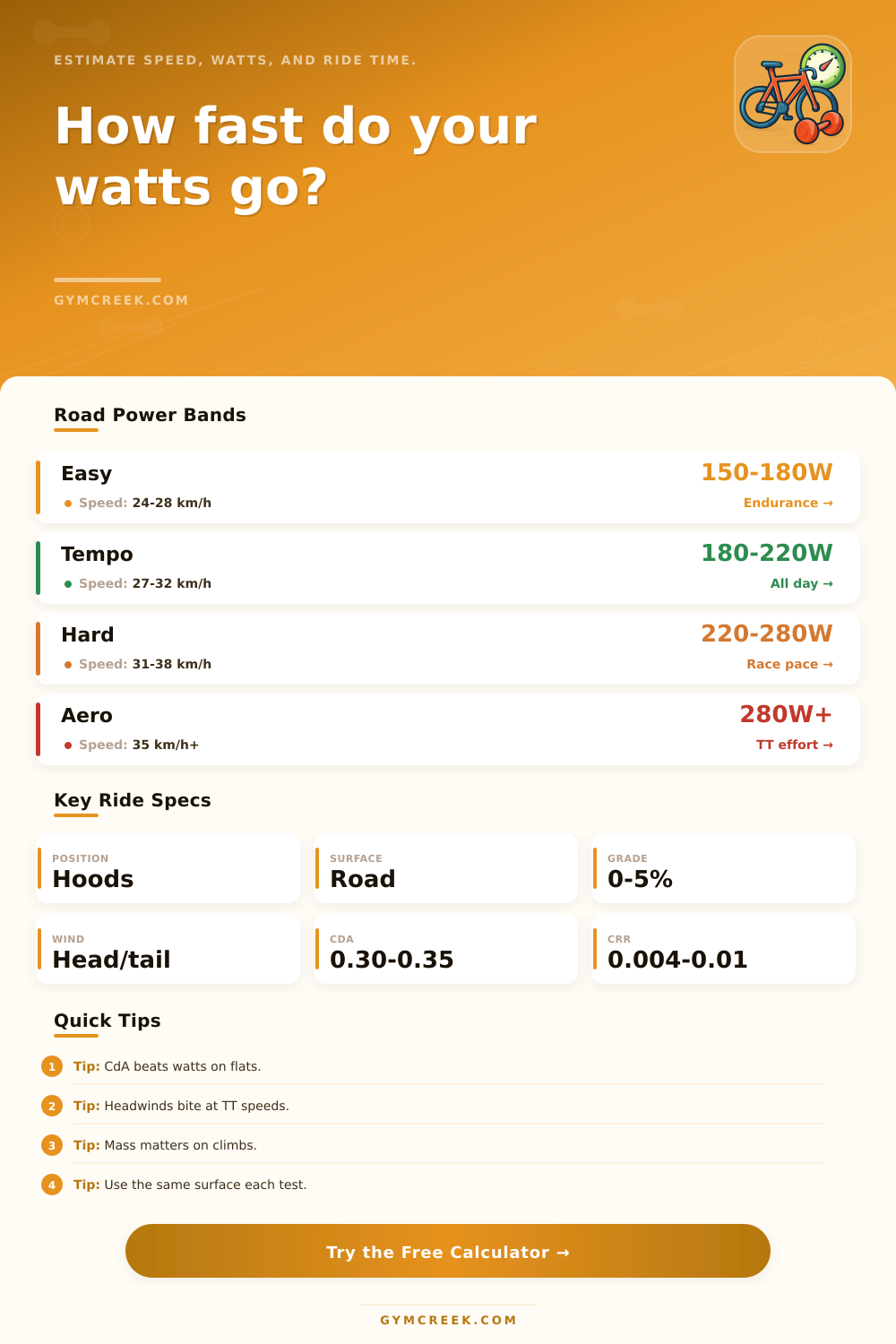
Estimate steady-state speed from watts or power from speed, then check time, watts per kilogram, and setup losses for road, gravel, TT, or climb work.
📌Presets
Each preset loads a realistic road, climb, gravel, or TT setup and updates the fields before you calculate.
⚙Calculator Inputs
Cycling power and speed snapshot
Enter watts or speed and the calculator will solve the steady-state ride profile.
📊Cycling Metrics Grid
📑Reference Tables
| Position | CdA | Feel | Best use |
|---|---|---|---|
| Upright | 0.50-0.60 | High drag | City rides |
| Hoods | 0.34-0.40 | Balanced | Endurance |
| Drops | 0.28-0.34 | Lower drag | Fast road |
| TT bars | 0.20-0.26 | Deep aero | Time trial |
| Surface | Crr | Feel | Best use |
|---|---|---|---|
| Smooth road | 0.003-0.004 | Fastest | Race day |
| Rough road | 0.004-0.005 | More drag | Typical road |
| Chip seal | 0.005-0.007 | Noisy roll | Mixed roads |
| Gravel | 0.007-0.010 | Slow roll | Off-road |
| Grade | Power effect | Speed feel | Best use |
|---|---|---|---|
| -6 to -2% | Low watts | Very fast | Downhill |
| -1 to 1% | Flat baseline | Set pace | Road test |
| 2 to 4% | Steady climb | Tempo | Rolling rise |
| 5%+ | Climb load | Slowest | Hill work |
| Scenario | Power cue | Speed cue | Use |
|---|---|---|---|
| Endurance | Easy watts | Stable pace | Long ride |
| TT | High watts | Deep aero | Fast solo |
| Climb | W/kg focus | Low speed | Grade test |
| Gravel | Higher drag | Lower pace | Rough road |
💡Tips
Power and speed are two differents metrics in cycling. Although they are different, power and speed are also connected since the power you produces can be measured in terms of the speed of your movement while cycling. Most cyclists may focus on the metrics of power output, which is easy to calculate with a power meter.
However, speed is the result of your power interacting with several environmental forces that impact your speed. These environmental forces includes wind, aerodynamic drag, rolling resistance and gravity. If you understand these forces, you will be able to better and accurate predict the speed that you will achieve with a given rate of power output.
How Power and Forces Affect Your Cycling Speed
Aerodynamic drag is a force that works against your movement through the air. The stronger the speed at which you are cycling, the more the aerodynamic drag will increases against you. Aerodynamic drag does not increase at a constant rate; instead, the force of aerodynamic drag increases by the square of your speeds.
For this reason, changing your bodily position while cycling will allow you to significantly increase your speed without increasing your rate of power output. For instance, cycling from the hoods of the bicycle to the drop or time trial bars will allow you to reduce your aerodynamic drag and cycle at a faster rate with the same wattage output from your power meter. Rolling resistance is another force that can impact your speed.
Rolling resistance is the friction between your bicycle tires and the road. The different types of road surfaces will create vary amounts of rolling resistance. Roads with smooth pavement will allow your tires to roll more easy and create less rolling resistance than gravel or roads with chip seal.
High amounts of rolling resistance will require you to produce more watts of power to maintain your cycling speed. Therefore, if you are on a road with gravel or chip seal, you will have to produce more power to maintain your speed then if you were to ride on pavement. Gravity will also have an effect on your cycling speed when you are riding on an incline.
On flat road surface, aerodynamic drag is the main force that you must overcome to cycle forward. However, on an incline, gravity will be the main force to overcome. The greater your total mass while cycling, the more force gravity will use to move your body and the bicycle forward.
Your total mass include your body weight, the weight of your bicycle and any accessories. The effect of gravity on your total mass means that your watts per kilogram ratio is a main metric to consider when cycling uphill. Your ratio will determine how fast you can climb a hill relative to another cyclist.
A higher ratio will result in the ability to ride uphill at a faster rate. Wind is one of the environmental factor that will impact your cycling speed. The force of the wind against yourself will either help or hinder your movement.
A headwind will decrease your speed and the distance that you can travel while riding. Conversely, a tailwind will increase your speed. Your power output can be high but your speed may be low if you are battling the force of a headwind.
Wind is another factor that you should consider in the calculation of your actual cycling performance or in planning the speed at which you will ride during your planned cycling ride. Drivetrain efficiency is another force that will impact the speed at which you can ride. Not all of the power that you generate through your body will be delivered to the road.
Some of your power is lost in the drivetrain due to friction between the bicycle chain and the chainring or between the pedals and the crank arm. The percentage of power loss in the drivetrain is between 2% and 6% of total power output. Therefore, if you dont maintain your bicycle with lubricant in the chain, you will experience a decrease in the efficiency of your drivetrain.
Decreasing drivetrain efficiency will require you to produce more power to maintain your speed. These variables can be used to plan your cycling rides and to increase the efficiency in which you train your cycling skills. Watts per kilogram can be used to calculate the power that you need to climb a hill of a specific distance.
Aerodynamic drag can be used to calculate the speed at which you can increase your speed by changing the position in which you ride your bicycle. Understanding the relationship between these different variables will allow you to better and accurately predict your cycling speed. If you understand each of these variables, you will understand how your power output creates different speeds in different environments.