IPF GL Points Calculator
Score meet totals, inspect the official coefficient, and map target totals across class and goal lines.
📌Presets
Each preset loads a real meet profile and syncs labels before you calculate.
⚙GL Scoring Form
IPF GL snapshot
Enter bodyweight and a meet total to calculate the score.
📊Score Ladder
📑Reference Tables
| Men division | A | B | C |
|---|---|---|---|
| Classic 3-lift | 1199.72839 | 1025.18162 | 0.00921 |
| Equipped 3-lift | 1236.25115 | 1449.21864 | 0.01644 |
| Classic bench | 320.98041 | 281.40258 | 0.01008 |
| Equipped bench | 381.22073 | 733.79378 | 0.02398 |
| Women division | A | B | C |
|---|---|---|---|
| Classic 3-lift | 610.32796 | 1045.59282 | 0.03048 |
| Equipped 3-lift | 758.63878 | 949.31382 | 0.02435 |
| Classic bench | 142.40398 | 442.52671 | 0.04724 |
| Equipped bench | 221.82209 | 357.00377 | 0.02937 |
| Points | Band | Meet use | Read |
|---|---|---|---|
| Under 80 | Base | Local | Build |
| 80-99.9 | Solid | Regional | Push |
| 100-119.9 | Elite | Big meet | Chase |
| 120+ | World | Top line | Rare |
| Class group | Examples | Use | Note |
|---|---|---|---|
| Women light | 43, 47, 52, 57 | Target list | Early anchors |
| Women mid | 63, 69, 76, 84 | Target list | Mid anchors |
| Men light | 53, 59, 66, 74 | Target list | Early anchors |
| Men heavy | 83, 93, 105, 120+ | Target list | Heavy anchors |
💡Tips
GL points are a system that the International Powerlifting Federation use to compare the strength of different powerlifter. GL points allow a person to compare the strength of a powerlifter to another powerlifter in a different bodyweight class. This is necesary because it is inherent true that a powerlifter who weigh more will be able to lift more total weight than a powerlifter who weighs less.
GL points allow for the creation of a fair comparison between all powerlifters. To calculate the GL points for a powerlifter, the bodyweight of the powerlifter in kilograms is used along with there total weight for the competition. The total weight for the competition is the total weight lifted for the squat, bench press, and deadlift exercises.
How GL Points Work in Powerlifting
The bodyweight must be an official bodyweight of the powerlifter. This official bodyweight will determine the coefficient that is used in the calculation of the GL points for that powerlifter. The coefficient is used to even out the difference in the bodyweight of the powerlifters being compared.
There are different modes of lifting for which the GL points can be calculated. A powerlifter can compete in classic lifting event or equipped lifting events. For equipped lifting events, the powerlifter may lift in supportive gear such as squat suits or bench shirt.
In this case, the coefficient that is used to calculate the GL points will be more different than the coefficient for classic lifting. Additionally, bench only competitions are held for which only the total bench press weight is consider in calculating the GL points for that powerlifter. The supportive gear for equipped lifting increase the total weight that the lifter will be able to lift.
Thus, the coefficient for equipped lifting is adjusted to ensure that the total GL points for equipped lifting are consistent with classic lifting. The preset functions within the GL point system can be used to plan for future competitions. Presets allow a powerlifter to define their sex, division, and lifting mode.
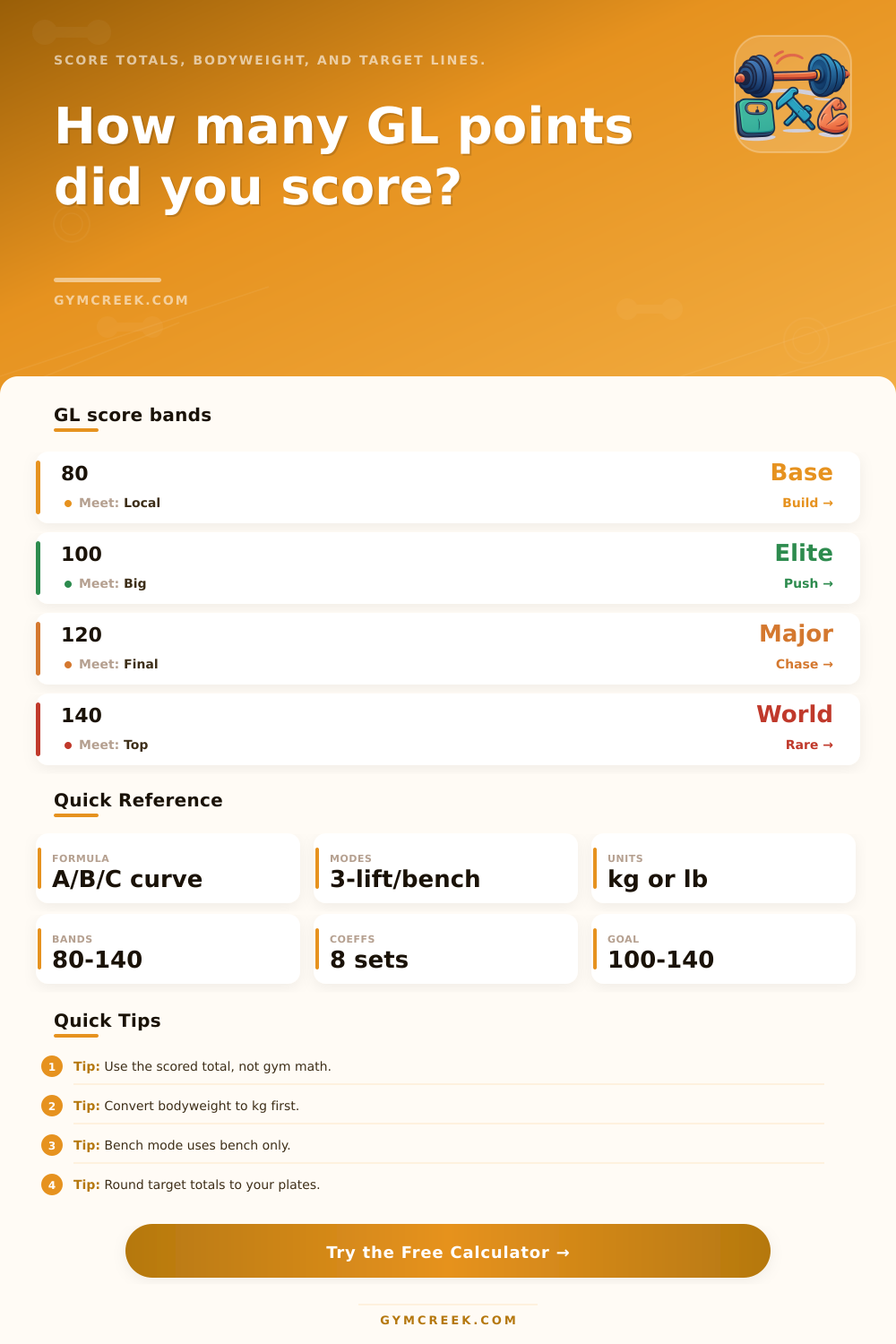
Using these presets, a powerlifter can determine what total weight for lifting will result in a specific number of GL points. Furthermore, presets allow a powerlifter to determine what total weight they will need to lift in order to reach a certain level of scoring for GL points. Scores below 80 is considered to be a base level for powerlifters.
Scores between 100 and 119 is considered to be an elite level for powerlifters. Scores of 120 or higher are considered to be a world class level for powerlifters. When calculating the GL points for a powerlifter, it is important to ensure that the proper unit are used.
The International Powerlifting Federation use the metric system. Thus, the weight of the powerlifter has to be in kilograms, not pounds. Additionally, the bodyweight that should be used is the official bodyweight of the powerlifter.
Using a different weight will result in a different coefficient, which will change the calculated GL points. One of the primary use of GL points is as a means of setting goals for lifters. If a powerlifter desire to have a specific number of GL points, that total weight can be calculated.
Furthermore, because weight plates come in specific increments, the total can be rounded to the nearest weight that can be lifted with those weight plate. Thus, GL points allow powerlifters to plan for the exact amount of weight that they will need to lift. GL points serve as a roadmap for powerlifters to follow in their development of lifting strength.
Using GL points, a powerlifter can determine if they should be attempting to lose or gain bodyweight. Additionally, if a powerlifter decide to move to a different weight class, their coefficient and GL points will change. Furthermore, GL points allow a powerlifter to track their increasing or decreasing strength throughout the year.
Overall, GL points allow for the raw points for lifting to be transform into a metric that can be used to compare all powerlifters, regardless of their bodyweight class or divisions.