Cycling Power Profile Calculator
Score sprint, punch, climb, and endurance strengths from five power durations, then see which rider type and race focus fit best.
📌Presets
Each preset loads a realistic rider shape and refreshes the profile fit before you calculate.
⚙Power Profile Inputs
Cycling power profile snapshot
Enter five efforts to score your rider type, discipline fit, best W/kg, and durability.
📊Profile Metrics
📑Reference Tables
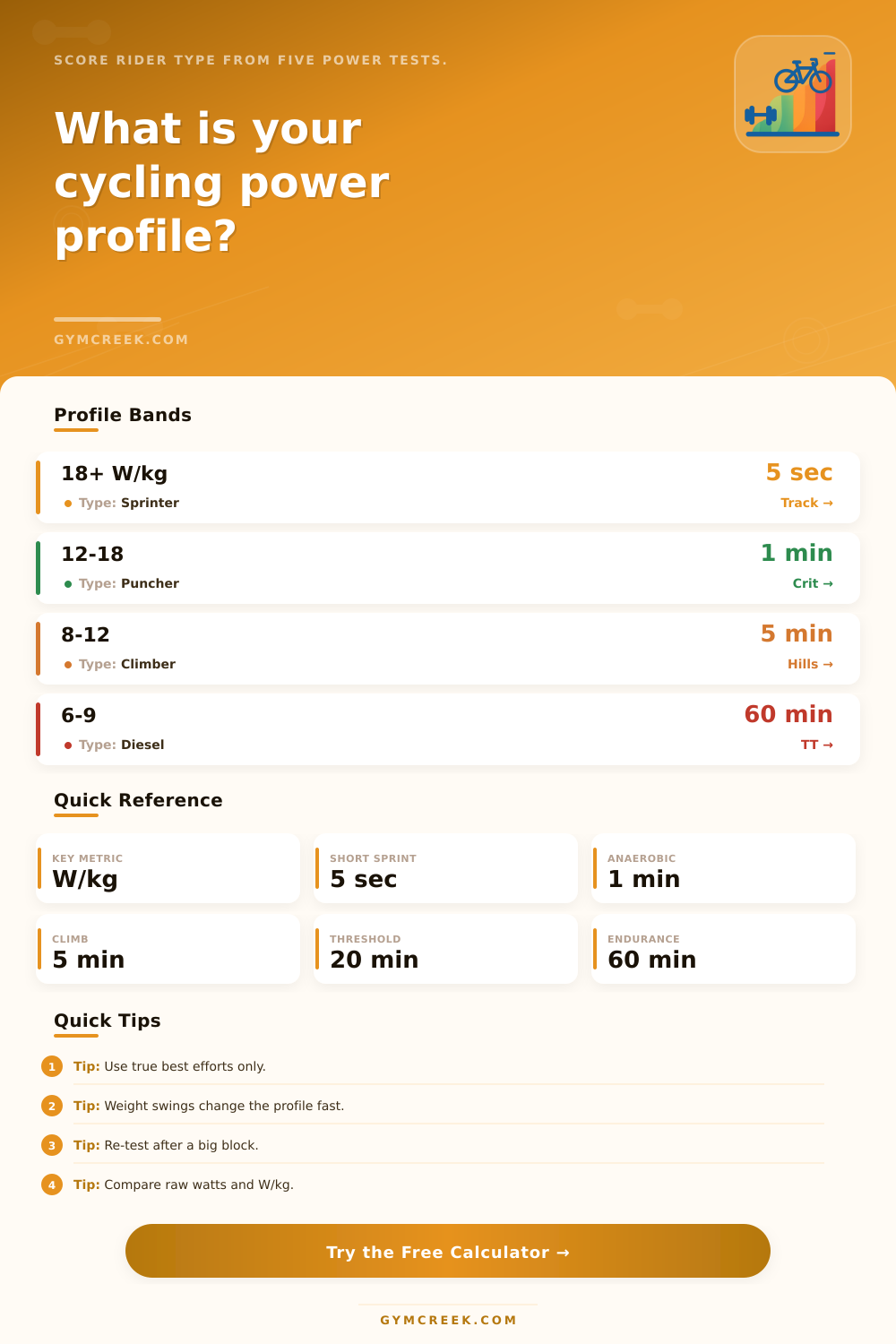
| Cue | Anchor | Type | Use |
|---|---|---|---|
| 18+ W/kg | 5 sec | Sprinter | Track |
| 12-18 | 1 min | Puncher | Crit |
| 8-12 | 5 min | Climber | Hills |
| 6-9 | 60 min | Diesel | TT |
| Duration | Base | Strong | Elite |
|---|---|---|---|
| 5 sec | 12 W/kg | 16 W/kg | 20 W/kg |
| 1 min | 8 W/kg | 11 W/kg | 14 W/kg |
| 5 min | 5.5 W/kg | 7.5 W/kg | 9.5 W/kg |
| 20 min | 4.5 W/kg | 6 W/kg | 7.5 W/kg |
| Focus | Best type | Key clue | Risk |
|---|---|---|---|
| Crit | Puncher | 1 min spike | Fade late |
| Climb | Climber | 20 min strong | Heavy sprint |
| TT | Diesel | 60 min steady | Start slow |
| Gravel | All-round | Repeat power | Overcook |
| Ratio | Read | Cue | Use |
|---|---|---|---|
| 0.90+ | Very steady | Hold pace | Stage |
| 0.80-0.89 | Solid | Train tempo | Road |
| 0.70-0.79 | Fade | Build endurance | TT |
| <0.70 | Fragile | Back off | Long |
💡Tips
A power profile is an measurement of the amount of power that a person can produce during various amounts of time. A power profile can reveal the physical capability of a person, as well as indicate whether an individual is better at producing power for short period of time or for longer periods of time. A power profile can help to individuals to understand there individual physical capabilities in relation to cycling, and can help to individuals to make decisions regarding their training and racing schedule.
A power profile curve can show the power that an individual can produce during short periods of time (high power) yet have low power for long periods of time, or have low power for short periods of time yet have high power for long periods of time. One of the factor that can help to indicate an individual’s power is the weight of the individual; power is often measured in watts per kilogram. Furthermore, watts per kilogram are a unit that allows for the comparison of the power of a light rider to that of a heavy rider.
What is a Power Profile?
There are five specific effort that can be used to determine an individual’s power profile. The five-second peak measures the power of an individual’s neuromuscular system. One-minute efforts measure the power of an individual’s anaerobic abilities.
Five-minute efforts measure an individual’s climbing power. Twenty-minute efforts help to indicate an individual’s threshold power. Finally, sixty-minute efforts indicate the power of an individual’s durability.
Each of these effort can be measured, and an individual’s result can be entered into a tool that calculates whether their power profile is specialized or balance. Riders of different types produce different ratios within each of these power efforts. For instance, sprinters can produce high watts per kilogram effort in short bursts of power.
Punchers have high power efforts during one-minute intervals. Climbers have high power efforts during five-minute intervals. Finally, diesels has high power efforts during sixty-minute intervals.
These power efforts can help to indicate to an individual which racing event they may excel at relative to others with different power profile. The durability ratio can help to indicate an individual’s ability to sustain high level of power. To calculate an individual’s power ratio, the power they produced during a twenty-minute interval can be divided by the power that they produced during a sixty-minute interval.
A ratio that is above 0.90 indicate strong endurance, but a ratio that is below 0.70 indicates that the individual may fade during long periods of time. An individual with a low durability ratio may benefit from increasing there base training to increase there endurance. Presets can be used to compare an individual’s power to that of other riders with specific power profiles.
Presets are pre-determined power profile, such as a track sprinter or gravel diesel rider. While these presets are not a direct measurement of an individual’s power, they can provide some context to an individual’s results. The raw watts and watts per kilogram can both be used to determine an individual’s capabilities; raw watts are beneficial for flat terrain, while watts per kilogram are more important for climbs.
One of the mistake that many individuals make is attempting to create a perfectly balance power profile. Such profiles indicate that the individual can produce even power with all periods of time, yet this does not necessarily ensure that they will win races. Specialists tend to win more races than balanced individuals.
Furthermore, an individual’s power profile can change over time. Therefore, their power profile should of be retested every eight week. An individual’s power profile can change as a result of altering there training, or by altering their body weight.
A power profile is a helpful tool in making smart bets on which races an individual will compete in. For instance, an individual with high one-minute power efforts can compete in criterium races, yet those with high sixty-minute power efforts may enjoy more gran fondo races. However, a power profile does not account for all of the variable in racing; variables such as drafting other riders in a group, or the type of equipment that is ridden, can impact the power that an individual must produce to maintain their desired speed.
However, a power profile can act as a map of an individual’s physiological capability, and can help to indicate to those with a strong power profile how to best respond to other riders that are accelerating past them.