🥩 Protein Intake Calculator
Calculate your ideal daily protein intake based on your weight, activity level, and fitness goals
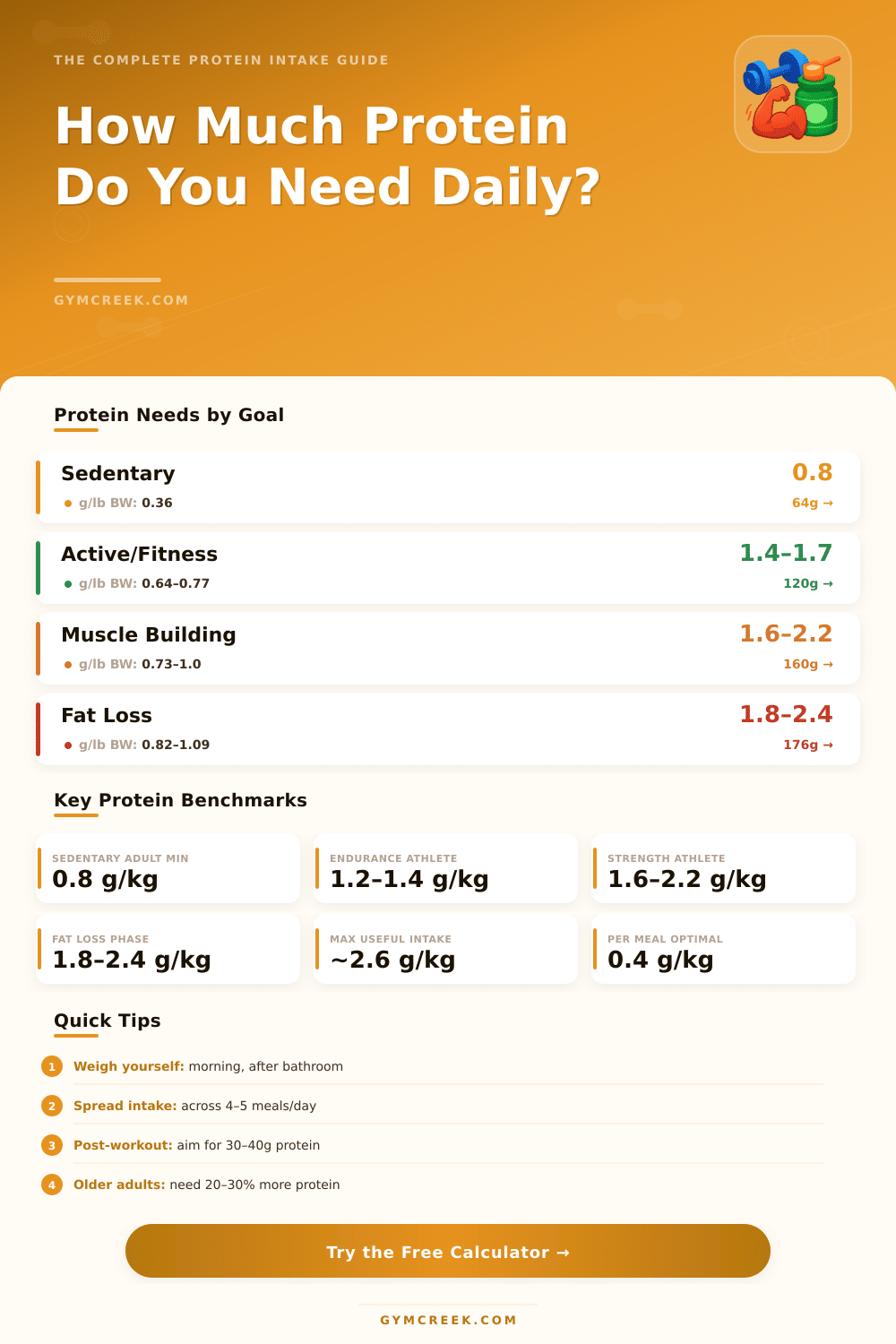
| Goal / Population | g/kg/day | g/lb/day | Example (75kg / 165lb) | Source |
|---|---|---|---|---|
| Sedentary Adult (RDA) | 0.8 | 0.36 | ~60g | DRI / WHO |
| Lightly Active | 1.0 – 1.2 | 0.45 – 0.55 | 75 – 90g | ISSN 2017 |
| Endurance Athlete | 1.2 – 1.6 | 0.55 – 0.73 | 90 – 120g | ACSM/AND/DC |
| Muscle Building / Hypertrophy | 1.6 – 2.2 | 0.73 – 1.0 | 120 – 165g | Morton et al. 2018 |
| Fat Loss (preserving muscle) | 1.8 – 2.4 | 0.82 – 1.09 | 135 – 180g | Helms et al. 2014 |
| Strength / Power Athlete | 1.6 – 2.2 | 0.73 – 1.0 | 120 – 165g | ISSN 2017 |
| Body Recomposition | 2.0 – 2.6 | 0.91 – 1.18 | 150 – 195g | Barakat et al. 2020 |
| Older Adults (65+) | 1.0 – 1.6 | 0.45 – 0.73 | 75 – 120g | PROT-AGE Study |
| Vegetarian / Vegan (+10–15%) | 1.8 – 2.5 | 0.82 – 1.14 | 135 – 188g | ISSN / Academy |
| Food Source | Serving Size | Protein (g) | Calories | Quality |
|---|---|---|---|---|
| Chicken Breast (cooked) | 100g / 3.5oz | 31g | 165 | Complete |
| Salmon (cooked) | 100g / 3.5oz | 25g | 208 | Complete |
| Eggs (whole) | 2 large eggs | 12g | 143 | Complete |
| Greek Yogurt (plain, 0% fat) | 200g / 7oz | 20g | 110 | Complete |
| Cottage Cheese (low-fat) | 200g / 7oz | 24g | 180 | Complete |
| Tuna (canned in water) | 100g / 3.5oz | 26g | 116 | Complete |
| Lentils (cooked) | 200g / 7oz | 18g | 230 | Incomplete |
| Black Beans (cooked) | 200g / 7oz | 15g | 227 | Incomplete |
| Tofu (firm) | 100g / 3.5oz | 8g | 76 | Complete |
| Edamame (cooked) | 100g / 3.5oz | 11g | 121 | Complete |
| Almonds | 30g / 1oz | 6g | 164 | Incomplete |
| Quinoa (cooked) | 185g / 1 cup | 8g | 222 | Complete |
| Timing Window | Recommended Amount | Purpose | Key Notes |
|---|---|---|---|
| Breakfast | 0.4 g/kg BW | Break overnight fast, initiate MPS | Avoid skipping; muscle loss risk overnight |
| Pre-Workout (1–2hr before) | 20 – 40g | Fuel training, reduce breakdown | Include carbs for glycogen support |
| Post-Workout (within 2hr) | 20 – 40g | Repair, rebuild muscle tissue | Leucine-rich sources preferred (whey, eggs) |
| Evening / Before Bed | 30 – 40g | Overnight MPS, recovery | Casein-rich foods ideal (cottage cheese) |
| Between Meals | 20 – 30g | Maintain positive protein balance | Spread remaining intake evenly |
| Category | Men (%) | Women (%) | Protein Need Adjustment |
|---|---|---|---|
| Essential Fat | 2 – 5% | 10 – 13% | Very high protein needed (2.0–2.6 g/kg) |
| Athlete | 6 – 13% | 14 – 20% | High: 1.6 – 2.2 g/kg |
| Fitness | 14 – 17% | 21 – 24% | Moderate–High: 1.4 – 1.8 g/kg |
| Average | 18 – 24% | 25 – 31% | Moderate: 1.2 – 1.6 g/kg |
| Above Average | 25 – 31% | 32 – 39% | Use lean mass for calculation |
| Obese | 32%+ | 40%+ | Calculate from lean body mass only |
🧮 If you have significant body fat: Enter your body fat % so the calculator uses your lean body mass for a more accurate protein target. Carrying excess fat does not require additional protein.
🌿 Plant-based eaters: Increase your target by 10–15% due to lower digestibility and incomplete amino acid profiles in many plant proteins. Combine complementary proteins (e.g. rice + beans).
🧓 Older adults (65+): Protein needs increase with age due to anabolic resistance. Aim for at least 1.2–1.6 g/kg/day even if sedentary, and prioritize leucine-rich sources.
Note: This article combines reliable information about Protein from several different sources and discussions.
DISCLOSURE: This post may contain affiliate links, meaning when you click the links and make a purchase, I receive a commission. As an Amazon Associate I earn from qualifying purchases.

The body depends on Protein for building and fixing tissues so that everything works well and for helping growth. Amino acids form the base of Protein, and there are around 20 different types that the body requires to work. Getting enough Protein is important, but exactly counting the amount can seem a bit hard.
How Much Protein Do You Need?
The Recommended Daily Dose estimates the base at 46 grams a day for women more than 19 years and 56 grams for men more than 19 years. RDA shows the usual daily intake that is enough for the basic food needs of most folks. On the other hand, new advice offers to reach between 1.2 and 1.6 grams each kilo of body weight…
A big change compared to the old 0.8 gram mark that served mainly for keeping nitrogen balance and stopping loss.
Protein should make up between 10 and 35 percent of your daily calories. The National Medical Academy agrees with that wide range. For people more than 65 years, aim for the higher limt, near 35 percent of calories from Protein, because it helps more.
Picture a woman weighing 140 pounds that aims for around 100 grams of Protein daily. A man of 220 pounds would need between 155 and 165 grams. When you want to build muscles, start with around 1 gram each pound of body weight as a good guide.
For serious bodybuilders in off season, reaching 1.6 grams each kilo is minimum, but going more near 2.2 grams each kilo commonly gives better results.
Getting 15 to 30 grams of Protein at every meal is a good plan. More than 40 grams in one sitting? That does not truly help more then staying in that 15-30 grams range.
The body tends to process about 30 grams at once.
A study followed 65 heavy women during six months. Those that followed a diet with high Protein, 25 percent of the total energy from Protein, lost much more weight than the other groups. If you want to lose weight, reaching between 0.45 and 0.68 grams each pound of body weight helps to protect the muscle that burns calories.
The numbers for Protein intake consider what you get from all sources together, not only from pills and powder. Meat, fish and eggs give all nine important amino acids, so they are complete Protein. Chicken and turkey are between the lean options and deliver all amino acids that the body itself can not make.
Adding Protein to every meal is the way thatmost helps.
Healthy kidneys do not struggle because of too much Protein in the diet. Problems happen only if there is already kidney disease. Even for folks that are not very active, it is useful to reach between 1 and 1.6 grams each kilo of body weight a day.