🏋 One Rep Max (1RM) Calculator
Estimate your maximum strength for any lift using proven formulas — Epley, Brzycki & more
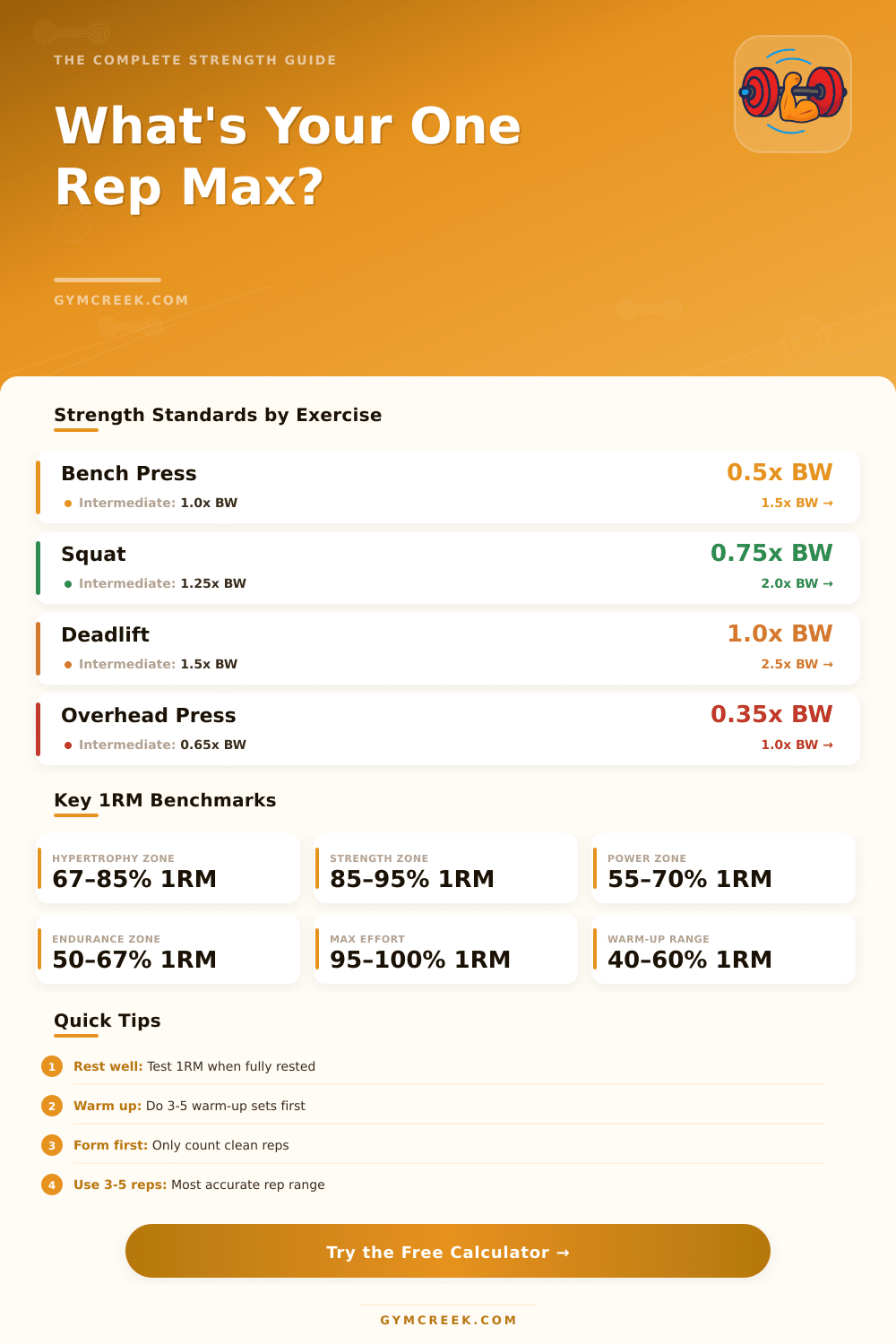
| Training Goal | % of 1RM | Rep Range | Sets | Rest Period |
|---|---|---|---|---|
| Maximal Strength | 90–100% | 1–3 | 3–5 | 3–5 min |
| Strength | 80–90% | 3–5 | 3–5 | 2–4 min |
| Strength-Hypertrophy | 75–85% | 5–8 | 3–5 | 2–3 min |
| Hypertrophy (Muscle Growth) | 67–85% | 6–12 | 3–4 | 60–90 sec |
| Muscular Endurance | 50–67% | 12–20 | 2–3 | 30–60 sec |
| Power / Speed-Strength | 55–80% | 3–6 | 3–6 | 2–5 min |
| Warm-Up / Activation | 40–60% | 10–15 | 2–3 | 60–90 sec |
| Exercise | Gender | Beginner | Intermediate | Advanced | Elite |
|---|---|---|---|---|---|
| Bench Press | Male | 0.5x BW | 1.0x BW | 1.5x BW | 2.0x BW |
| Bench Press | Female | 0.35x BW | 0.65x BW | 1.0x BW | 1.35x BW |
| Back Squat | Male | 0.75x BW | 1.25x BW | 1.75x BW | 2.5x BW |
| Back Squat | Female | 0.5x BW | 0.85x BW | 1.25x BW | 1.75x BW |
| Deadlift | Male | 1.0x BW | 1.5x BW | 2.0x BW | 2.75x BW |
| Deadlift | Female | 0.65x BW | 1.0x BW | 1.5x BW | 2.0x BW |
| Overhead Press | Male | 0.35x BW | 0.65x BW | 1.0x BW | 1.35x BW |
| Overhead Press | Female | 0.2x BW | 0.4x BW | 0.65x BW | 0.85x BW |
| Barbell Row | Male | 0.5x BW | 0.9x BW | 1.25x BW | 1.6x BW |
| Barbell Row | Female | 0.3x BW | 0.55x BW | 0.85x BW | 1.1x BW |
| Formula | Best For | Accuracy Range | Notes |
|---|---|---|---|
| Epley (1985) | General use | 1–10 reps | Most widely used formula worldwide |
| Brzycki (1993) | Low rep sets | 2–10 reps | Most accurate for 5 reps or fewer |
| Lander (1985) | Higher reps | 1–12 reps | Good balance across rep ranges |
| Lombardi (1989) | High reps | 5–15 reps | Tends to overestimate slightly |
| Mayhew et al. | Bench press | 6–20 reps | Validated for bench press specifically |
| O'Conner et al. | General use | 1–15 reps | Simple, slight underestimation tendency |
Determining your true strength are part of the gym experience for many lifters. While you may be able to perform five or eight impressively repetitions of a given exercise such as the bench press, how strong are you theoreticaly for one repetition? This is where a max one rep calculator become of great use to lifters of any level. Rather than putting great effort into attempting to lift the maximum weight for one repetition, these calculators can provide you with an idea of your strength based off weights you can lift for multiple repetitions.
Understand your one rep max (1RM) and you can determine appropriate weight for your training goals. Whether your goal is to increase strength, endurance or muscular size, knowing your 1RM allow you to train to achieve your goals, while minimizing the risk of injury. Even better, researchers in the field of sports science has determined the calculations behind these calculators through decades of research with thousands of athletes.
Max One Rep Calculator
What Is a Max One Rep Calculator and Why Does It Matter?
A max one rep calculator is a tool that uses mathematics to calculate the maximum weight you can lift for one repetition of an exercise. Instead of attempting to lift the maximum weight for one repetition, which can be taxing on the body and lead to injuries, you can use a rep weight that is manageably for yourself and allows your body to remain within safe parameters for lifting weights. Furthermore, you can use this calculator even if you train alone and do not have any spotter for your exercises. The calculator ensures that you are never lifting weights that may strain your body.
Depending on the weight you lift for multiple repetitions you can input into the calculator, different mathematical formula can be used to calculate your 1RM. The Epley formula is the most popular formula for estimating 1RM. For instance, if you can lift a given weight for 5 repetitions, the Brzycki formula calculate your 1RM for that specific exercise. Furthermore, there are also formulas that studies developed through focus on exercises like the bench press, and others that were created with the intention of using them for calculating 1RM for any exercise.
In addition to calculating your 1RM, many calculators also provide you with a measurement of your strength to body weight ratio. This is especially useful for those who want to compare their strength to body size, or to compare their strength to another athlete’s strength. For instance, a 200-pound deadlift may indicate strength for an athlete whose body weight is 150 pounds, but indicate weakness for an athlete whose body weight are 250 pounds. The ratio help to indicate relative strength.
Furthermore, training percentages of your 1RM can help you to structure your training program. For instance, many coaches may prescribe weight that are some percentage of your 1RM for specific training goals. A coach may prescribe a percentage of 80% for an athlete aiming to increase their strength, while a coach may prescribe a percentage of 70% for those aiming to increase their muscular size. Without a method of calculating your 1RM, the prescribed percentage would be meaningless.
However, it should be noted that these calculators only provide estimates to your strength. Your body factor like your level of sleep, nutrition, and stress can influence the results of your calculator. Furthermore, the more repetitions of a given exercise that you can perform, the less accurately the calculator may be in determining your 1RM. If you perform fewer than five repetitions of an exercise, or if you perform more than ten repetitions, the estimate may not accurately reflect your 1RM. Results are most accurate if you can lift a weight for five repetitions with perfect technique.
These calculators are also of great use in that lifters can use them to set goals for their strength. If you calculate your one rep max for exercises like the bench press and find that you can only lift 185 pounds for one repetition, you may wish to seek to lift 225 pounds in six month. These goals allow lifters to focus on attaining specific and measurable objective. Furthermore, if you are planning to compete in a powerlifting contest, your calculated 1RM will help you plan the strategy you will use when attempting to lift the maximum strength on the platform.
Furthermore, setting a record in the gym will provide a confidence boost for lifters. Regardless of if an athlete calculates the one rep max for an exercise, hitting a new personal record will provide that confidence. A confidence boost help lifters to maintain their motivation to continue lifting in the gym.
Although calculators may be able to provide a theoretical 1RM for an athlete, coaches may use these calculators as another data point in addition to testing a lifter’s 1RM at 90% of their calculated 1RM, for instance. These two measurement of 1RM typically produce the most accurate result for a lifters true strength.
Beyond the ability for coaches and lifters to use these calculators for the benefits mentioned above, the calculators themselves also serve as an educational tool for lifters to understand the mathematics behind their lifting program. Thus, these tools provide the knowledge and information that lifters need to understand their programs and to manage their training and goals.
As the world of strength training continues to develop with technology and strength in the area of sports science, tools like the one rep max calculator will continue to be of great use to lifters of all experience level. Furthermore, removing some of the uncertainty of how strong an athlete is, the calculator allow lifters to focus on other area of their training program and develop their strength in the gym overall.