🔥 Harris-Benedict TDEE Calculator
Calculate your Total Daily Energy Expenditure using the revised Harris-Benedict equation — your science-backed daily calorie baseline.
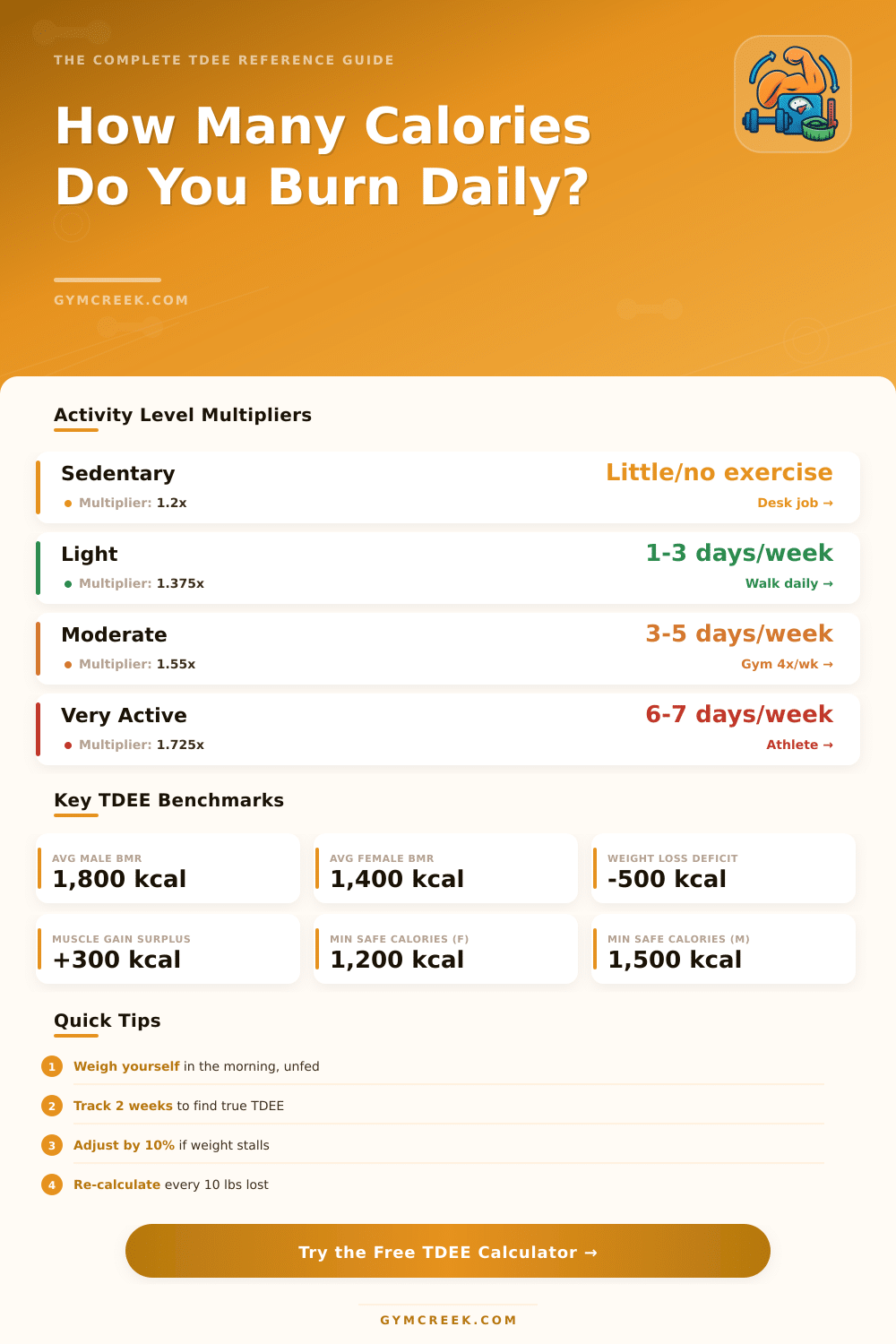
| Activity Level | Description | Multiplier | Weekly Exercise |
|---|---|---|---|
| Sedentary | Desk job, little movement | 1.2× | 0 days |
| Lightly Active | Light walks, occasional gym | 1.375× | 1–3 days |
| Moderately Active | Regular gym sessions | 1.55× | 3–5 days |
| Very Active | Hard training most days | 1.725× | 6–7 days |
| Extra Active | Athlete, physical job, 2x/day | 1.9× | Daily + job |
| Age Group | Male BMR (kcal) | Female BMR (kcal) | Notes |
|---|---|---|---|
| 18–25 yrs | 1,750–2,050 | 1,350–1,600 | Peak metabolic rate |
| 26–35 yrs | 1,700–2,000 | 1,300–1,550 | Slight decline begins |
| 36–45 yrs | 1,620–1,900 | 1,250–1,480 | Muscle mass key factor |
| 46–55 yrs | 1,550–1,800 | 1,180–1,420 | Hormonal changes |
| 56–65 yrs | 1,450–1,700 | 1,100–1,350 | Protein intake critical |
| 65+ yrs | 1,350–1,600 | 1,050–1,280 | Monitor micronutrients |
| Goal | Protein | Carbohydrates | Fat |
|---|---|---|---|
| Weight Loss | 35% | 35% | 30% |
| Maintenance | 25% | 45% | 30% |
| Muscle Building | 30% | 45% | 25% |
| Athletic Performance | 25% | 55% | 20% |
| Low Carb / Keto | 30% | 10% | 60% |
| Category | Minimum Calories | Recommended Floor | Risk Below |
|---|---|---|---|
| Adult Female | 1,000 kcal | 1,200 kcal | Nutrient deficiency |
| Adult Male | 1,200 kcal | 1,500 kcal | Muscle loss, fatigue |
| Active Female | 1,400 kcal | 1,600 kcal | Hormonal disruption |
| Active Male | 1,600 kcal | 1,800 kcal | Performance decline |
The Harris-Benedict formula helps to estimate how many calories the body burns daily. It was created in 1918, and updated in 1984 even though it still shows up in common use today. For counting the basic metabolic rate of people, or BMR, the method considers age, gender, weight and height.
DISCLOSURE: This post may contain affiliate links, meaning when you click the links and make a purchase, I receive a commission. As an Amazon Associate I earn from qualifying purchases.

BMR simply said shows how many calories the body would use, if it would stay fully still the whole day. When you find the BMR value, you multiply it by an activity factor to get the total daily energy use, called TDEE.
Use the Harris-Benedict Formula to Find Your Daily Calories
For males and females the Harris-Benedict formula has different versions. For females it counts BMR as 655.1 plus 9.563 times weight in kilos plus 1.850 times height in centimetres minus 4.676 times age. For males the version is similar, but with some differences in the numbers, and it works the same way.
Then you multiply the BMR result by a number based on the activtiy level of the person, which gives the rough daily calorie need.
TDEE covers all calories, that the body burns during one day. It covers not only the BMR, but also movement and even the energy for digestion. Knowing this value really is useful.
Want you to lose weight? Then calorie deficit matters most. Want you too get muscle?
Then eat a bit more than needed. The Harris-Benedict formula helps set this goal.
There are also other methods. For example the Mifflin-St Jeor formula is another commonly used one. It focuses more on height and less on weight than the Harris-Benedict.
There is also the Katch-McArdle formula, which differs, because it includes lean body mass. Neither Mifflin-St Jeor nor Harris-Benedict does that. The Katch-McArdle approach can be more accurate, because adding data about body fat helps the calculation.
Different methods commonly give slightly different values. For instance one comparison shows, that Harris-Benedict gives BMR of 1377 and TDEE of 1894, while Katch-McArdle reaches BMR of 1199 and TDEE of 1648. Every formula is based on lab studies, and any could prove better for certain people over time.
Really the best way is trial and error, to find your exact TDEE.
Medical specialists commonly use Harris-Benedict calculations in clinics, for instance for nutrition therapy. Calorie deficit of 500 to 750 under the TDEE can help lose one or two pounds weekly. Combining tracking of calories with a food diary or app helps to stay on the right track.
Also online calculators let you choose the right activitylevel, which fits well with daily calorie needs.