🏋 Max Back Squat Calculator
Estimate your 1-rep max (1RM) from any set — then find your training zones & strength level
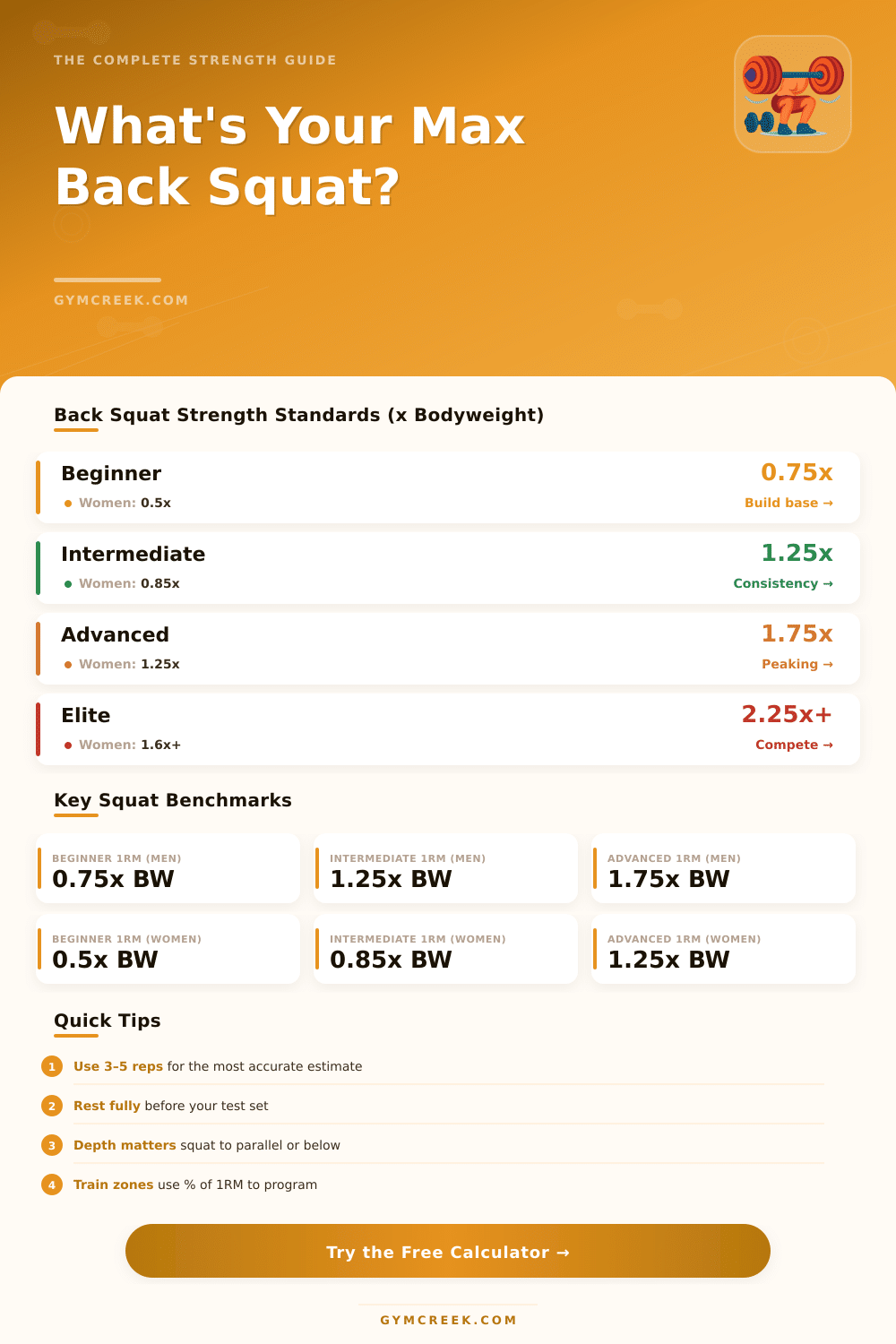
| Level | Men (x BW) | Women (x BW) | Rep Range Focus | Training Goal |
|---|---|---|---|---|
| Untrained | 0.5x | 0.35x | 5–8 | Learn movement |
| Beginner | 0.75x | 0.50x | 5–8 | Build base strength |
| Novice | 1.00x | 0.70x | 3–5 | Linear progression |
| Intermediate | 1.25x | 0.85x | 3–5 | Consistent overload |
| Advanced | 1.75x | 1.25x | 1–3 | Peak & peak cycles |
| Elite | 2.25x+ | 1.60x+ | 1–2 | Competition prep |
| Reps | % of 1RM (Epley) | Zone | Primary Adaptation |
|---|---|---|---|
| 1 | 100% | Max Strength | Neuromuscular efficiency |
| 2 | 97% | Max Strength | Max strength |
| 3 | 94% | Strength | Strength & power |
| 4 | 92% | Strength | Strength |
| 5 | 89% | Strength | Strength / Size |
| 6 | 86% | Strength / Hypertrophy | Size & strength |
| 8 | 81% | Hypertrophy | Muscle growth |
| 10 | 75% | Hypertrophy | Muscle growth |
| 12 | 70% | Hypertrophy | Size & endurance |
| 15 | 63% | Endurance | Muscular endurance |
| 20 | 55% | Endurance | Conditioning |
| Formula | Best For | Rep Range | Notes |
|---|---|---|---|
| Epley | General use | 1–10 | Most widely used; slight overestimate at high reps |
| Brzycki | Low-rep accuracy | 2–10 | Very accurate under 10 reps; underestimates above 10 |
| Lombardi | Higher rep sets | 5–15 | Tends to give slightly higher estimates |
| Mayhew et al. | Moderate reps | 6–20 | Developed for bench press; applies to squat |
| O’Conner et al. | Simple estimate | 1–12 | Linear formula, very conservative |
The back squat exercise are one of the most effectve compound exercises for developing strength and muscle mass in the lower body. Determining one’s true one-rep maximum for squat lifts are essential to setting appropriate training goals. However, performing such a test too frequent can lead to injuries. This is where the use of a max back squat calculator can be helpful for individuals of all strength level.
These calculators allow an individual to enter the number of repetitions performed with a given load to estimate the theoretical maximum strength for that individual. Researchers created such estimates from mathematical formula over time through research in the field of strength. Knowing how to read such estimates and when to use them can dramatically improve one’s strength training program.
Understanding 1RM and its use in training
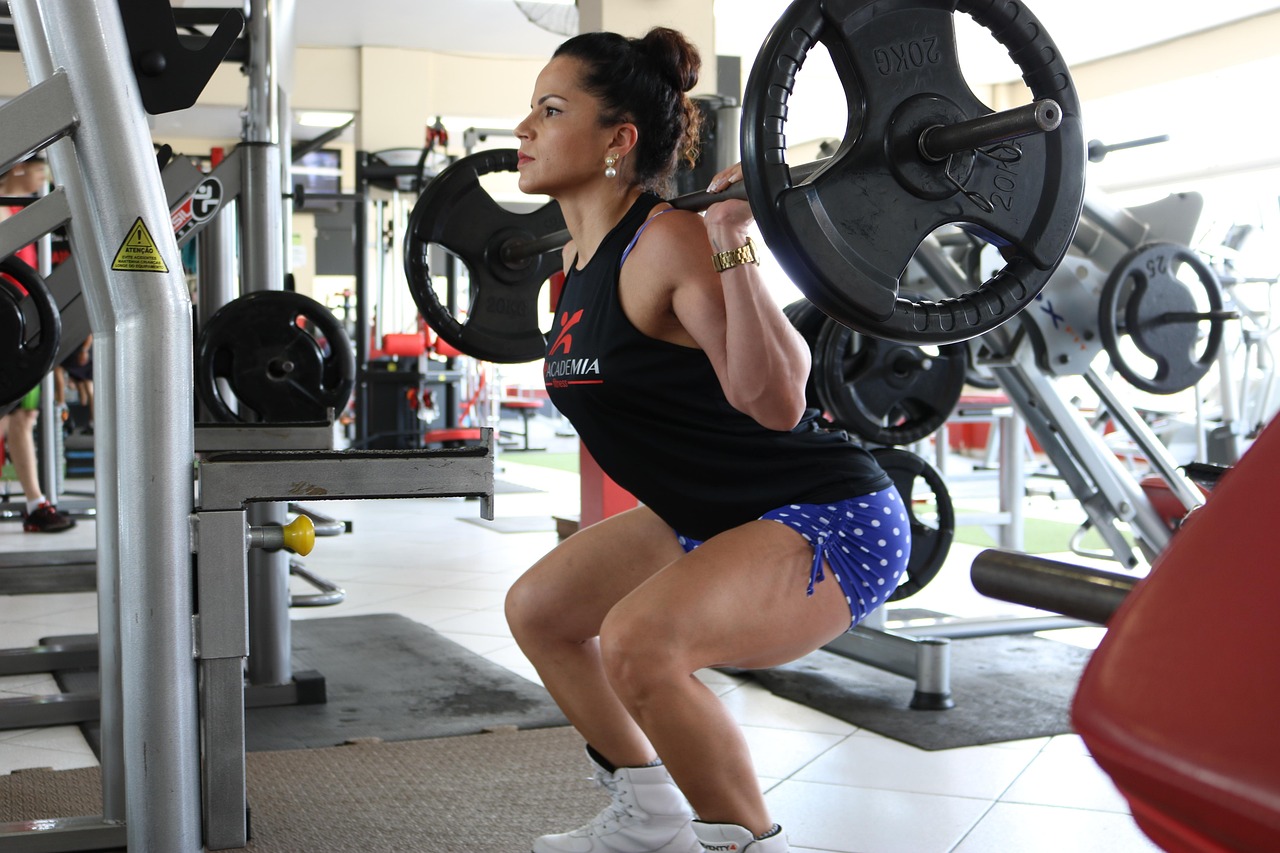
The one-rep max for squats refer to the maximum load that an individual can lift for one rep. While the measurement of one’s true one-rep max is the most accurate measurement of 1RM, it carries with it the potential for injuries. Furthermore, the body requires longer recovery period to restore the strength depleted during such efforts. For these reasons, estimation is the preferred method for the majority of athlete and coaches.
The percentage of 1RM that is used for training efforts is one of the primary variable in the construction of successful strength training programs. For instance, percentages between 50% and 67% of 1RM are used to develop muscular endurance. Training percentages between 67% and 80% lead to the hypertrophy of muscles. Percentages between 80% and 100% is used to develop raw strength and power in the muscles.
The Epley formula is a popular formula that estimates 1RM for squat lifts. This formula work best for sets of repetitions between 3 and 8 reps. For those looking for alternative formulas for estimating 1RM, the Brzycki and Lombardi formulas are two of the most commonly used formulas that provide accurate result for individuals performing sets with a low number of repetitions. Furthermore, many lifters aim for a squat 1RM that is 1.25 times an individual’s body weight for intermediate lifters and 1.75 times the body weight for more advanced lifters.
For female lifters, the targets are lower at around 0.85 times body weight for intermediate lifters and 1.25 times the body weight for advanced lifters.
Furthermore, an individual can use the rate of perceived exertion (RPE) to determine the actual 1RM for squats for an individual. For instance, if an individual is performing sets of squats, it is possible to complete five reps of a squat but be able to perform two more reps with the same effort. In this case, the effort level would be rated at an RPE of eight on a scale of ten. By accounting for the reps that an individual could still perform while training, the 1RM can be more accurately determine.
By training an individual at percentages between 85% and 90% of their 1RM, it is possible for those lifter to develop maximal strength using lower repetition schemes. Between 70% and 80% of 1RM is consider the sweet spot for muscular hypertrophy. For those lifters who wish to decrease the load that they are placing on their muscles, percentages between 60% and 70% of 1RM can be used during deload week.
An individual’s estimated 1RM enable the coach or the lifter themselves to understand the percentages at which to train. Such an understanding prevents the development of plateaus in strength for that individual.
An individual’s age, experience with strength training, genetic makeup, sleep and nutritional habits can all affect their 1RM. Any estimate created by the squat max calculator is based solely on an individual’s body composition and mathematical model. The actual 1RM for any given individual may fluctuate from these calculation.
If an individual is to calculate an individual’s 1RM, it is important to perform the squat to true parallel or below-parallel. Furthermore, at least three to five minutes of rest should be allowed between sets to allow for recovery. Additionally, the individual should perform the sets when the individual is at the peak of their strength after a training cycle. In the calculator above, an individual’s body weight and gender can help to provide an idea of the classification of their strength.
Beyond developing raw strength in the squat exercise, the determination of 1RM can have a significant impact on the development of athletes of all age. For instance, young athletes use 1RM as a means of teaching them the principle of strength training. Additionally, for lifters of various age, 1RM can help to develop a program that is suitable for that individual’s strength and recovery capacity. Finally, for those who compete in powerlifting competitions, the use of 1RM as a determining factor can allow for the development of a program that optimizes their potential 1RM as competitive powerlifter.
The squat max calculator provide estimates of an individual’s 1RM for squat lifts. The individual’s strength measurement on any given day can only determine the true measurement of 1RM for an individual. For coaches who wish to develop strength in their athletes, it is recommended to use the calculated 1RM as the training 1RM for percentages between 90% and 95%. This percentage allow for the athlete to gain the strength that is required while also minimizing the risk of injury to that athlete.
Despite the benefit that may arise from the implementation of the squat calculator, it remains a guide for individuals strength program. To develop the 1RM for squat lifts, an athlete should work alongside their coach to develop a program that works for that individual. The calculator for estimating 1RM can transform the approach that athletes and coaches take towards strength training. Whether the athlete is competing in powerlifting competition or simply wishes to increase the strength of their squat lifts, the determination of the 1RM for squat lifts will provide the athlete with the foundation for developing an effective strength training program.