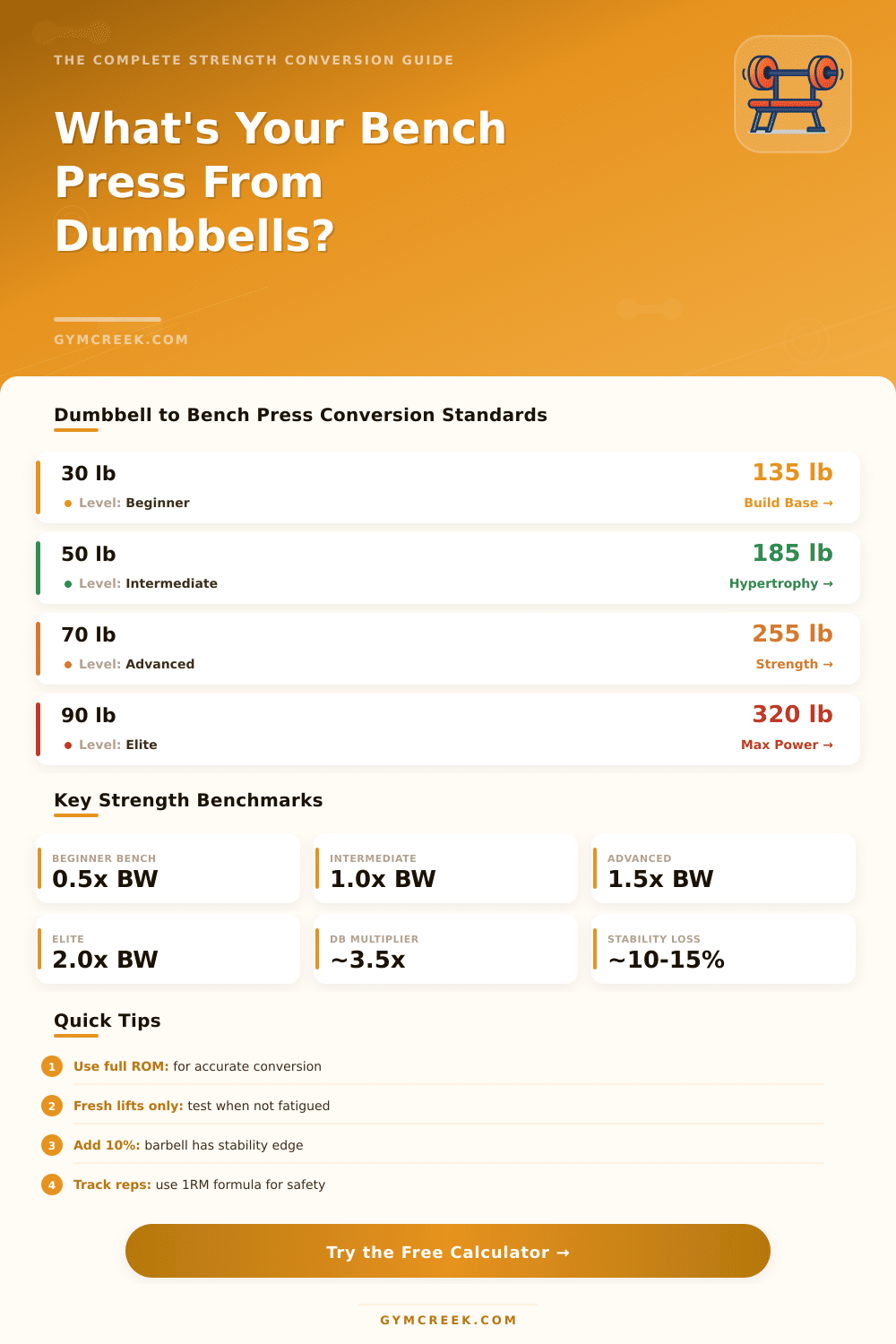
🏋 Dumbbell to Bench Press Calculator
Estimate your barbell bench press 1RM from dumbbell press weight & reps
| DB Weight (each) | DB Weight (kg) | Est. Bench 1RM (lb) | Est. Bench 1RM (kg) | Level |
|---|---|---|---|---|
| 20 lb | 9 kg | ~95 lb | ~43 kg | Beginner |
| 30 lb | 14 kg | ~135 lb | ~61 kg | Beginner |
| 40 lb | 18 kg | ~165 lb | ~75 kg | Intermediate |
| 50 lb | 23 kg | ~185 lb | ~84 kg | Intermediate |
| 60 lb | 27 kg | ~215 lb | ~98 kg | Advanced |
| 70 lb | 32 kg | ~255 lb | ~116 kg | Advanced |
| 80 lb | 36 kg | ~285 lb | ~129 kg | Advanced |
| 90 lb | 41 kg | ~320 lb | ~145 kg | Elite |
| 100 lb | 45 kg | ~350 lb | ~159 kg | Elite |
| Reps | % of 1RM | Training Zone | Primary Benefit |
|---|---|---|---|
| 1 | 100% | Max Strength | Neural Drive |
| 2 | 97% | Max Strength | Neural Drive |
| 3 | 94% | Strength | Strength & Size |
| 4 | 92% | Strength | Strength & Size |
| 5 | 89% | Strength / Power | Strength & Size |
| 6 | 86% | Hypertrophy | Muscle Growth |
| 8 | 81% | Hypertrophy | Muscle Growth |
| 10 | 75% | Hypertrophy / Endurance | Size & Conditioning |
| 12 | 70% | Endurance | Conditioning |
| 15 | 65% | Muscular Endurance | Conditioning |
| 20 | 56% | Endurance | Conditioning |
| Bodyweight | Beginner | Intermediate | Advanced | Elite |
|---|---|---|---|---|
| 130 lb | 80 | 130 | 185 | 240 |
| 150 lb | 90 | 150 | 215 | 280 |
| 175 lb | 105 | 175 | 250 | 325 |
| 200 lb | 115 | 200 | 285 | 370 |
| 225 lb | 125 | 225 | 315 | 410 |
| 250 lb | 135 | 245 | 345 | 445 |
Many lifters often struggle with whether to stick to the benefits of training with dumbbell exercises or to challenge themself with the strength of the barbell bench press exercise. While both of these exercises target the same muscle, the amount of weight that lifters are able to lift with each of these tools varies. A dumbbell to bench press calculator, therefore, can help these athletes to find the difference between their strength using these two implement.
By understanding how many pounds an athlete can lift with a dumbbell while performing a press exercise, that individual can determine how many pound they can bench press on the barbell. Lifters can use this information to either prevent the plateauing of their strength or to determine their individual strength goal. Additionally, this information can help to determine their overall fitness level.
Why Dumbbell and Barbell Presses Differ
Due to the fact that lifters must maintain more stability with dumbbells than with barbells, the amount of weight that can be lifted with dumbbells is typically less than the amount of weight that can be lifted with barbells. The total amount of weight that can be lifted with dumbbells is typically between 70% and 80% of the amount of weight that can be lifted with barbells for the same number of repetition. This percentage difference is due to the different levels of strength that athletes typically have in each of their limbs.

Beginners who are learning to perform these exercises have a larger difference between their dumbbell and barbell numbers than do more experienced lifters. This is due to the stronger strength in each limb of more experienced weightlifters. As a result, experienced lifters have a greater strength in each of their limbs such that their strength difference is smaller than that of beginners.
In addition to strength in each limb, various training method can also cause the difference between the amount of weight that can be lifted with a dumbbell press and a barbell press. For instance, incline dumbbell presses allow for more even developing of the upper chest muscles yet permit less weight to be added to the dumbbells. Similarly, floor presses allow for less range of motion in the press yet permit less development of the chest muscles. Additionally, the grip with which the barbell is held can also impact the development of the various muscle groups in the body.

The body weight of an individual also relates to the amount of weight that they can press. Stronger athletes can typically press 1.5 times their body weight or more with their chest muscle. The strongest lifters can typically press an amount of weight that is equal to double their body weight. As such, an athlete’s ability to perform a dumbbell press can help to reveal their level of strength. For instance, an average athlete can typically lift between 50 and 70 pound with a dumbbell press exercise. Using this information, it is possible to assume that their barbell bench press strength is between 185 and 250 pounds for the same number of repetitions.
The formulas for determining the strength of an individual for a given amount of repetitions and weights can help to reveal an athlete’s bench press strength for both barbells and dumbbells. One of the most common formulas used for the estimation of one-repetition maximum strength is the Epley equation. This formula, when applied correctly to both bench and dumbbell exercises, can reveal accurate estimations of the amount of weight that can be pressed. These estimations, however, are still estimations of an individual’s strength. The actual amount of strength of an athlete for these exercises may be up to 10% or 15% more or less than the estimation provided by these formula.
Each of these exercise implements has its place in the training of athletes yet the other. Dumbbell exercises allow for more even development of each limb and can reveal muscular imbalance. Barbell exercises, in contrast, allow for more strength to be placed into the muscles yet require more balance. As such, athletes can choose to use the calculator above to help them understand the strength that they have with each of these implements.
In order to accurately determine the strength of an individual, it is important to ensure that they test their strength while they are rested. Additionally, it is important that the individual performs a warm-up prior to performing the test with heavy weight. The form with which individuals perform these exercises is more important than the numbers that they are able to lift. Performing the exercises with poor form could result in injury to the muscles and joints of the lifter.

Depending upon the goal that an athlete is setting for themself, they may incorporate one implement into their training yet not the other. Powerlifters, for instance, may incorporate dumbbell exercises into their training to even out muscular imbalances within their body. Bodybuilders may prefer to utilize dumbbell exercises to provide more even stretch to their muscles. CrossFit athletes, as a result of the competitions that they often enter, may train with either implement.
Each of the formulas and calculations for strength with the different implement are merely a means of measuring an athlete’s current strength. Athletes will make actual improvements in the gym as a result of the dedication that athletes place into their training programs, proper nutrition, and sufficient periods of recovery from their workouts.
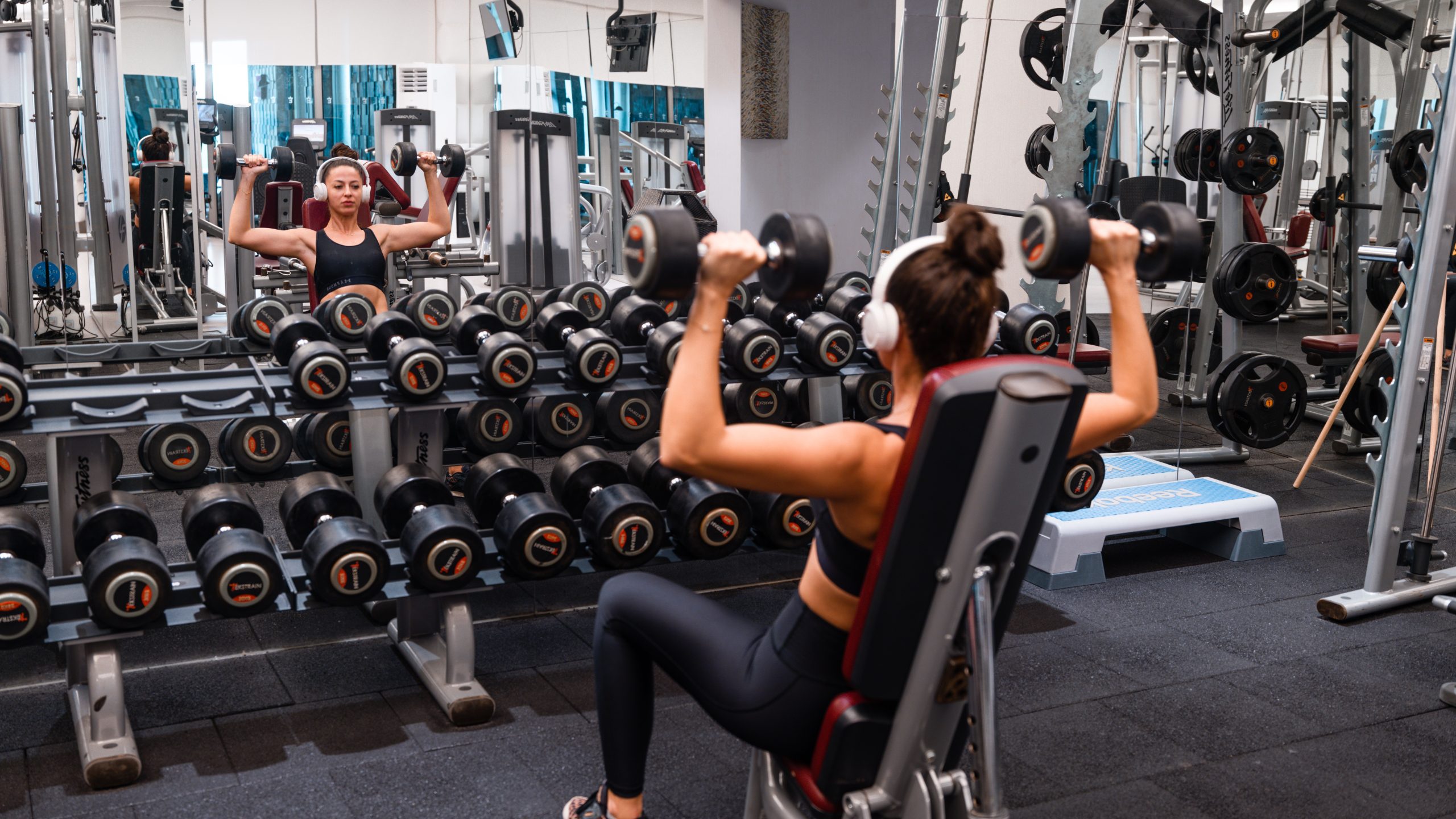

Most lifters will find that they can increase their strength using the dumbbells at the same time as their barbell bench press strength. The two exercises are similar such that the strength built into the dumbbells can be transferred to barbell strength. However, it is also possible to increase an athlete’s barbell strength, which will reflect improvements in the amount of weight that is pressed with the dumbbells. Youll find that this is a naturaly occuring process.

Athletes implement these calculations and formulas as a means of aiding athletes in their training programs yet the training itself. These calculations will allow athletes to train more intelligently for their goals while avoiding injuries that may result from inappropriate training strategies.
Therefore, it is important for athletes to understand the difference between the two implement yet to also understand that neither implement is superior to the other. By understanding how each implement relates to the others, athletes will be able to develop a more complete understanding of their potential and their current capabilities. Thus, the value of each implement may be understood in relation to the others.
Ultimately, each implement has its value in the training of lifters yet the other. An athlete should use these calculations and understand the benefits of each implement to maximize their strength for their goals. They could of worked harder to reach there potential, but these tools helps alot.