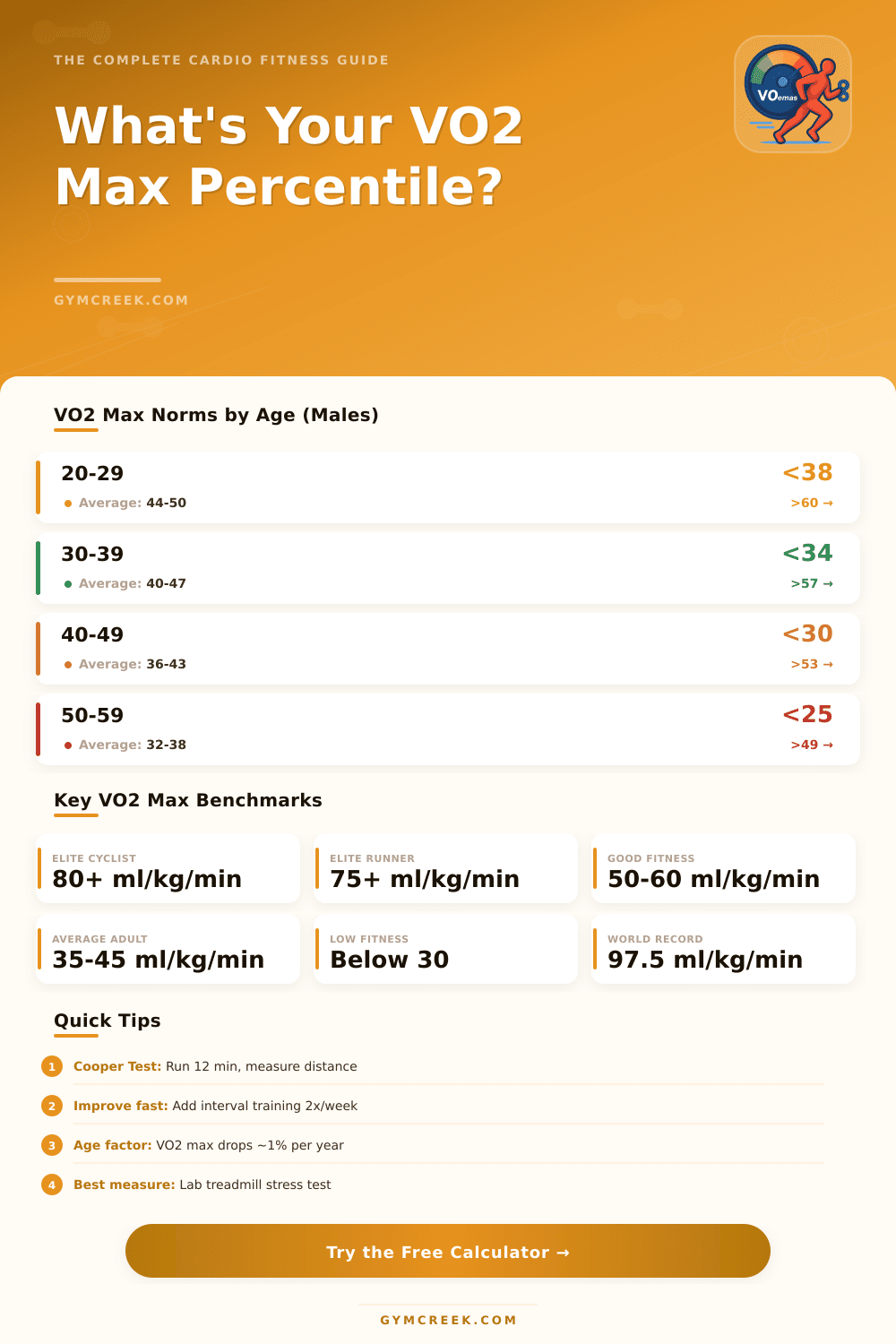
🏃 VO2 Max Percentile Calculator
Estimate your cardio fitness level and see where you rank for your age & gender
| Age Group | Very Poor (<20th) | Poor (20–39th) | Fair (40–59th) | Good (60–79th) | Excellent (80–89th) | Superior (>90th) |
|---|---|---|---|---|---|---|
| 13–19 | <35.0 | 35.0–38.3 | 38.4–45.1 | 45.2–50.9 | 51.0–55.9 | ≥56.0 |
| 20–29 | <33.0 | 33.0–36.4 | 36.5–42.4 | 42.5–46.4 | 46.5–52.4 | ≥52.5 |
| 30–39 | <31.5 | 31.5–35.4 | 35.5–40.9 | 41.0–44.9 | 45.0–49.4 | ≥49.5 |
| 40–49 | <30.2 | 30.2–33.5 | 33.6–38.9 | 39.0–43.7 | 43.8–48.0 | ≥48.1 |
| 50–59 | <26.1 | 26.1–30.9 | 31.0–35.7 | 35.8–40.9 | 41.0–45.3 | ≥45.4 |
| 60–69 | <20.5 | 20.5–26.0 | 26.1–32.2 | 32.3–36.4 | 36.5–44.2 | ≥44.3 |
| 70+ | <17.5 | 17.5–22.7 | 22.8–28.7 | 28.8–35.0 | 35.1–40.0 | ≥40.1 |
| Age Group | Very Poor (<20th) | Poor (20–39th) | Fair (40–59th) | Good (60–79th) | Excellent (80–89th) | Superior (>90th) |
|---|---|---|---|---|---|---|
| 13–19 | <25.0 | 25.0–30.9 | 31.0–34.9 | 35.0–38.9 | 39.0–41.9 | ≥42.0 |
| 20–29 | <23.6 | 23.6–28.9 | 29.0–32.9 | 33.0–36.9 | 37.0–41.0 | ≥41.1 |
| 30–39 | <22.8 | 22.8–26.9 | 27.0–31.4 | 31.5–35.6 | 35.7–40.0 | ≥40.1 |
| 40–49 | <21.0 | 21.0–24.4 | 24.5–28.9 | 29.0–32.8 | 32.9–36.9 | ≥37.0 |
| 50–59 | <20.2 | 20.2–22.7 | 22.8–26.9 | 27.0–31.4 | 31.5–35.7 | ≥35.8 |
| 60–69 | <17.5 | 17.5–20.1 | 20.2–24.4 | 24.5–30.2 | 30.3–31.4 | ≥31.5 |
| 70+ | <15.0 | 15.0–18.0 | 18.1–22.0 | 22.1–27.0 | 27.1–31.5 | ≥31.6 |
| Sport / Activity | Male Range (ml/kg/min) | Female Range (ml/kg/min) | Notes |
|---|---|---|---|
| Elite Marathon Runner | 70–85 | 60–75 | Sub-2:10 marathoners often >80 |
| Elite Cyclist (Road) | 75–90 | 65–80 | Grand Tour contenders often >85 |
| Elite Cross-Country Skier | 80–96 | 68–78 | Highest recorded sport averages |
| Elite Rower | 65–80 | 55–70 | Upper body component lowers relative score |
| Elite Triathlete | 68–82 | 58–72 | Ironman vs. sprint distance varies |
| Recreational Runner | 45–55 | 38–48 | Training 3–4 days/week |
| Average Sedentary Adult | 30–40 | 25–35 | No structured aerobic training |
| World Record (Espen H. Bjerke) | 97.5 | — | Highest ever recorded VO2 max |
Fitness level and many other health indicators relies upon measurement of VO2 max to determine the level of fitness of an individual. A VO2 max value is calculated as a measurement of how much oxygen an individual can use during exercise, and reflects the fitness of the cardiovascular and respiratory systems, muscles, and more. Knowing where an individual values of VO2 max falls compared to others of the same age and gender allows individuals to understand there relative fitness level to others, which is one of the reasons why many individuals use a VO2 max percentile calculator to understand there fitness level relative to others of their age and gender.
While VO2 max can be calculated through a variety of different laboratory tests, individuals can also use different field tests and formulas to calculate VO2 max that almost anyone with a smartwatch or with a few health-related measurements of themselfs can perform. Such an alternative method of calculating VO2 max relative to others allows for individuals to understand their rank in relation to others with similar characteristics. Furthermore, knowing where they fit within the population allows individuals to set goals for increasing there VO2 max levels over time.
What VO2 Max Means and Why Percentiles Are Useful
VO2 max is a measurement of the amount of oxygen that an individual can consume per kilogram of body weight per minute, in ml/kg/min. Competitive athletes has values that range in the high 70s (with a maximum of 85), while individuals that are relatively sedentary have VO2 max values that range in the low 20s and 30s. A variety of factors influence these values, such as genetic predisposition, age, physical training, body composition, and more. For most individuals, VO2 max begins to decline after the age of 25 or 30 by approximately 1% per year.
These values of VO2 max can provide a variety of individuals with an understanding of their relative fitness levels to others of their age and gender. An individual that has a VO2 max of, for example, 38 at the age of 42 may indicate that they are in the 35th percentile of individuals of their age and gender, or that they are in the 70th percentile. Such values can provide individuals with an understanding of their relative fitness to others in their demographic.
Furthermore, higher levels of VO2 max are correlated to lower rates of mortality in those individuals of all ages. Individuals with excellent levels of VO2 max tend to experience increased levels of energy, experience shorter periods of illness, and have increased levels of longevity as they age. Furthermore, the difference between average VO2 max values and the values of the top 10% of individuals can provide several extra years to the life expectancy of those individuals with excellent cardiovascular fitness.
The calculator above allows individuals to explore the effects that age and activity levels have upon there VO2 max levels and percentiles relative to others of there age and gender. Often, individuals of any age that use such a calculator discover VO2 max relative to there peers inspires them to begin or increase there level of physical activity to increase there fitness levels.
There are a variety of tests that can be used to estimate the VO2 max level of individuals. For instance, one of the most common methods of estimating VO2 max is the Cooper test, during which an individual must measure how far they can run in 12 minutes. Related tests, such as the Rockport test, require individuals to walk a one-mile distance and determine there heart rate after walking the distance. Yet other formulas exist that use resting heart rates and the calculation of the individual’s estimated maximum heart rate to estimate VO2 max levels of individuals.
Each of these tests have some benefits and shortcomings to there methods of calculating VO2 max levels. For example, individuals may begin to decline somewhat in VO2 max if they are performing the tests during less than ideal conditions. Furthermore, individual VO2 max levels may fluctuate from test to test due to fatigue, illness, or other factors. However, each of these tests are generally within 10-15% of the VO2 max calculations from a laboratory. Furthermore, performing VO2 max tests at similar times of the day with similar conditions and levels of physical activity will produce the best estimates of VO2 max of an individual.
Knowing an individual’s VO2 max levels also allows for the individual to understand the zones at which they should train there cardiovascular systems to maximize both fat burning and VO2 max improvements. For example, an individual’s fat-burning zone is typically between 60% and 70% of there maximum heart rate. Zones of 80% to 90% of an individual’s VO2 max is the zone at which VO2 max increases the most with increased training of those zones.
An individual’s VO2 max can be increased through training. For instance, increasing the number of sessions of aerobic exercise (especially interval training) an individual performs will lead to increases of 10% to 20% in VO2 max levels over time periods of several months. Most individuals that are relatively inactive and sedentary can improve there VO2 max from a poor rank to a fair or good rank with dedication to increasing there cardiovascular fitness levels. Increases in VO2 max levels are the result of the body’s ability to increase the amount of oxygen that can be delivered to the muscles (through increased blood volume and increased blood pumping efficiency by the heart), increasing the delivery of oxygen to the muscles’ cells, and increasing the efficiency of those cells in utilizing oxygen for combustion of fat and glycogen to create the energy used by the individual’s muscles to perform work.
Age and gender influence individuals’ VO2 max levels. Women tend to have lower values of VO2 max than men due to physical differences in the bodies of women and men. However, separate norms for women of each age that account for these differences are used to calculate percentiles. Furthermore, VO2 max levels tend to peak in the twenties (around age 20) of an individual’s life, after which the levels begin to decline each year after that peak of VO2 max levels. Thus, a 55-year-old with a VO2 max of 38 may actualy have a higher percentile of VO2 fitness compared to a 25-year-old with the same VO2 max level.

For an individual tracking there fitness, knowing there relative VO2 max levels over time may be of more interest than any individual VO2 max test. For example, many athletes of all ages use methods to track there VO2 max levels each month, and often discover the slow increase in there VO2 max levels as a result of there training of those physical systems. Increases of as little as 2 or 3 points in VO2 max level can lead to an individual moving from one fitness level to another of higher rank compared to others of there age and gender.
While there are methods of calculating an individual’s VO2 max levels, they are all estimations of the true VO2 max levels of that individual. The most accurate measurements of VO2 max levels occur in laboratory settings using specialized equipment. Thus, individuals with any known cardiovascular conditions or issues should use these estimations to calculate VO2 max levels as a discussion with a physician is needed. For the majority of active individuals, however, the calculations and tracking of there VO2 max levels is of benefit to the individual and provides motivation for them to continue to increase there level of fitness levels.
Beyond being able to provide an individual with an understanding of there VO2 max levels and percentiles relative to others of there age and gender, the main purpose of a VO2 max calculator is to inspire individuals of any age to begin to increase there levels of physical fitness. Individuals with VO2 max levels that are relatively low compared to others of there age and gender may feel motivated to begin to incorporate physical activity into there lives as a means of increasing there VO2 max levels. Those with VO2 max levels that are already high relative to others of there age may feel encouraged in there current physical fitness levels, but may also seek out additional goals to challenge themself further.

Overall, an indicator of an individual’s fitness levels of the cardiovascular system is one of the most moddern benefits to increase an individual’s health and longevity. Thus, regardless of where an individual falls in relation to others of there age and gender, there body possesses the ability to increase there VO2 max levels with consistent effort. Thus, as an individual continues to increase there physical activity and strength of there cardiovascular system, they will begin to experience an increase in there VO2 max levels, there ability to perform other physical activities, and an increase in there overall quality of life.