🚴 Cycling VO2 Max Calculator
Estimate your aerobic capacity from cycling performance data — get your fitness category, training zones & benchmarks
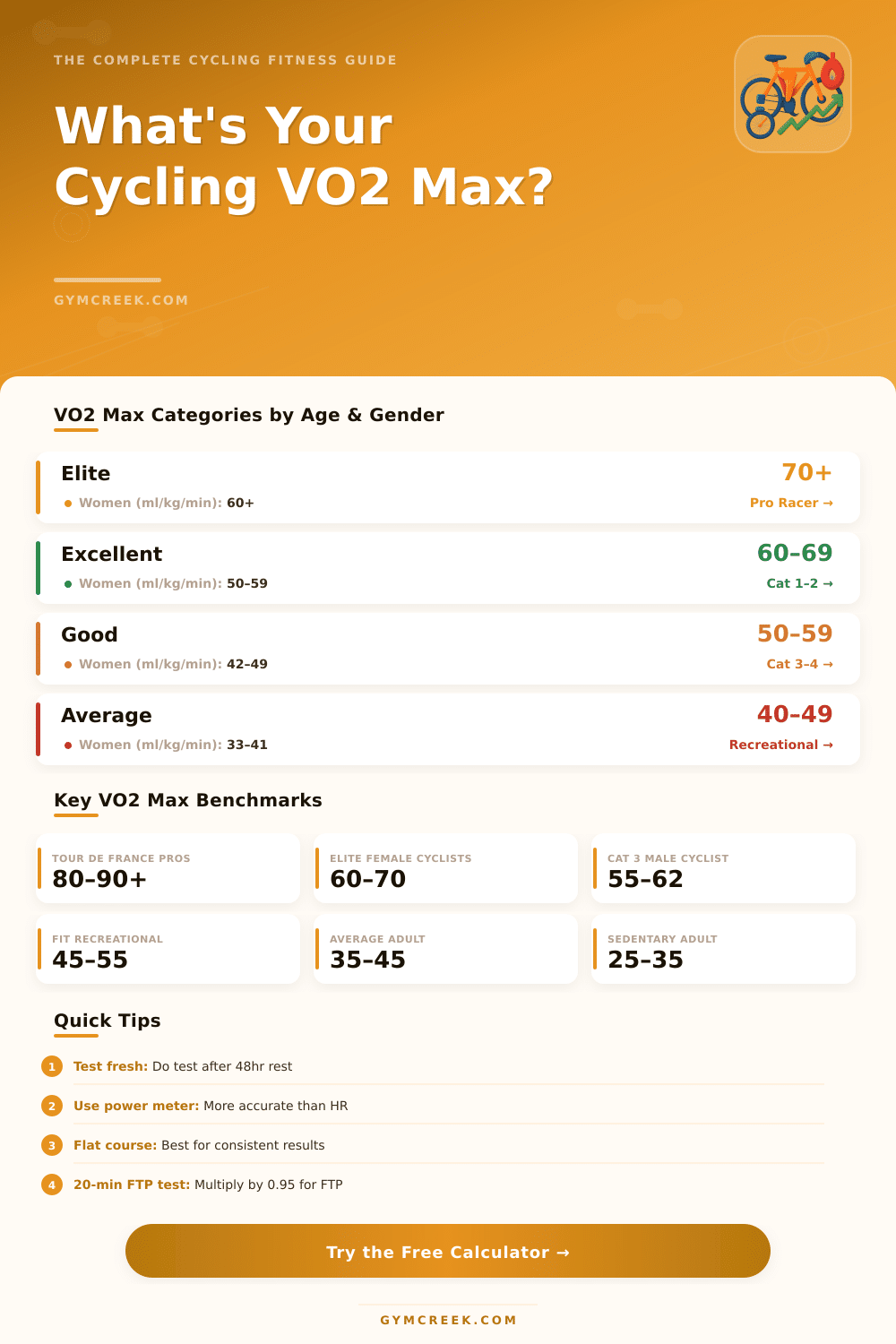
| Category | Men (ml/kg/min) | Women (ml/kg/min) | Typical Rider Level | Est. FTP/kg (men) |
|---|---|---|---|---|
| 🟣 Poor | Below 30 | Below 25 | Very sedentary / untrained | Below 2.0 w/kg |
| 🟡 Below Average | 30 – 39 | 25 – 33 | Casual / infrequent rider | 2.0 – 2.5 w/kg |
| 🟢 Average | 40 – 49 | 34 – 41 | Recreational rider (2–3x/wk) | 2.5 – 3.0 w/kg |
| 🔵 Good | 50 – 59 | 42 – 49 | Serious club rider / Cat 3–4 | 3.0 – 3.7 w/kg |
| 🟠 Excellent | 60 – 70 | 50 – 59 | Competitive racer / Cat 1–2 | 3.7 – 4.5 w/kg |
| 🟥 Elite / Pro | 71 – 90+ | 60 – 75+ | Pro tour / national team | 4.5 – 6.4+ w/kg |
| Level | Men FTP (w/kg) | Women FTP (w/kg) | 5-Min Power (w/kg) | Approx VO2 Max |
|---|---|---|---|---|
| Untrained | Below 2.0 | Below 1.5 | Below 3.0 | < 35 |
| Fair | 2.0 – 2.5 | 1.5 – 2.0 | 3.0 – 4.0 | 35 – 42 |
| Moderate | 2.5 – 3.2 | 2.0 – 2.6 | 4.0 – 5.0 | 42 – 52 |
| Good | 3.2 – 3.8 | 2.6 – 3.2 | 5.0 – 6.0 | 52 – 58 |
| Very Good | 3.8 – 4.5 | 3.2 – 3.8 | 6.0 – 7.0 | 58 – 65 |
| Exceptional | 4.5 – 5.5 | 3.8 – 4.5 | 7.0 – 8.5 | 65 – 75 |
| World Class | 5.5 – 6.4+ | 4.5 – 5.5+ | 8.5 – 10+ | 75 – 90+ |
| Zone | Name | % Max HR | % VO2 Max | Perceived Effort | Primary Benefit |
|---|---|---|---|---|---|
| Z1 | Active Recovery | < 68% | < 55% | Very easy | Recovery, fat oxidation |
| Z2 | Aerobic Base | 68 – 75% | 55 – 65% | Easy / conversational | Aerobic base, mitochondria |
| Z3 | Tempo | 75 – 83% | 65 – 80% | Moderate / comfortably hard | Lactate threshold |
| Z4 | Threshold | 83 – 91% | 80 – 90% | Hard / race pace | FTP, lactate clearance |
| Z5 | VO2 Max | 91 – 97% | 90 – 100% | Very hard / 3–8 min efforts | VO2 max, aerobic power |
| Z6 | Anaerobic | 97 – 100% | 100%+ | Maximal / sprint | Anaerobic capacity |
🏆 Oskar Pereiro (Tour de France Winner)
Measured VO2 Max in lab testing
🥇 Lance Armstrong (7x TdF)
Measured in 1993 (age 21)
🇳🇴 Espen Harald Bjerke
One of the highest ever recorded
🚴 Average Recreational Cyclist
Cycling 3x per week, moderate intensity
❤️ Heart Rate Reserve: Best when you know your TRUE max HR from a race or all-out hill sprint. Age-predicted max HR (220 – age) reduces accuracy. Accuracy: ±7%.
📊 Astrand Method: Perform 6 minutes at constant power. Ideal HR = 125–170 bpm. More accurate at moderate intensity. Accuracy: ±10%.
🏁 Cooper Method: Use a flat, windless course. 12 minutes, absolute maximum effort. Warm up well. Accuracy improves on an indoor trainer. Accuracy: ±8%.
Cycling is one of the best form of exercise for building cardiovascular fitness. No other fitness metric are as effective at gauging the cardiovascular fitness of a cyclist as VO2 max. Often referred to as an “gold standard” of cardiovascular fitness tests, VO2 max is the measurement of how efficient a cyclist can take in, transport, and use the oxygen in there body when exerting themselves at a high rate. While there are numerous ways to test a person’s VO2 max in a laboratory, there are field tests that will provide a reliable estimate of a cyclists VO2 max, without setting foot in a lab!
Understanding VO2 max can help with determining the reason behind an athlete’s power output, as well as allow them to set goals for their cardiovascular fitness over time. Regardless of cycling ambition for the year, knowing this key metric allows each cyclist to make better decisions in their training.

Cycling VO2 Max Calculator
What Is a Cycling VO2 Max Calculator and Why Does It Matter?
A cycling vo2 max calculator is a tool that allows each cyclist to estimate their VO2 max by inputting their cycling performance data. Performance formulas utilized by calculators include information from elite cycling scientist like Andrew Coggan, as well as researchers behind the Astrand and Cooper tests. Because cycling is a weight-bearing sport with measurable power outputs, these calculators will provides an accurate measurement of an athlete’s VO2 max.
VO2 max is a measurement of the efficiency of a cyclists cardiovascular system. The higher the measurement, the more better the cyclist is able to sustain their power output without experiencing the fatigue caused by the byproducts of cellular respiration. Elite cyclists will have VO2 max ratings that range from above 70 ml/kg/min for men to the high 50s and low 60s for women. Cyclists who train recreationally will have VO2 max ratings between 35 and 50 ml/kg/min. Not only will cyclists become aware of their VO2 max through the calculator, but they can also track their VO2 max over time to see the impact of their training regimen. Higher VO2 max ratings indicate better training effectiveness, while lower number may mean an athlete is overtraining or aging.
One of the most common method of calculating an athletes VO2 max is utilizing their functional threshold power (FTP). FTP is a cyclists power output in watts that can be sustained for approximately one hour of cycling. Using this value and an athlete’s body weight, calculators can find an estimate of their VO2 max. For athletes who track their FTP well, this calculation will be within 5% of their actual measurement. Other method include calculating VO2 max with a cyclists heart rate reserve and without using a power meter altogether.
A cyclists age and gender will affect their VO2 max rating. Men will have higher measurements due to there muscular and hemoglobin content. However, highly trained female cyclists will have higher ratings than less-trained male cyclists. VO2 max decline with age, at a rate of approximately 1% per year after age 30 for individuals who do not include cycling in their fitness routine. However, cyclists who incorporate cardiovascular training into their training routines will experience half that decline. An aging cyclist who continues to train will have a VO2 max value that rival those of a younger, recreational cyclist.
To increase an athlete’s VO2 max, the cyclist should include a training regimen that include intervals at the “sweet spot” and threshold power outputs. Additionally, specific intervals at VO2 max values will provide the best result. Such intervals will require a cyclist to ride at 105% to 120% of an athlete’s FTP for durations of three to five minutes with shorter periods of recovery in between those intervals. Such sessions are physically demanding yet provide the best returns on training effort. Ensuring the cyclist gets enough sleep and eats proper is just as important to increasing VO2 max as the cycling intervals themselves.
To contextualize the number that a cyclists VO2 max calculator determines, a rating of 55 ml/kg/min may be considered good for a 45-year-old who rides recreationally but may be average for a 25-year-old who is more ambitious in their cycling goal. The best cycling VO2 max calculators will provide a comparison of that value to other cyclists of the same age and gender group. The calculators may determine an athlete’s FTP per kilogram, as well. These additional value can help each cyclist understand their VO2 max in relation to others in their cycling population.
The field test used to calculate a cyclists VO2 max have some limitations. Factors like sleep, hydration, and warm-up routine can impact their results. Additionally, the effect of the environment on outdoor tests can skew the results. Cyclists may wish to retest every 8 to 12 week to monitor their VO2 max over time using the calculator included in this article.
While a cyclists VO2 max is one of the most important determinant of a cyclists strength and endurance, it is not the only one. Other factor that impact a cyclist’s strength include the efficiency of their movement, their lactate threshold, their muscular endurance, and even their mental strength. An athlete with a lower VO2 max than there opponent may still outperform them in a race or cycling event. Therefore, it is simply one component of an athletes cycling performance.
Overall, the benefit of understanding an athlete’s VO2 max is that it provide guidance in their cycling training. With the knowledge of their VO2 max level, cyclists can focus their training on overcoming their weakness, achieving cycling goals, as well as experiencing the greatest amount of progress with their training efforts. Whether racing or recreationally-cycling, or even desiring to ride stronger well into the later decade of their life, knowing about their VO2 max and finding ways to improve it will provide one of the best path toward maximizing their cycling potential.
Consistent training, recovery, and testing will yield the best result for an athlete looking to improve their VO2 max. However, the cycling VO2 max calculator will remove some of the guesswork in the athletes quest to maximize there potential.