💪 Macro Calculator for Men
Calculate your personalized daily protein, carbs & fat targets based on your goal
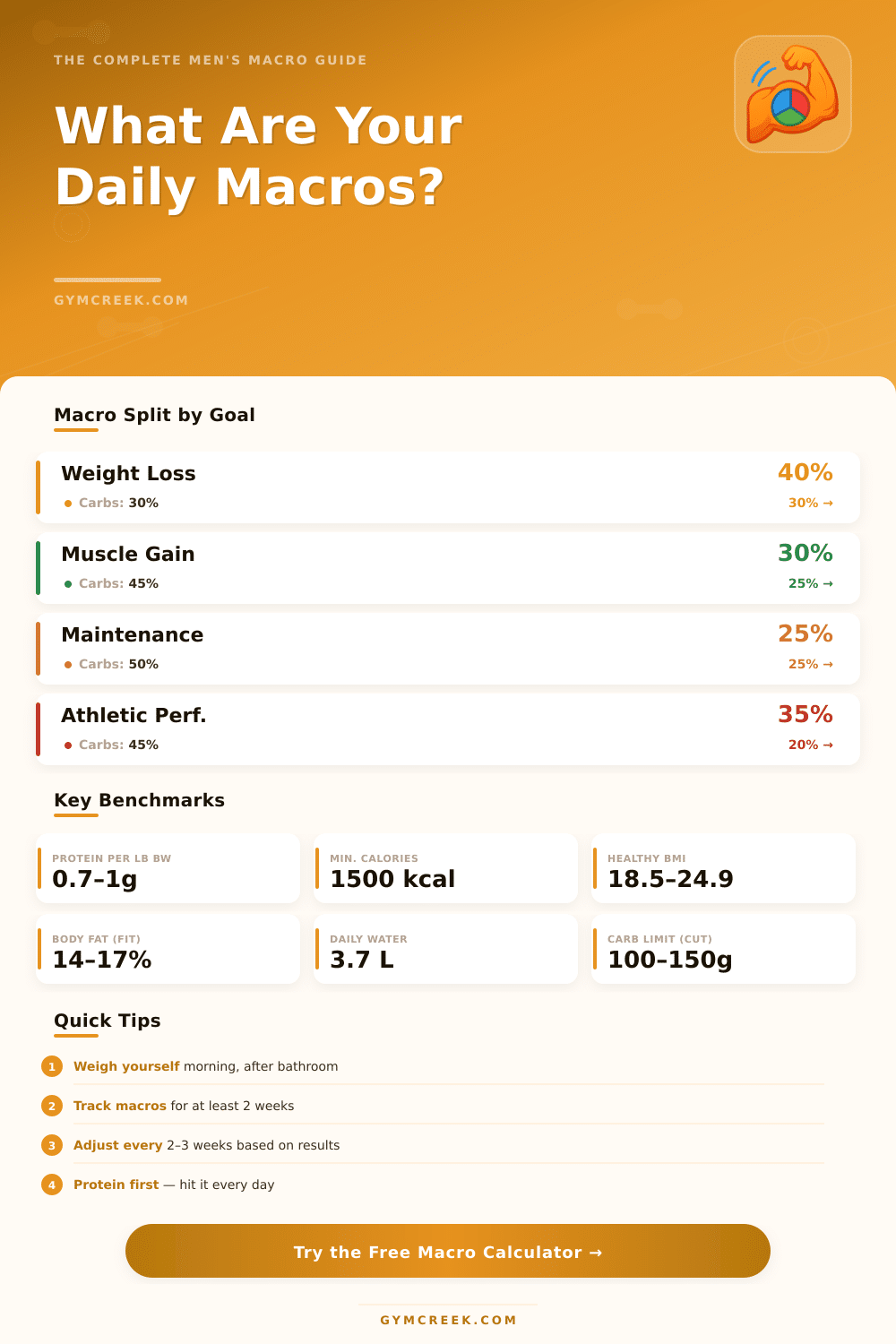
| Goal | Protein | Carbs | Fat | Calorie Adjustment |
|---|---|---|---|---|
| Aggressive Fat Loss | 40% | 30% | 30% | −500 cal/day |
| Fat Loss | 35% | 35% | 30% | −300 cal/day |
| Maintenance | 25% | 50% | 25% | TDEE |
| Lean Bulk | 30% | 45% | 25% | +200 cal/day |
| Muscle Building | 30% | 45% | 25% | +400 cal/day |
| Body Recomposition | 35% | 40% | 25% | TDEE |
| Ketogenic | 30% | 5% | 65% | −200 to +200 |
| Athletic Performance | 25% | 55% | 20% | +100 to +300 |
| Category | Body Fat % | Description | Typical Look |
|---|---|---|---|
| Essential Fat | 2–5% | Minimum for organ function | Competition bodybuilder |
| Athletic | 6–13% | Highly defined muscles | Visible abs, striations |
| Fitness | 14–17% | Lean, some definition | Abs visible, athletic build |
| Average | 18–24% | Typical healthy male | Soft, no visible abs |
| Overweight | 25–31% | Above healthy range | Noticeable belly fat |
| Obese | 32%+ | High health risk | Significant excess fat |
| Goal / Status | g per lb BW | g per kg BW | Example (180 lb / 82 kg) |
|---|---|---|---|
| Sedentary / General Health | 0.36 | 0.8 | 65g / day |
| Weight Loss (preserve muscle) | 0.7–0.9 | 1.5–2.0 | 126–162g / day |
| Muscle Building | 0.8–1.0 | 1.7–2.2 | 144–180g / day |
| Body Recomposition | 0.9–1.1 | 2.0–2.4 | 162–198g / day |
| Endurance Athlete | 0.6–0.8 | 1.3–1.8 | 108–144g / day |
| Older Men (50+) | 0.8–1.0 | 1.8–2.2 | 144–180g / day |
| Profile | BMR (kcal/day) | TDEE Sedentary | TDEE Active |
|---|---|---|---|
| 5'7" / 150 lb / Age 25 | ~1,650 | ~1,980 | ~2,558 |
| 5'10" / 175 lb / Age 30 | ~1,840 | ~2,208 | ~2,852 |
| 6'0" / 195 lb / Age 30 | ~1,975 | ~2,370 | ~3,061 |
| 6'0" / 195 lb / Age 45 | ~1,850 | ~2,220 | ~2,868 |
| 6'2" / 220 lb / Age 35 | ~2,100 | ~2,520 | ~3,255 |
| 5'9" / 165 lb / Age 55 | ~1,680 | ~2,016 | ~2,604 |
• Weigh yourself in the morning after using the bathroom, before eating or drinking.
• Body fat % helps generate more precise results via Katch-McArdle formula. Use a Navy method calculator or skinfold calipers.
• Track your macros for at least 2 weeks before adjusting — short-term weight swings are often water, not fat.
• Activity multipliers are averages. If results stall after 3 weeks, reduce calories by 100–150 kcal.
Understanding Your Daily Nutritional Needs
Understanding your nutritional needs is one of the best way to ensure that you reach your fitness goals. Men have different needs from women due to their bodies physical make-up and the way that they burns calories. A macro calculator for man can help to provide recommendations regarding the amount of each macronutrient that you should consume daily to help you fulfill these needs.
Why Men Need a Personalized Macro Calculator for Man
Macronutrients is the essential components of the meals that you consume daily. Getting the right balance of these components will allow your body to achieve your fitness goals faster, while avoiding common problems with macronutrient imbalances within the body. Most men tend to waste months pursuing their fitness goals with information from fitness magazines and social media websites. By utilizing a personalized approach to macros intake, you can skip the guesswork and begin to see results more fastly.
Due to the physical make-up of men, they generally contain more muscle and less body fat than women. Men generally burn more calories than women perform at rest, as well as require more protein to support the muscles within their bodies. Furthermore, the hormone testosterone plays a role in the way that men burn calories and distribute nutrients to muscles rather than fat within their bodies.

As men age, their natural testosterone levels tend to decline. Men in their thirties, for example, will generally contain lower levels of testosterone than younger men in their twenties. This can make it more challenging for them to lose body fat, assuming that their caloric intake is not adjusted according to.
An individual’s activity level is another crucial variable in determining their caloric and macro intake needs. Men who stands all day and do not regularly lift weights will require different nutritional intakes compared to men who perform strenuous work or who lift weights regularly. Each individual must account for their activity level in order to prescribe the appropriate amount of each macronutrient.
In addition to activity level, mens body fat percentage can also play a role in determining their macronutrient needs. Men that contain more body fat can generally burn more calories in a day than lean men, as their bodies burn fat as a source of energy. Furthermore, if the Katch-McArdle formula accounts for the body fat percentage of a man in his intake calories, his calorie needs will be met with more accuracy than if he utilized another formula to calculate those needs.
A mans fitness goals can play a role in his macronutrient needs. For instance, if a man is attempting to lose body fat, his macro intake will need to be higher in protein content to preserve his muscles, as his body will be breaking down body fat rather than muscle tissue. In contrast, if his goal is to gain muscle, he will burn more calories than when attempting to maintain his current weight, as well as consume more carbohydrates as a fuel source for his muscles during workouts. Additionally, body recomposition, or losing body fat and gaining muscle at the same time, will require a certain balance to macronutrient intake to allow for these two processes to occur simultaneously.
Protein intakes for men that perform physical activity are generally between 1.6 and 2.2 gram per kilogram of body weight. Endurance sports require men to contain more carbohydrates in their diet than strength sports athletes do, as their bodies require more energy for those types of physical activities. Additionally, men that perform those types of endurance sports may contain less protein in their diets than strength athletes do. Find the “sweet spot” in this example that best helps the athlete to perform the type of activities that they perform.
Carbohydrate intakes are required for men to fuel their physical activities. In contrast, fats are important to a mans diet due to the role that testosterone and other male hormones play in their bodies, but the fats should not comprise the majority of a mans daily calorie intake.
Many men are lacking consistency in their diets due to a lack of willpower. A macro calculator will help men to gain an awareness of their diets and food choices. Over time, they will have an understanding of which foods to eat and which to avoid, increasing their willpower and their ability to maintain the diet over time.

Setting realistic goals for men with a macro calculator will allow for them to see the changes that they desire. For example, men will begin to see the results of their diets after three to four weeks of consistently using the macro calculator and adhering to the dietary goals that it provides for them. In addition to the scale, men should also track their body measurements, weight of body muscles, and the way that their clothing fit.
As a mans body changes, his caloric needs will change, as well. For instance, if a man is losing weight, his body will eventually require less calories than it is burning at the present time. This is because his body has less mass, and therefore burns fewer calories. The same is true for gaining muscle mass; a man will have to increase his calories to gain that muscle.
Another benefit of utilizing a macro calculator for men is the reduction in the anxiety that many men have regarding their diets. Most men will eventually gain an understanding of the nutritional needs of their body, and will feel confident in their ability to provide their bodies with the nutrients that they require. This knowledge will serve them both in and out of the kitchen.
Macronutrient intakes for men are averages. It is okay for a mans intakes to be slightly above or below the number that the macro calculator calculates. However, consistency is the goal in creating and maintaining a diet.
Combining a macro calculator with the use of resistance training and sleep will provide a man with the best environment for changing his body composition. Each component of this trifecta is essential, and neglecting any component will limit the effectiveness of a mans body changes.
Overall, a macro calculator for man will provide a man with an understanding of the nutritional needs of his body. Men can use the calculator above to understand the impact that various fitness goals will have upon his macronutrient needs. This understanding and use of macronutrients will allow men to reach their goals and beyond within their fitness journeys. Furthermore, the knowledge of proper nutrition for men will remain with them even after their diets have ended.