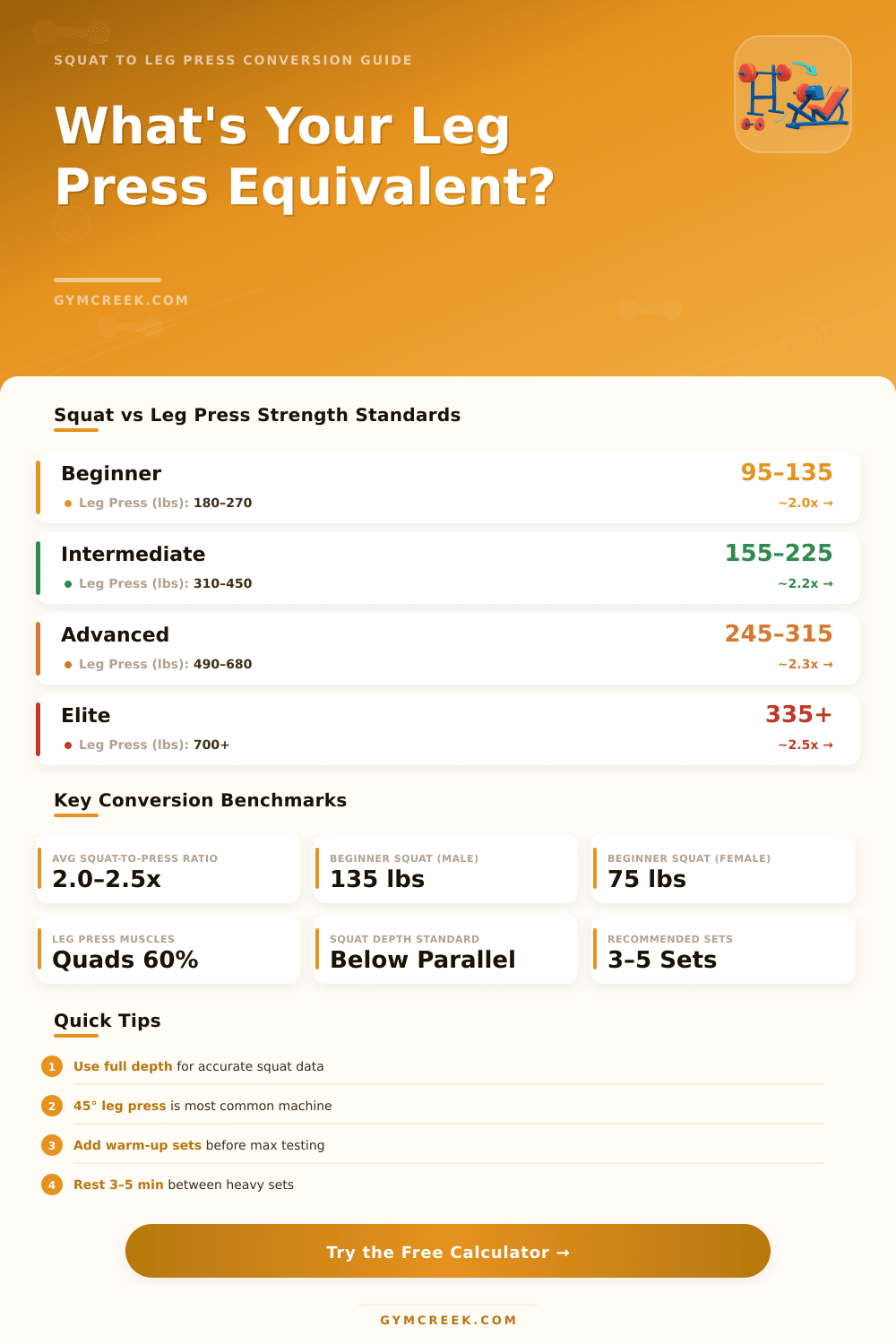
🦵 Squat to Leg Press Calculator
Convert your barbell squat weight to leg press equivalent — and vice versa — using evidence-based strength ratios.
| Level | Bodyweight | Squat 1RM | Leg Press Est. | Ratio |
|---|---|---|---|---|
| Beginner | 154 lbs | 95–135 lbs | 190–280 lbs | 2.0x |
| Novice | 154 lbs | 155–185 lbs | 310–400 lbs | 2.1x |
| Intermediate | 176 lbs | 205–245 lbs | 430–530 lbs | 2.2x |
| Advanced | 198 lbs | 275–335 lbs | 590–750 lbs | 2.3x |
| Elite | 220 lbs | 365–455 lbs | 800–1050 lbs | 2.5x |
| Level | Bodyweight | Squat 1RM | Leg Press Est. | Ratio |
|---|---|---|---|---|
| Beginner | 110 lbs | 55–75 lbs | 110–155 lbs | 2.0x |
| Novice | 132 lbs | 85–115 lbs | 175–245 lbs | 2.1x |
| Intermediate | 143 lbs | 125–155 lbs | 265–330 lbs | 2.2x |
| Advanced | 154 lbs | 175–215 lbs | 370–470 lbs | 2.3x |
| Elite | 165 lbs | 230–285 lbs | 500–650 lbs | 2.5x |
| Machine Angle | Typical Ratio | Mechanical Advantage | Notes |
|---|---|---|---|
| 30° Incline | 1.8–2.0x squat | Lower | Closer to squat mechanics |
| 45° Incline | 2.0–2.3x squat | Moderate | Most common machine type |
| 60° Incline | 2.3–2.6x squat | Higher | Easier per pound loaded |
| Horizontal Seated | 1.5–1.8x squat | Lowest | Least mechanical advantage |
| Hack Squat Machine | 1.2–1.5x squat | Near squat | Closest to free squat |
| Reps (RM) | % of 1RM (Epley) | Example: 1RM = 225 lbs | Goal Zone |
|---|---|---|---|
| 1RM | 100% | 225 lbs | Max Strength |
| 3RM | ~93% | ~209 lbs | Strength |
| 5RM | ~87% | ~196 lbs | Strength / Power |
| 8RM | ~80% | ~180 lbs | Hypertrophy |
| 10RM | ~75% | ~169 lbs | Hypertrophy |
| 12RM | ~70% | ~158 lbs | Endurance / Tone |
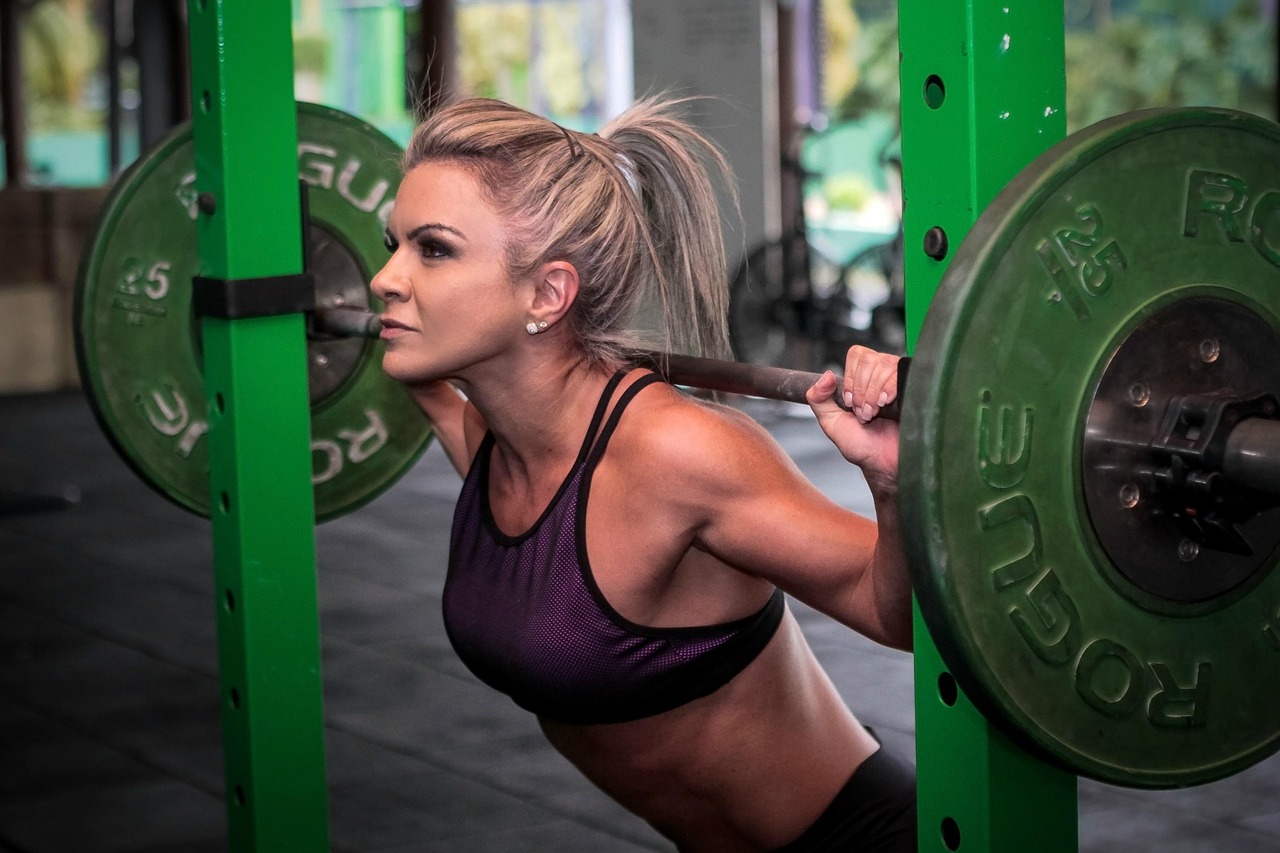
The squat and the leg press is two of the most popular lower-body exercises. While many consider the barbell back squat a gold standard for lower-body strength training, the leg press exercise allows individuals to use more weight without placing as much strain on the spine. For individuals who regularly use either exercise, it is natural to wonder how one relate to the other. A squat to leg press calculator makes it easier for lifters to understand the relationship between these two exercises.
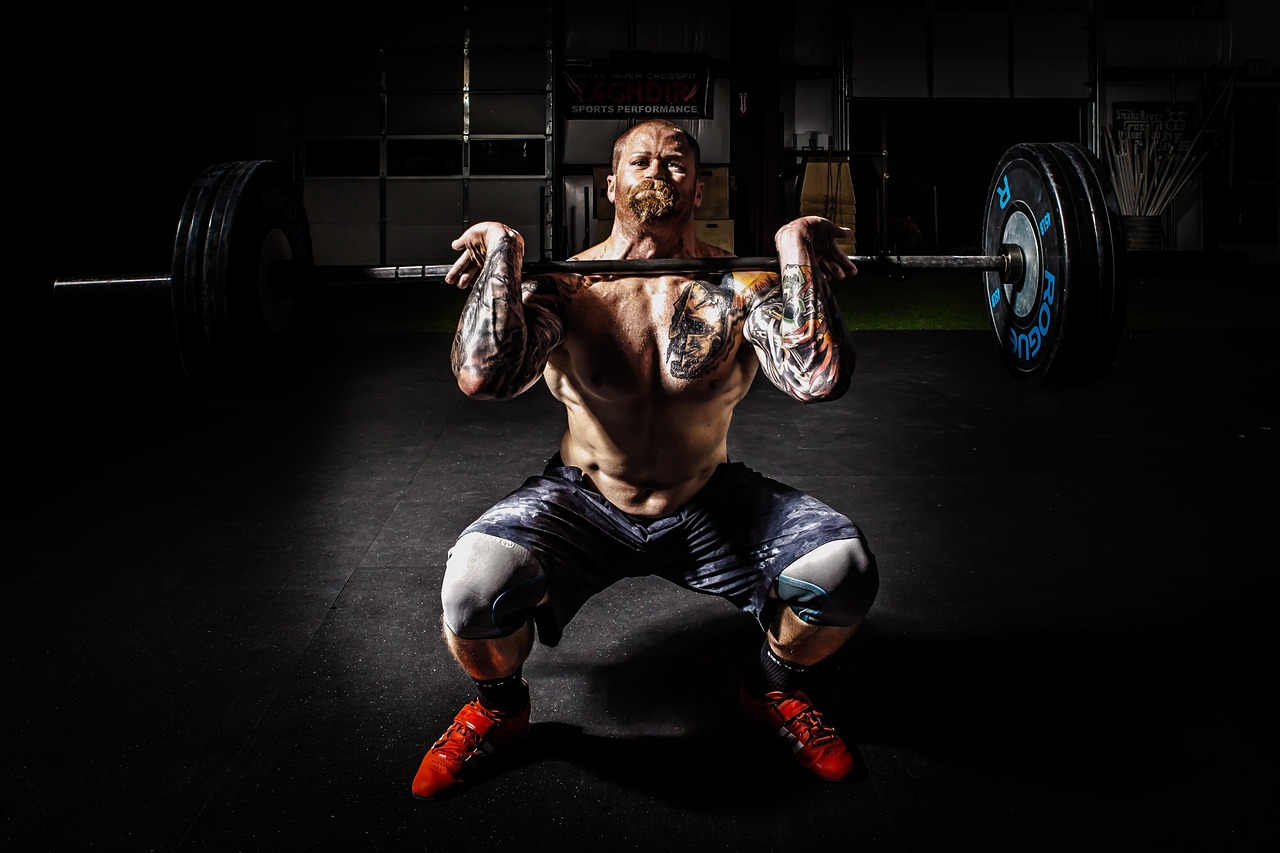
Understanding the relationship between squats and leg press exercises allow individuals to better design their training programs. Whether an individual is tracking their strength gains during specific training phases or making decisions about the type of lower-body strength training they perform at the gym, understanding the relationship between these two exercises can provide valuable information for lifters of all experience levels. While the ratio that an individual may experience can vary depending on their strength, body composition, and other factors, the strength ratio between these two exercises are a good starting point for most individuals.
Why the Numbers Don’t Match Up
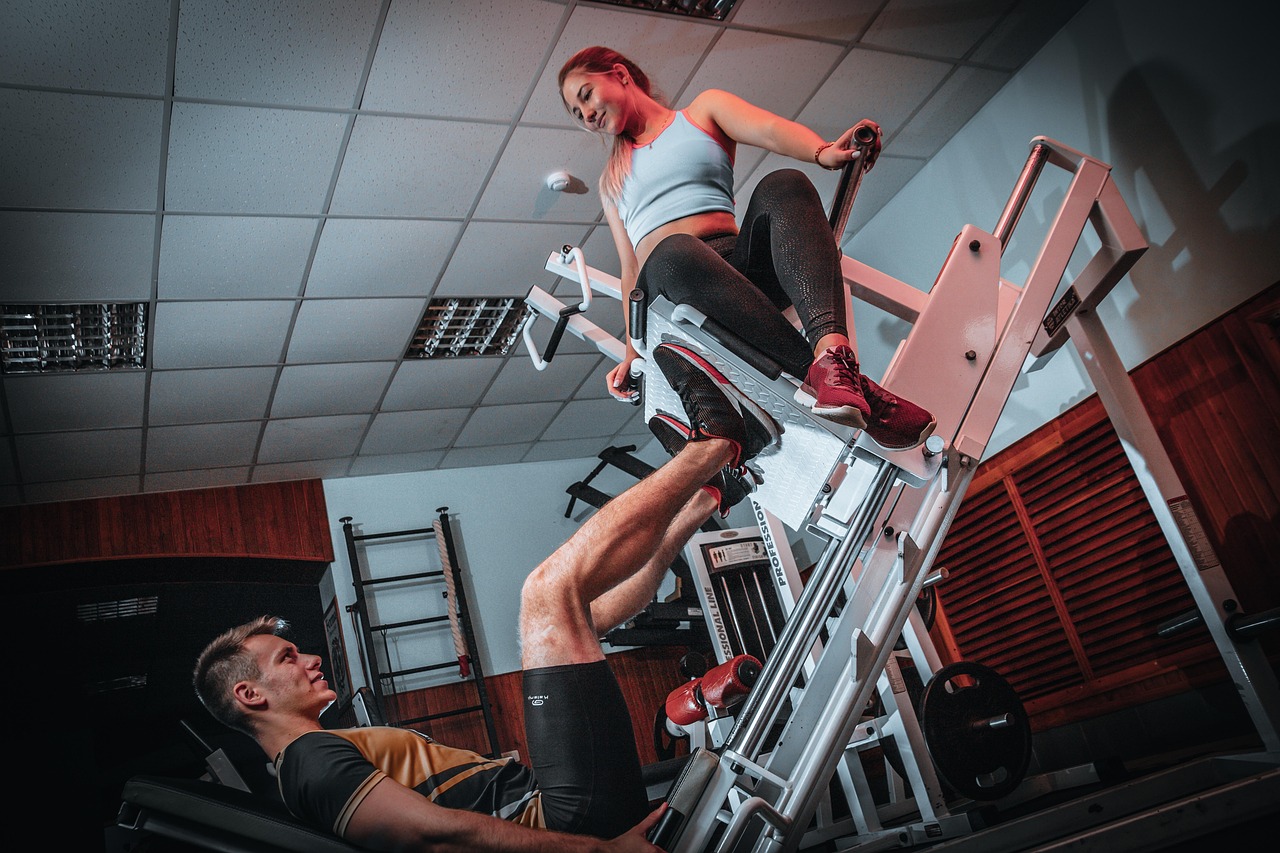
The leg press allows individuals to lift significantly more weight than they can perform with a squat exercise. When performing a squat exercise, individuals must maintain their balance on two limb while lifting a barbell. In addition, they must engage their core and various muscles along their lower body to maintain their posture during the exercise. In contrast, when performing a leg press exercise, the machine’s backrest supports the lifter, which allow them to focus on the muscles in their legs.
Most lifters can lift between 2.0x and 2.5x their squat weight on the leg press exercise. The reason that the ratios tend to be higher for beginners is that they are not as coordinated or confident in their squatting ability. Competitive powerlifters tend to have a higher degree of coordination in their squat exercises, and as a result, their ratios are closer to 1.0x on both exercises.
The different angles of the leg press machine can alter the weights that individuals can lift. For example, machines that feature a 45-degree angle will allow individuals to lift more weight than leg press machines with steeper angle. Additionally, placing individuals feet in higher and wider position on the leg press platform will allow individuals to lift more weight than placing their feet in a narrow position.
Furthermore, the number of repetitions that an individual can perform with the squat or the leg press may have an impact on the relationship between the two exercises. For instance, the weight that an individual can squat once is not the same than the weight they can squat ten times. One equation that helps calculate the number of repetitions for a one-repetition maximum for both exercises is known as an Epley equation.
The additional weight of the carriage that most leg press machines use can also impact the strength calculations between the squat and the leg press. Most leg press machines with a 45-degree angle feature a carriage that weighs between 75 and 100 pound. Individuals who wish to calculate their strength ratios accurately should be aware of whether their gym features such a carriage, as the weights that the machine displays do not typically feature this starting weight.
In addition to the factors discussed above, the sex of the individual who perform the exercises may also impact the calculations. The structure of the hips of women are different from men’s, which alters the way that their muscles distribute the strength throughout their lower bodies. Additionally, the experience level of the individual with their squat movements may alter the strength ratio. An individual who is recovering from an injury to their lower body or back may have a significantly different strength in both exercises than an uninjured athlete.
Despite the number of factors that influence the relationship between squat and leg press exercises, having a general idea of the strength ratio allows individuals for a variety of benefits. For instance, if an individual finds that the squat machines at the gym that they typically train at are always occupied, they may use a leg press exercise to achieve a similar strength gain to that required for their squats. Additionally, if an individual is transitioning from rehab exercises for their lower body to squat exercises, they can use this ratio to determine the starting weight for their squat exercises. Even competitive powerlifters may use this ratio, particularly if they use leg press exercises as a way of increasing the volume of the quadriceps without placing as much strain on the back.
While the squat and leg press exercises are popular with strength athletes of all experience levels, it is natural to assume that the leg press is a direct substitute for squat exercises. However, while the leg press is an excellent exercise for building strength in the lower body muscles and increasing the size of those muscles, it does not offer the same benefits as the squat exercise for muscles such as the core and upper back. As such, many coaches recommend that athletes incorporate both exercises into their training programs. While squats allow athletes to develop their overall strength and power with their lower body, leg press exercises allow for the development of those muscles with greater focus and with less strain placed upon the bodys system.
In both squat and leg press exercises, individuals must utilize proper techniques to maximize the benefits of the exercise and avoid injuries to their body. For squat exercises, an individual’s technique can alter the amount of strength that they can produce with each squat exercise. Similarly, with leg press exercises, avoiding excessive rounding of the back at the bottom of the exercise help to protect their spine. One benefit of leg press exercises is that the exercise’s backrest supports the spine. However, if the individual begins to round their back or to develop a tucked pelvis, they can experience the same strain as if they performed the exercises without the leg press machine.
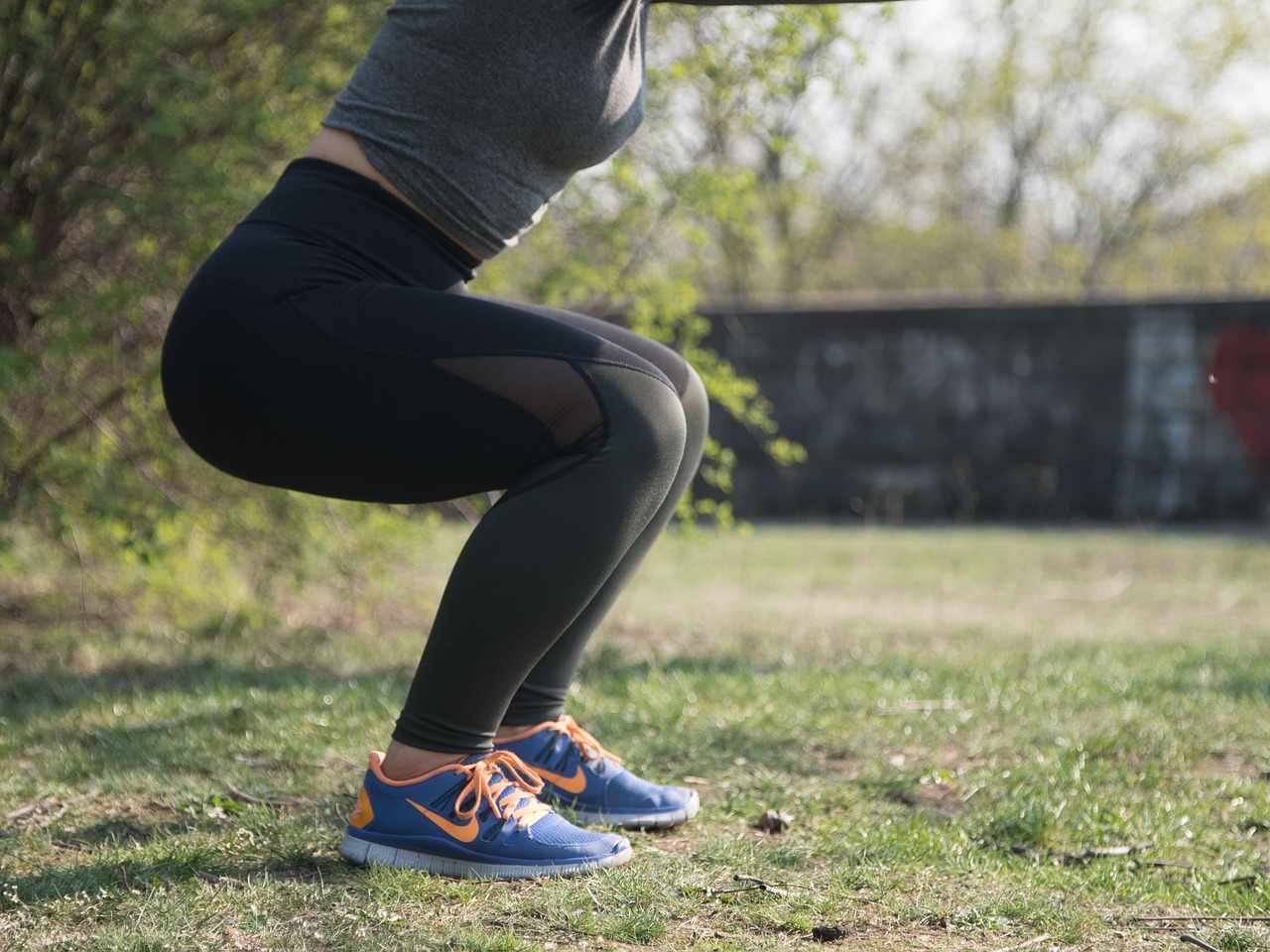
Periodization plans for athletes may benefit from understanding the equivalences between squat and leg press exercises. For example, during phases dedicated to gaining strength in the lower body muscles, an individual may use leg press exercises as a means of increasing the volume of those exercises without placing as much strain on their back muscles. Additionally, during strength phases, the individual may focus more on their squat exercises, using the leg press as an accessory exercise to their training program.
Although the squat-to-leg-press calculator is a helpful tool to estimate the relationship between these two exercises, it is not an absolute rule. A variety of factors influence the true relationship between an individuals strength with these two exercises. Additionally, individual ratios may settle around a specific number. For example, some athletes may have a ratio of 2.2x for squat-to-leg-press exercises on the standard 45-degree leg press machines. Others may be able to develop a ratio of 2.8x or higher.
By tracking the number of repetitions and the weight that an individual can lift in both exercises over a period of months or years, coaches and athletes can glean information about the effectiveness of their training programs. Additionally, individuals of all experience levels can take advantage of the information provided on the relationship between squat and leg press exercises. Whether an individual is just beginning to incorporate these exercises into their training program, or if they are an experienced athlete who is attempting to overcome an injury to their lower body, the information regarding the differences and similarities between the two exercises can be of great benefit to an athlete’s overall performance in their programs.
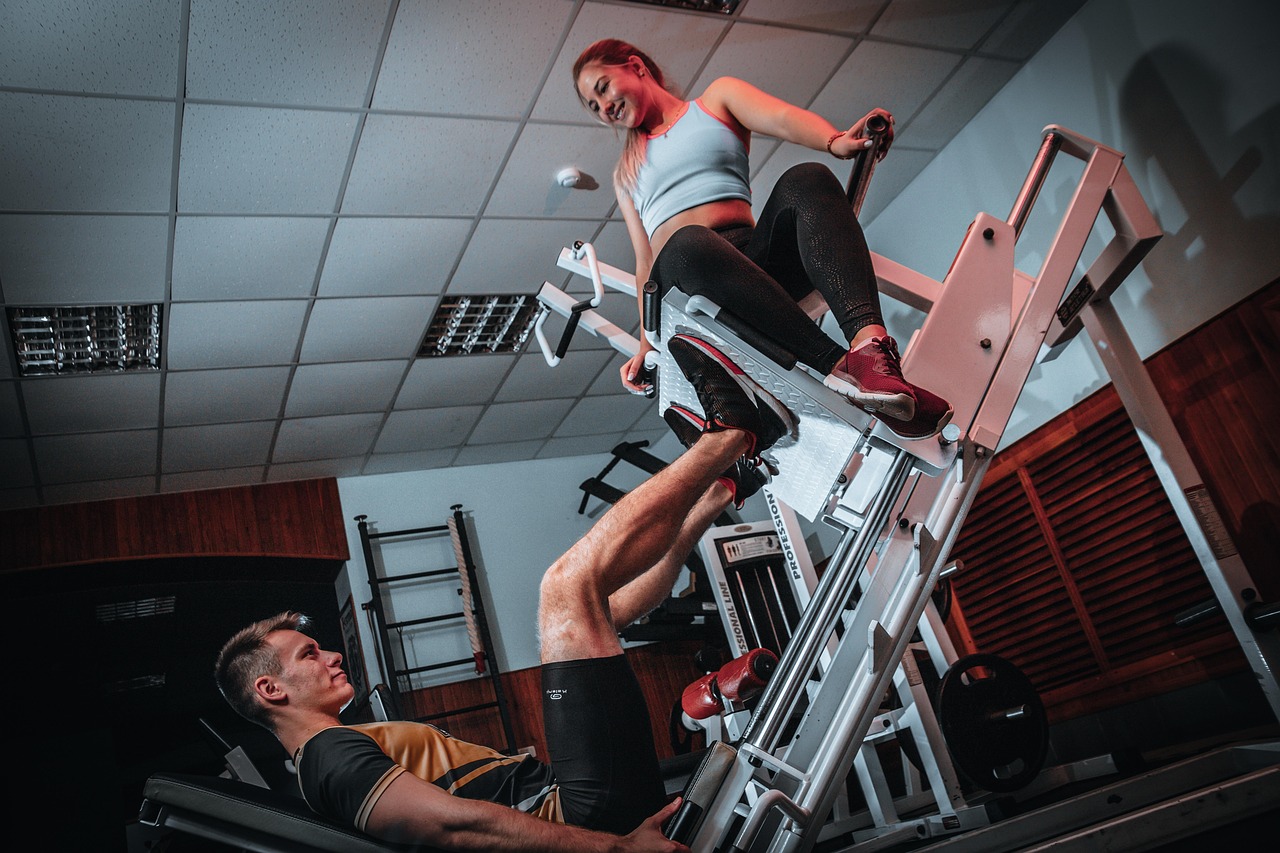
Ultimately, the relationship between squat and leg press exercises is an area of strength for athletes of all experience levels. However, the true gains in strength are based upon an individuals dedication to consistently training with these exercises. As such, while the squat-to-leg-press calculator can be of great benefit to athletes, the most accurate calculator for determining an individuals squat-to-leg-press strength ratio is the one that live between the two ears of an athlete after spending months training in their gym with both the barbell and the leg press machine.