🏋 Incline Bench Press Max Calculator
Estimate your 1-Rep Max using your working weight & reps — with strength standards & training zone breakdowns
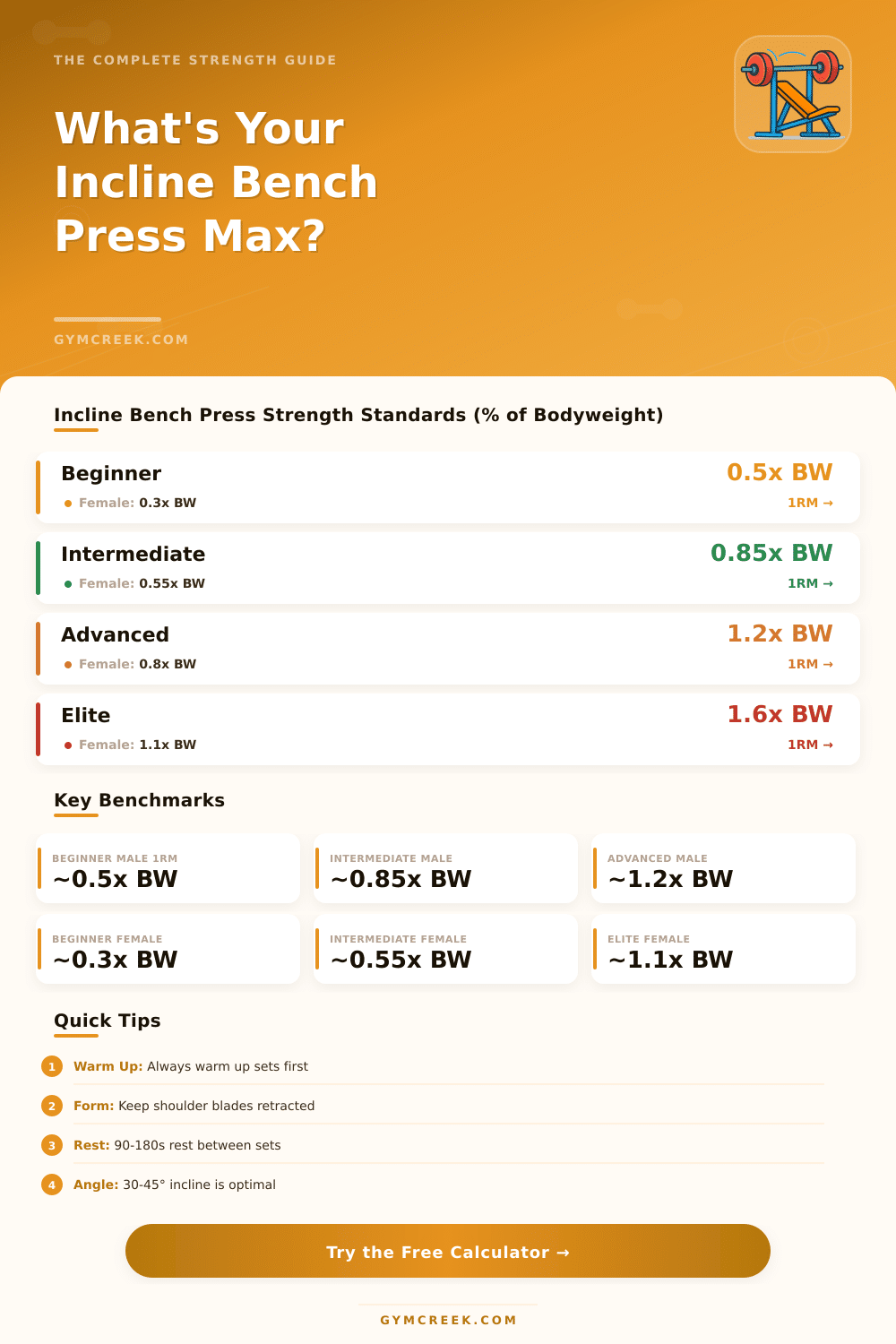
| Level | Male (x BW) | Female (x BW) | Male Example (175 lbs) | Female Example (135 lbs) |
|---|---|---|---|---|
| Untrained | 0.35x | 0.20x | 61 lbs | 27 lbs |
| Beginner | 0.55x | 0.35x | 96 lbs | 47 lbs |
| Novice | 0.75x | 0.50x | 131 lbs | 68 lbs |
| Intermediate | 0.95x | 0.65x | 166 lbs | 88 lbs |
| Advanced | 1.25x | 0.85x | 219 lbs | 115 lbs |
| Elite | 1.60x | 1.10x | 280 lbs | 149 lbs |
| Reps | % of 1RM | Training Goal | RPE Range |
|---|---|---|---|
| 1 rep | 100% | Max Strength Test | RPE 10 |
| 2 reps | 97% | Maximal Strength | RPE 9.5–10 |
| 3 reps | 94% | Maximal Strength | RPE 9–9.5 |
| 4 reps | 92% | Strength | RPE 8.5–9 |
| 5 reps | 89% | Strength / Power | RPE 8–9 |
| 6 reps | 86% | Strength / Size | RPE 8 |
| 8 reps | 81% | Hypertrophy | RPE 7.5–8 |
| 10 reps | 75% | Hypertrophy | RPE 7–8 |
| 12 reps | 70% | Hypertrophy / Endurance | RPE 7 |
| 15 reps | 65% | Muscular Endurance | RPE 6.5–7 |
| 20 reps | 55% | Endurance | RPE 6 |
| Formula | Equation | Best For | Accuracy Note |
|---|---|---|---|
| Epley | w x (1 + r/30) | General use, most popular | Slight overestimate at high reps |
| Brzycki | w x 36 / (37 – r) | 1–10 rep range | Most accurate under 10 reps |
| Lombardi | w x r^0.10 | Higher rep ranges | Conservative estimate |
| Mayhew | 100 x w / (52.2 + 41.9 x e^(-0.055 x r)) | Athletic populations | Good for trained athletes |
| O'Conner | w x (1 + r/40) | Beginners | Lower estimate, safer starting point |
| Goal | % of 1RM | Rep Range | Rest Between Sets | Sets |
|---|---|---|---|---|
| Max Strength | 90–100% | 1–3 | 3–5 min | 3–5 |
| Strength | 80–90% | 3–5 | 2–4 min | 4–6 |
| Power | 55–75% | 2–5 (explosive) | 2–3 min | 3–5 |
| Hypertrophy | 67–80% | 6–12 | 60–90 sec | 3–5 |
| Endurance | 50–65% | 12–20+ | 30–60 sec | 2–4 |
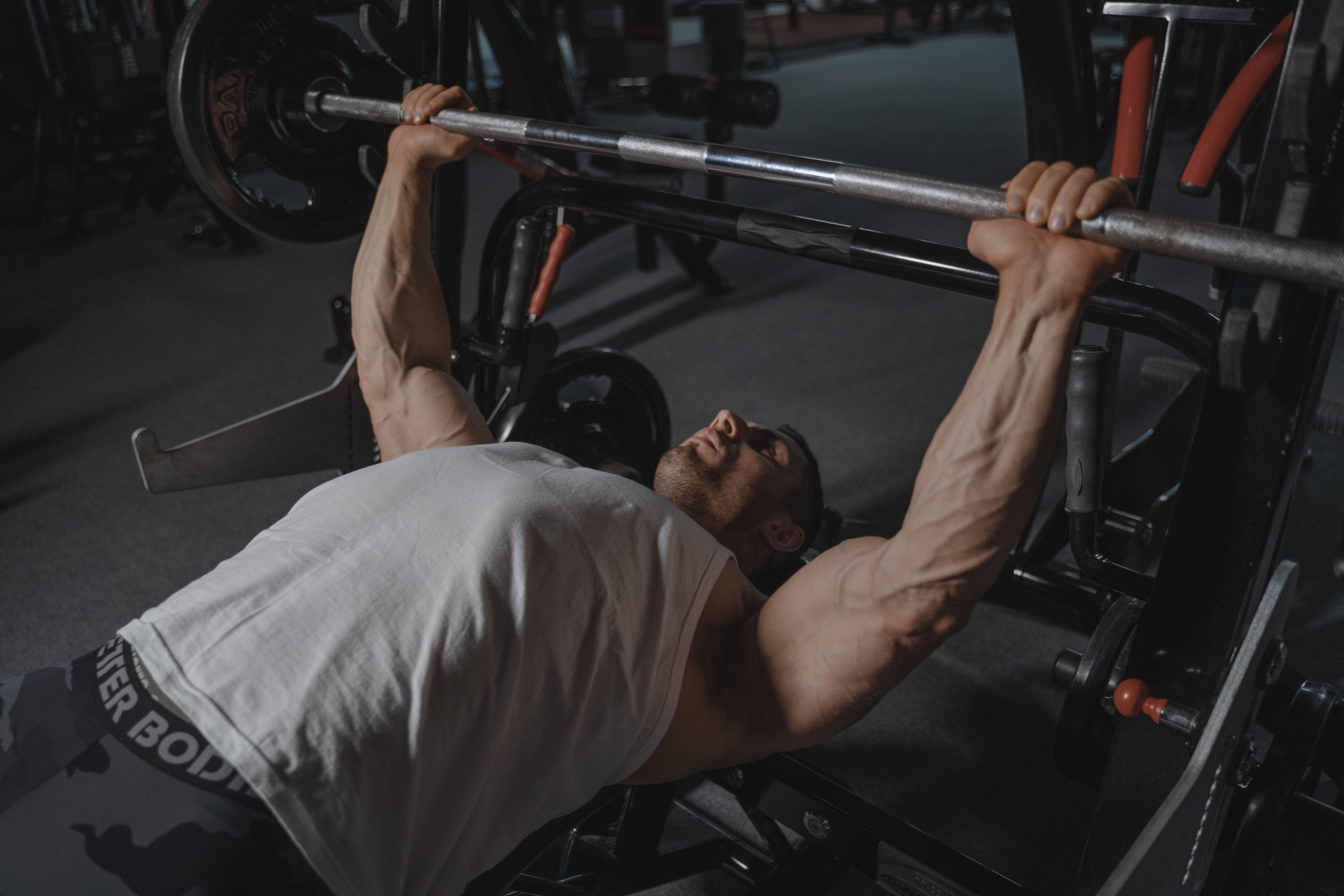
The incline bench press exercise is regarded as the most effective for developing the upper chest muscles, along with the front deltoids and the triceps. The incline bench press allows lifter to target the clavicular head of the pectoralis muscle more than the flat bench press exercise does. This makes it a great tool for individuals who are either powerlifters or bodybuilders looking to develop balance in there upper body muscles.
Knowing the true limits of your one repetition maximum for the bench press without having to attempt to lift the weight yourself is essential for any lifter. One of the best ways to do this is to utilize an incline bench press max calculator. These calculator ask for the weights you can lift for a certain number of repetitions. It can then estimate your one repetition maximum for the bench press using mathematical formula.
Understanding the Science Behind Incline Bench Pressing
The incline bench press is different from the flat bench press in that when the bench press incline is set to between 30 and 45 degrees, the shoulders is activated more and the chest muscle is in a stretched position. However, an athlete cannot press more weight on the incline compared to the flat bench press. For trained athletes, the one repetition maximum for the incline press is between 70-80% of the flat bench press maximum.

There are a variety of factors that affect an individual’s performance with the incline bench press. These factors include an individual’s shoulder mobility, triceps strength, and the specific angle of their bench press incline. The steeper the incline, the more the exercise perform the same as a bench press for the shoulders. Therefore, many recommend that the incline remain between 30 and 45 degrees.
An intermediate male lifter who weighs around 175 pounds should have a one repetition maximum for the incline bench press of around 165 pounds. For women who lift the same muscle as men at the same training levels, their strength can be expected to be between 65-70% of the mens bench press strength. These standards allow lifters to understand where they stand in relation to their goal. The relationship between an individual’s incline bench press one repetition maximum and their body weight can be seen above.
Using the formula to calculate an individual’s one repetition maximum for the incline bench press has the additional benefit of allowing lifters to avoid any injury to their joints. The act of attempting to lift the maximum weight for the bench press puts a tremendous amount of stress on the lifters’ bodies. By estimating a one repetition maximum, lifters are able to reach their strength and strength goals while minimizing the risk of injury to their joints.
Depending on an individual’s goals for their bench press strength, there are different percentage of the one repetition maximum that are used during lifting. For those who are focused upon increasing their strength, the percentages used are between 85-95% of their calculated one repetition maximum. For those who are focused upon muscular hypertrophy, the percentage is between 70-85%. For those who are focused upon muscular endurance, percentages is used for weights that is lighter than the 70% range.
The most popular of the mathematical formulas used to calculate an individual’s one repetition maximum for the incline bench press is the Epley formula. However, others use the Brzycki formula, which is considered accurate for weights between 10 repetitions and fewer. Other formula include those of Lombardi and Mayhew. Most calculators will provide an individual with the option of choosing which formula to use. The variations between these different formulas are relatively small.
Regardless of the calculation of an individual’s bench press one repetition maximum, technique is essential when performing the incline bench press. Many individuals who achieve high weight with the incline bench press do so at the cost of sacrificing proper technique. The most important technique for the incline bench press is having the lifter’s back remain flat on the bench while pressing the chest and shoulders upward with control. The incline should be to a comfortable angle for the individual; steeper than 45 degrees is typically not recommended.
Because an incline bench press can take less absolute load than the flat bench press, lifters are capable of training the muscle more frequently. For instance, programs that alternate between flat, incline, and decline bench presses allow for the development of a more complete upper and mid chest muscle group without overtraining the muscle.
Using a calculator to determine an individual’s one repetition maximum for the incline bench press allows for the lifters to track the effectiveness of the training program. If an individual isnt seeing the desired increase in the weights they can press for one repetition, there may be the need for a change in lifting technique, training recovery, or even training program. Calculators allow lifters to establish records for their bench press strength and other lifter can use the information to compare their techniques to others.

The calculations produced by incline bench press calculators are merely estimates. An individual’s performance with the exercise may be affected by their level of strength, fatigue, body composition, sleep quality, and a variety of other factor. However, the estimate can be utilized over time with the same formula and with the same individual to determine an individual’s relative strength and their rate of development. The calculator above can be used to quickly determine where an individual’s working weights might fit into the range for their estimated one repetition maximum strength.
The bench press max calculator is just one of many tools lifters can use to make better decisions with their training program. Combined with the other tools available to lifters, such as strength trackers and body composition calculators, the tool allows lifters of all levels to have a better understanding of their physical strength and how to maximize their training programs. Whether an individual is trying to increase their bench press strength, their upper chest development, or just to maintain their strength, knowing the levels of strength that their chest muscles have will allow them to have better control of their fitness program.