🏋 Weightlifting Calorie Calculator
Estimate calories burned during strength training based on your body, session type & intensity
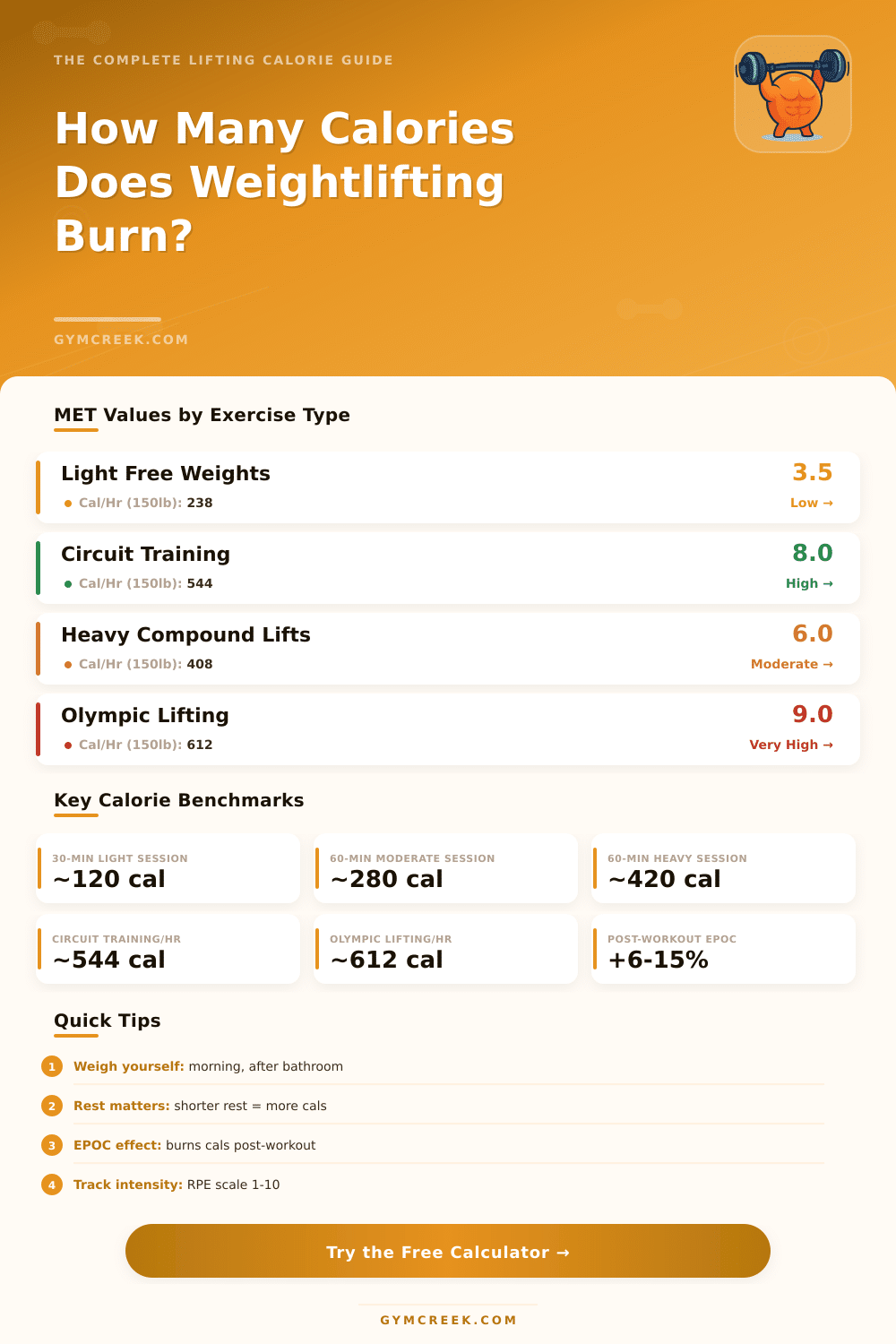
| Exercise Type | MET Value | Cal/hr (150 lb) | Cal/hr (200 lb) | Intensity |
|---|---|---|---|---|
| Light Machine Work | 3.5 | 238 | 318 | Low |
| General Weight Training | 4.0 | 272 | 363 | Low–Moderate |
| Bodybuilding (Moderate) | 5.0 | 340 | 454 | Moderate |
| Heavy Compound Lifts | 6.0 | 408 | 544 | Moderate–High |
| Power Lifting | 7.5 | 510 | 680 | High |
| Circuit Training | 8.0 | 544 | 726 | High |
| Olympic / Explosive | 9.0 | 612 | 816 | Very High |
| CrossFit-Style HIIT | 9.8 | 666 | 889 | Very High |
| Lift | Beginner (lb) | Intermediate (lb) | Advanced (lb) | Elite (lb) |
|---|---|---|---|---|
| Back Squat (175 lb BW) | 135 | 225 | 315 | 405+ |
| Bench Press (175 lb BW) | 95 | 175 | 255 | 315+ |
| Deadlift (175 lb BW) | 155 | 275 | 385 | 495+ |
| Overhead Press (175 lb BW) | 65 | 115 | 165 | 205+ |
| Barbell Row (175 lb BW) | 85 | 155 | 225 | 285+ |
| Training Style | EPOC Duration | Extra Calories | Best For |
|---|---|---|---|
| Light / Machine Work | 30–60 min | +5–8% | Recovery, beginners |
| Moderate Hypertrophy | 1–3 hrs | +8–12% | Muscle building |
| Heavy Compound / Powerlifting | 3–8 hrs | +12–18% | Strength & fat loss |
| Circuit / CrossFit-Style | 4–10 hrs | +15–20% | Fat loss, conditioning |
| Olympic Lifting | 3–7 hrs | +10–16% | Power, athletic performance |
| Goal | Rep Range | Sets | Rest Period | % of 1RM |
|---|---|---|---|---|
| Max Strength | 1–5 | 3–6 | 3–5 min | 85–100% |
| Power / Olympic | 1–6 | 3–5 | 3–5 min | 75–95% |
| Hypertrophy | 6–12 | 3–5 | 60–120 sec | 65–80% |
| Muscular Endurance | 12–20+ | 2–4 | 30–60 sec | 50–65% |
| Circuit / Fat Loss | 10–20 | 3–5 | 15–45 sec | 50–70% |
Weightlifting is one of the best form of exercise for those looking to increase there muscle mass and metabolism. For lifters of all experience level, understanding the energy burned during a weightlifting session can help achieve specific body composition goals. A weightlifting calorie calculator can provide an individual with an estimate of the number of calories they will burn during a typical weightlifting routine.
Where many individual burn calories during weightlifting routines through excess post-exercise oxygen consumption or EPOC, a variety of different factors will impact the energy expended by the body during such routines. Factors such as the type of lifts performed, the amount of time taken to rest between sets, the number of sets performed, and the experience level of the weightlifter will impact the total energy spent during a typical weightlifting routine. As a result, many lifters turn to general calorie charts to estimate there energy expenditure; yet, given these various factor that influence energy expenditure during weightlifting, such general estimates may be inaccurate. Instead, many lifters employ methods that incorporate these factors to provide more accurate calculations to track there energy expenditure.

How a Weightlifting Calorie Calculator Works
Calorie calculators take various factors into consideration when attempting to calculate an individual’s energy expenditure during weightlifting. Such factors include an individual’s age, gender, body weight, and the various characteristic of there lifting routine. For instance, energy expenditure for performing different types of weightlifting routines can differ; high intensity weightlifting routines that burn 9 METs may expend more energy than individuals who perform 3.5 METs of machine-based lift. In addition, individuals who expend more energy during there lifting routine burn more calories than those who use less energy in there lifting routine.
Within such calculators, there is a distinction between gross and net calories burned by an individual during there lifting routine. Gross calories account for all the energy expended by the individual during a period of time. Net calories burned, however, is the energy expended by an individual during there lifting routine but minus the calories that an individual would normally burned during rest. When an individual performs intense weightlifting routines, they expend more energy than during any other type of exercise routine. Furthermore, a study in the journal of Medical Science & Sports & Exercise indicated that resistance training can boost an individual’s metabolism for up to 38 hours after there lifting routine. The number of calories burned during this “afterburn” effect can range from 5 to 20 percent of the total calories expended during weightlifting.

Body composition plays a crucial role in the number of calories that an individual burns during a weightlifting routine. Individuals that contain more lean muscle mass will burn more calories during weightlifting routines than individuals with the same body weights but less lean muscle mass. As a result, an individual that possesses more muscle mass than another with similar body weight but less muscle mass will burn more calories during weightlifting efforts. Furthermore, the body composition of an individual has a correlation with there experience level in weightlifting. Individuals that possess more muscle mass also have a higher experience level in weightlifting than those with less muscle mass.
Beyond body composition, the experience level of the individual with there strength and endurance routine will influence the number of calories that they burn during there routine. Individuals with limited experience with weightlifting may burn fewer calories than individuals with more experience with strength and endurance exercises. This is due to the fact that beginners in weightlifting may have less strength and endurance than experienced lifters, and, therefore, may not be able to perform the same number of sets and lifts as more experienced individuals during there routine.
In addition to experience level, the rest periods an individual takes while performing there lifting routine can impact the number of calories that they burn during such sessions. For instance, taking short rests of 30-60 seconds between sets of weightlifting exercises will burn more calories during the routine than taking long rests of 3-5 minutes between sets. This is due to the effect that the short rests have upon the heart rate of the individual, requiring the individual’s heart rate to remain elevated throughout the lifting routine.
Understanding these factors and how they impact the energy burned by an individual during there weightlifting routine can help an individual of any experience level to incorporate the use of a weightlifting calorie calculator into there fitness routine. For instances where an individual is attempting to lose fat from there bodies, calculating the energy expenditure by an individual from weightlifting will allow them to determine the proper calorie deficit to be utilized in there diet. During bulking periods, an individual will use the information from the calculator to ensure that they dont consume too many calories, which can lead to the gain of excessive body fat.
Due to the afterburn effect created by the body after performing heavy weightlifting routines, an individual will burn additional calories beyond those burned during there lifting routine. These calories can range from 50 to 200 calories (and beyond) after the performance of heavy weightlifting exercises such as squats, lunges, burpees, and bench presses. This continued burning of calories after the performance of a lifting routine is due to the body’s need to repair any muscle damage occur during the routine. Additionally, the body burns calories to replenish depleted glycogen stores after the performance of these exercises.
Beyond understanding how the body burns calories after lifting weights, the information gained from a weightlifting calorie calculator can allow an individual to better understand the importance of proper nutrition for there body. For individuals who desire to continue to burn calories at the rates calculated by there weightlifting calorie calculator, proper nutrition is essential to the attainment of these goals. Experts recommend that an individual consume 20-40 grams of protein and 30-60 grams of carbohydrates within 30-45 minutes after performing there lifting routine to allow the body both to replenish its glycogen stores and to restore muscle tissue damaged during the routine.
Beyond the importance of proper nutrition within the body, the use of a weightlifting calorie calculator also allows an athlete to better periodize there training regimen. During deload weeks when an athlete takes a break from lifting weights, the energy expenditure by that individual will differ from lifting weeks. As a result, there nutrition plan should be adjusted according to these changed energy expenditure calculations. Additionally, when the athlete is in need of further increasing there strength or gaining more lean muscle mass, they can manipulate there training plan to reflect the needs of such goals, which will impact the energy requirements of the athlete during such periods.
All calculators provide estimates as to the number of calories that are burned during a lifting routine. The factors that influence the energy burned by an individual include an individual’s genetics, hormones, sleep cycles, and stress. Consequently, while a weightlifting calorie calculator is beneficial in providing estimates as to energy expenditure of an individual during weightlifting sessions, the body composition changes and performance metrics of each individual should also be tracked with consistency to gain a proper understanding of energy expenditure.
In addition to the benefits of employing a weightlifting calorie calculator to estimate energy expenditure, weightlifting, in general, provides a variety of other benefits to an individual. Benefits to the body of individuals that incorporate weightlifting into there training regimen include, but are not limited to, improved bone density, improved insulin sensitivity, improved cognitive function, and improved mental strength. Consequently, individuals of all experience levels who incorporate weightlifting into there fitness routine will find both benefits to there body, as well as the ability to understand the role that lifting has on the bodys metabolism.
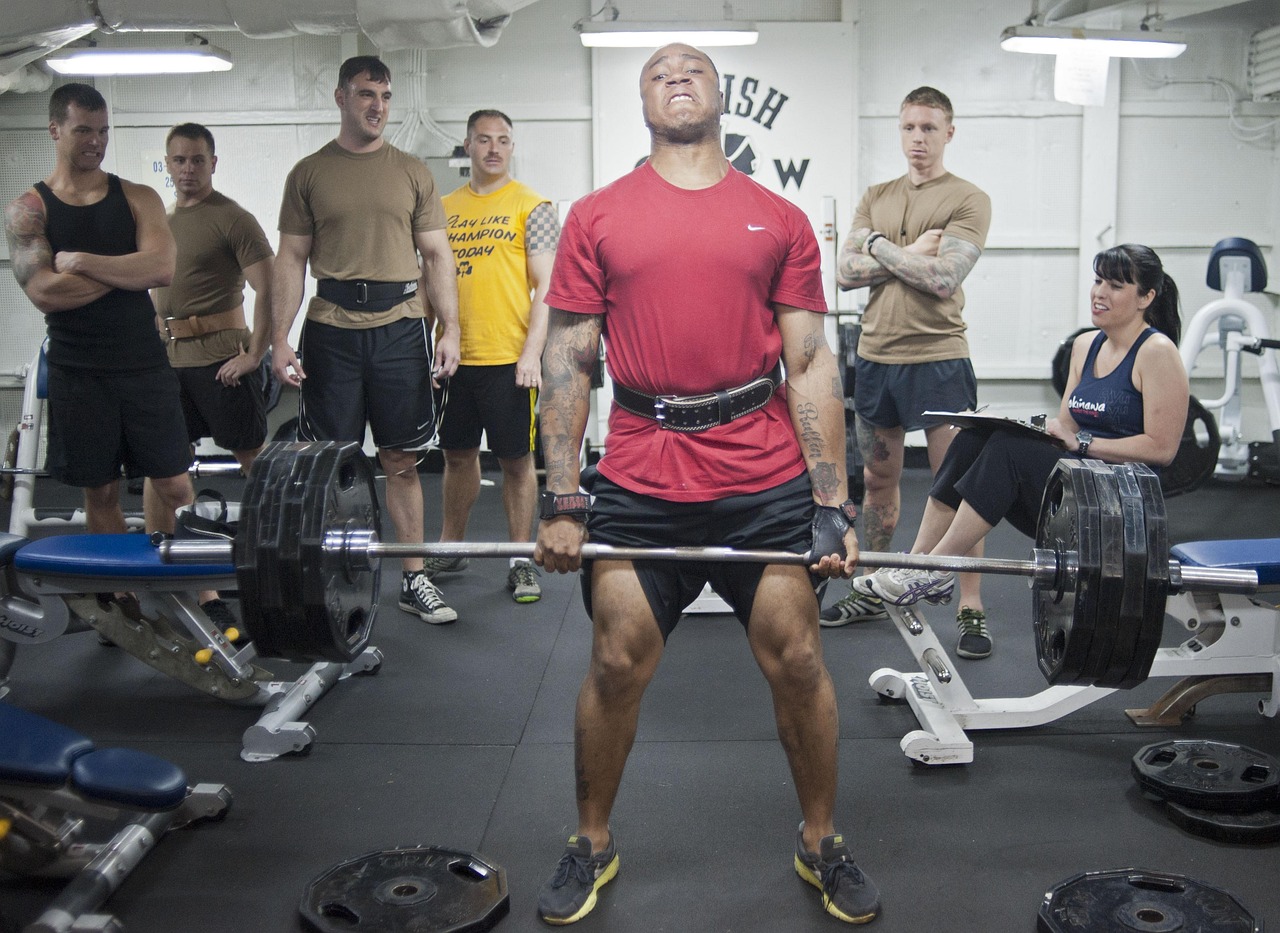
Whether an individual is a powerlifter, a bodybuilder, or simply looking to increase there strength and overall health, understanding how weightlifting impacts an individual’s metabolism is a crucial aspect to developing desirable results from there training program. By understanding these various factors that influence the energy expenditure of an individual during there lifting routine, an athlete can more efficiently manage both there training and nutritional programs.
The next time an individual steps into the gym to lift weights, they should remember the role that weightlifting has on there energy expenditure. As a result, those individuals that employ an understanding of these concepts will find both physical and mental strength in there bodies, as well as transform there bodies to achieve there desired physique.