🏋 Max Back Squat Calculator
Estimate your 1-rep max (1RM) from any set — then find your training zones & strength level
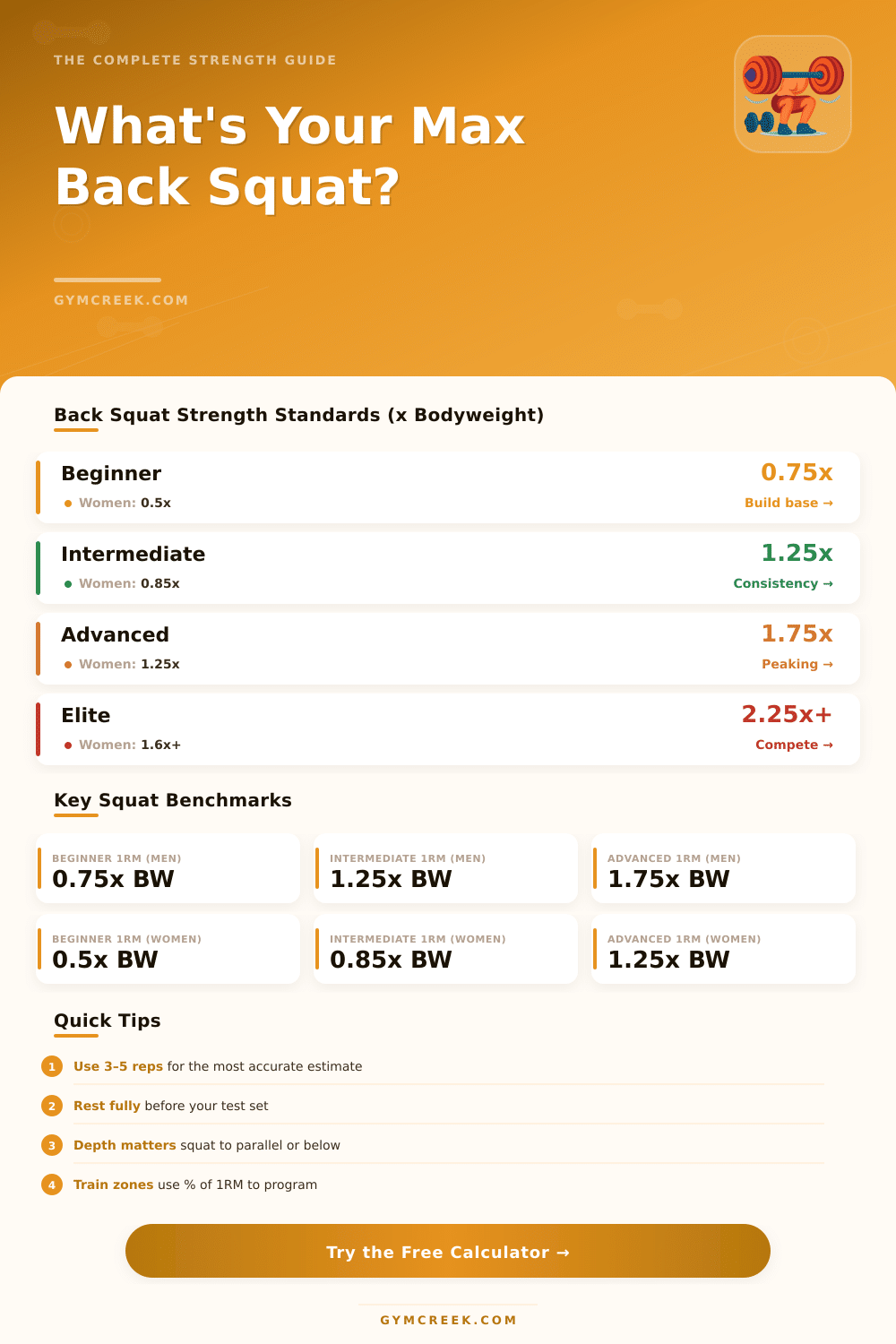
| Level | Men (x BW) | Women (x BW) | Rep Range Focus | Training Goal |
|---|---|---|---|---|
| Untrained | 0.5x | 0.35x | 5–8 | Learn movement |
| Beginner | 0.75x | 0.50x | 5–8 | Build base strength |
| Novice | 1.00x | 0.70x | 3–5 | Linear progression |
| Intermediate | 1.25x | 0.85x | 3–5 | Consistent overload |
| Advanced | 1.75x | 1.25x | 1–3 | Peak & peak cycles |
| Elite | 2.25x+ | 1.60x+ | 1–2 | Competition prep |
| Reps | % of 1RM (Epley) | Zone | Primary Adaptation |
|---|---|---|---|
| 1 | 100% | Max Strength | Neuromuscular efficiency |
| 2 | 97% | Max Strength | Max strength |
| 3 | 94% | Strength | Strength & power |
| 4 | 92% | Strength | Strength |
| 5 | 89% | Strength | Strength / Size |
| 6 | 86% | Strength / Hypertrophy | Size & strength |
| 8 | 81% | Hypertrophy | Muscle growth |
| 10 | 75% | Hypertrophy | Muscle growth |
| 12 | 70% | Hypertrophy | Size & endurance |
| 15 | 63% | Endurance | Muscular endurance |
| 20 | 55% | Endurance | Conditioning |
| Formula | Best For | Rep Range | Notes |
|---|---|---|---|
| Epley | General use | 1–10 | Most widely used; slight overestimate at high reps |
| Brzycki | Low-rep accuracy | 2–10 | Very accurate under 10 reps; underestimates above 10 |
| Lombardi | Higher rep sets | 5–15 | Tends to give slightly higher estimates |
| Mayhew et al. | Moderate reps | 6–20 | Developed for bench press; applies to squat |
| O’Conner et al. | Simple estimate | 1–12 | Linear formula, very conservative |
The Back Squat is a combo exercise that requires full body effort, and it is a big burden for the knees. Many lifters follow their progress by tracking, as their max one-rep squat grows. On the other hand, testing yourself in high reps and using a calculator to estimate the max, is truly a wiser way than simply testing the real one-rep max directly in the gym.
DISCLOSURE: This post may contain affiliate links, meaning when you click the links and make a purchase, I receive a commission. As an Amazon Associate I earn from qualifying purchases.

Three exercises rule when talking about estimating raw force: the Back Squat, the bench press and the deadlift. These are exactly the same three moves that powerlifters compete in, and their total gives a pretty clear picture of overall force. Standards for force exist so that lifters can compare themselves with others in their weight class.
Safe Ways to Test and Improve Your Back Squat
Calculators give an approximate one-rep max, if you enter the weight that you lift, the number of reps, sex, age and body weight. After entering that data, you receive a table that shows where you stand on the scale from beginner to elite level. Because most training happens between 85 and 100 percent of your one-rep max, lowering those limits helps to keep your sessions in the right zone, pretty hard for progress, but pretty safe to stay healthy.
For many folks, doing a squat with your own body weight for one rep is a good target to reach. Those squats strongly work the hamstrings, quadriceps and glutes, muscles that become more important as one ages. Sharing forse in percent of body weight can be helpful, but here is the case: raw numbers do not always project the potential one-rep max well.
A lifter of 50 kilos has a bigger chance to reach a 300-percent squat than a lifter of 136 kilos. Also body proportions matter, truly. Shorter athletes with thick legs commonly do better in squats.
Lifters with a long trunk usually succeed well, because such a build helps them stay more upright during the move.
Common squats are the core for improving the squat. High-bar Back Squats work best as the main variety, because they focus on the leg muscles without too much tiredness in other parts. Front squats deserve to be added, they truly strongly hit the quadriceps, although one lifts less weight.
For pure strength gain, five sets of five reps stay a top mode, although some studies point that four sets of four reps could be even more effective.
Form makes all the difference. Keep the bar high on the traps with a grip that is firm and close. Choose a spot at eye height or on the wall and set your eyes there during the whole exercise; that helps to keep the back straight.
Breathe deeply in, hold the breath below and breathe out rising. Spend some minutes stretching the hips before lifting weight. Swings, side moves and goblet squats make a fast warmup that truly is worth the time.
Starting any squat program by testing your recent max is key. Note a safe working weight based on your one-rep max and count your percentages from that value, it is the wisest way too protect yourbottom back on a long-term basis.