🏋 Bench Press Calculator
Calculate your one-rep max, strength level & rep-based training targets
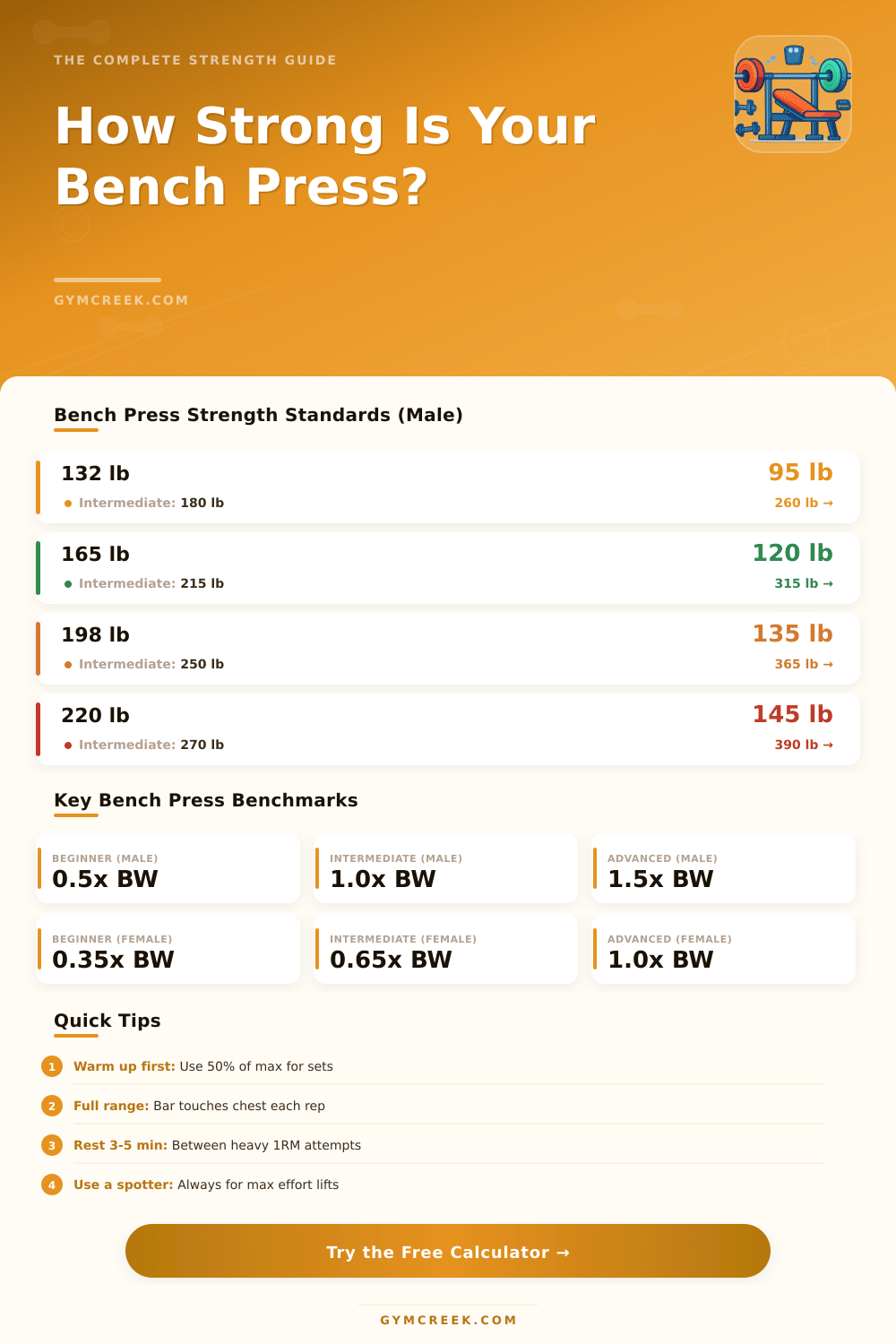
Male Standards (lb, by body weight)
| Body Wt | Beginner | Intermed. | Advanced |
|---|---|---|---|
| 132 lb | 95 | 175 | 255 |
| 148 lb | 110 | 195 | 285 |
| 165 lb | 120 | 215 | 315 |
| 181 lb | 130 | 230 | 340 |
| 198 lb | 135 | 250 | 365 |
| 220 lb | 145 | 270 | 390 |
| 242 lb | 155 | 285 | 410 |
Female Standards (lb, by body weight)
| Body Wt | Beginner | Intermed. | Advanced |
|---|---|---|---|
| 97 lb | 45 | 85 | 130 |
| 114 lb | 55 | 100 | 150 |
| 132 lb | 65 | 115 | 175 |
| 148 lb | 70 | 125 | 190 |
| 165 lb | 75 | 135 | 205 |
| 181 lb | 80 | 145 | 215 |
| 198 lb | 85 | 150 | 225 |
| Goal | % of 1RM | Rep Range | Sets | Rest Period |
|---|---|---|---|---|
| Max Strength | 90–100% | 1–3 reps | 3–5 | 3–5 min |
| Strength / Power | 80–90% | 3–5 reps | 4–6 | 2–4 min |
| Hypertrophy | 65–80% | 6–12 reps | 3–4 | 60–90 sec |
| Muscular Endurance | 50–65% | 12–20 reps | 2–3 | 30–60 sec |
| Warm-Up / Rehab | 30–50% | 15–20 reps | 2 | 60 sec |
| Level | Male Ratio (1RM / BW) | Female Ratio (1RM / BW) | Description |
|---|---|---|---|
| Untrained | 0.35–0.5x | 0.20–0.35x | Less than 3 months training |
| Beginner | 0.5–0.75x | 0.35–0.50x | 3–12 months consistent training |
| Intermediate | 0.75–1.25x | 0.50–0.75x | 1–3 years structured training |
| Advanced | 1.25–1.75x | 0.75–1.0x | 3–5 years dedicated training |
| Elite | 1.75x+ | 1.0x+ | Competitive / 5+ years |
| Formula | Equation | Best For | Accuracy |
|---|---|---|---|
| Epley | w × (1 + r/30) | General use (1–10 reps) | Very High |
| Brzycki | w × 36/(37–r) | Low rep ranges (1–6) | High |
| Lombardi | w × r^0.10 | Higher rep ranges (6–12) | Moderate |
| Mayhew | 100w / (52.2 + 41.9e^–0.055r) | Athletic populations | High |
| O'Conner | w × (1 + 0.025r) | Conservative estimate | Moderate |
The bench press is one of the more popular exercises for developing upper body strength. Whether you are a competitive powerlifter or you simply enjoy some strength training as part of your weekly routine, understanding your bench press capability is an essential part of maximizing your training routine. A bench press calculator can help show you what your one-rep max is without having to attempt to lift it yourself each time.
Knowing your maximum bench press strength has always been a bit of a challenge. You could either attempt to lift excessively heavy weight and risk injury to your shoulder or upper body, or you could be too conservative about your lifting ability and not reach your full strength potential. Bench press calculators work around these challenges by using mathematical formula to calculate your one-rep maximum based on the weights that you can lift for multiple repetitions.

How a Bench Press Calculator Can Help With Your Training
Bench press calculators ask for information about your lifts. By entering the weights and the number of clean repetitions that you lifted with your bench press, the calculator can estimate your one-rep maximum. Your one-rep maximum can help determine the percentage of weight that you should lift for specific goals within your training program.
These calculators use different strength standards to factor in variables like your body weight, your age, your gender and your experience with weight training. A man who weigh 185 lbs. And who can lift 225 lbs. For a few repetitions is in a different strength category than a 145 lb. Woman who can lift the same amount of weight. Bench press calculators factor these variables in to determine where an individual stand in comparison to others of similar demographics.

These calculators help with workout planning. A strength percentage of 85-95% is used to develop maximal strength in the upper body. A percentage of 65-80% will work to maximize the size of your muscles. A percentage of 50-65% can help maximize the endurance of those muscle. Without knowing your one-rep maximum, it is difficult to work within these percentages. A calculator makes it possible to plan your bench press workouts with precision.
Bench press calculators are also helpful in that they allow lifters to track the strength gains that they make over time. If your bench press maximum increase from 185 lbs. To 245 lbs. Over a six-month period, for example, you can see the gains that you have made to your upper body strength. This visual component of strength gains is more motivational than simply feel stronger.
The mathematical formulas that are used in these calculators have been studied over time. One of the most popular formulas is the Epley formula. The Brzycki formula is used for lower rep sets. Other formulas includes the Lombardi and Mayhew formulas. Most calculators permit the lifter to select which formula they will use to calculate their one-rep maximum. The variations between these formulas are small, however, for those who train with repetition rate of 10 or fewer sets.
One of the benefits to using a bench press calculator is that it promotes the use of safe training practices. Because lifting a one-rep maximum can be detrimental to the body, calculators allow individuals to determine their one-rep maximum from lifts that are lower than their maximum strength. This reduces the risk of injury to the body while maximizing the ability to view one’s strength capabilities. Coaches who have experience in the fitness industry recommend using lifts of 3-8 reps rather than determine one’s one-rep maximum.

These calculators allow an individual to determine their strength in relation to their body weight. A body weight and strength ratio can help with determining if an individual is too light or too heavily for the amount of strength that they possess. These variables can also be of great interest to athletes who compete in weight class sports.
Many lifters also use a maximum strength calculator to account for the impact of age on their strength. Those who is younger and between the ages of 25 and 35 typically have the maximum strength potential for their bodies. However, lifters who dedicate their lives to strength training can retain that strength well into their 50s and 60s. Calculators that include a field for age allow for individuals of different ages to understand their potential.

Another benefit to these calculators is that they allow lifters to understand the time that it will take for them to reach certain goals. The move from intermediate to advanced strength levels takes several years of training. These calculators allow lifters to understand how long it will take to reach the next level according to their body characteristic.
While calculators are helpful within the training world, they can never replace the importance of understanding the body. Each lifter must understand their body’s capabilities so that they can incorporate the information gained from these calculators into their training routine. Factors like sleep, stress, nutrition and level of training will impact the strength that the individual put out during any given session. No calculator can factor in these element.
Lifters can use a calculator to determine their maximum strength, but they can also use the information to guide their training routine. Many lifters will use the information from the calculators to structure the majority of their training session. However, they may test their actual maximum every few training sessions with a friend or spotter to compare the value from the calculators with their actual maximum strength.

For those who are just beginning to incorporate weight training into their routines or for those who have trained for decades, the use of a bench press calculator can add both motivation and precision to training programs. As can be seen in the calculator above, the calculators make it possible for an individual to easily understand the relationship between their bench press and their training program. Incorporating these tools into their training program can help lifters of all ages and experience to gain an advantage in the world of strength training and powerlifting.