Ideal Body Weight Calculator for Amputations
Get your adjusted IBW using clinically validated Devine and Hamwi formulas, corrected for limb weight.
Quick Presets:
| Amputation Type | % Body Weight | Amputation Type | % Body Weight |
|---|---|---|---|
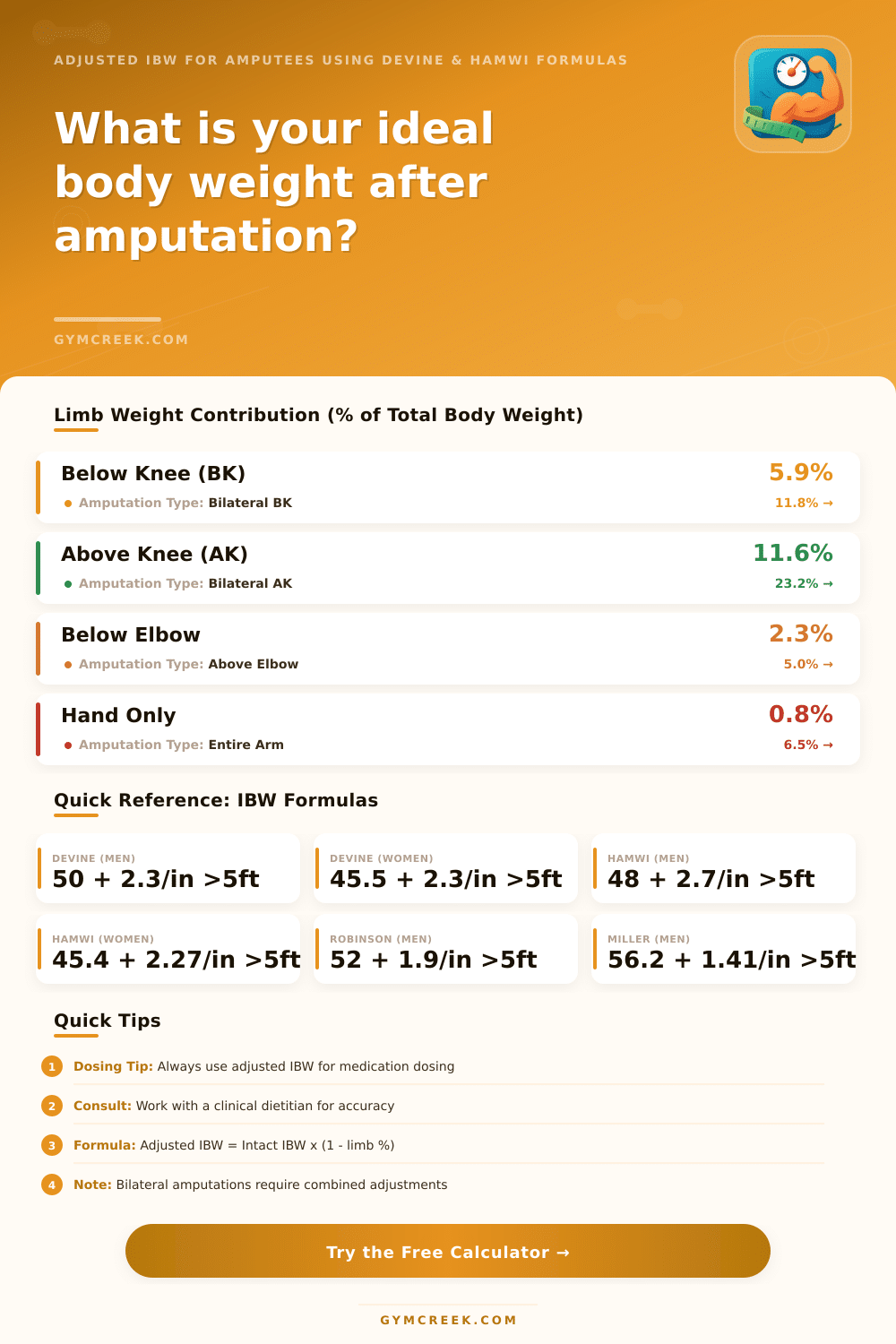
| Below Knee (BK) | 5.9% | Bilateral BK | 11.8% |
| Above Knee (AK) | 11.6% | Bilateral AK | 23.2% |
| Foot Only | 1.8% | Both Feet | 3.6% |
| Below Elbow | 2.3% | Above Elbow | 5.0% |
| Hand Only | 0.8% | Entire Arm | 6.5% |
| Formula | Men (kg) | Women (kg) | Notes |
|---|---|---|---|
| Devine | 50 + 2.3/in >5ft | 45.5 + 2.3/in >5ft | Most widely used |
| Hamwi | 48 + 2.7/in >5ft | 45.4 + 2.27/in >5ft | Common in dietetics |
| Robinson | 52 + 1.9/in >5ft | 49 + 1.7/in >5ft | Often used in pharmacy |
| Miller | 56.2 + 1.41/in >5ft | 53.1 + 1.36/in >5ft | Lower estimates |
Determining one’s ideal body weight are challenging for many individuals. For those who have underwent amputations, the calculation of ideal body weight can be even more challenging due to the loss of one of the body limbs.
An ideal body weight calculator for amputations can help these individuals more better understand there body composition and provide adjusted figures for their ideal body weight.
Healthcare providers calculates ideal body weight for individuals who have undergone amputations in a way that factors in the percentage of the individual’s body weight that their amputated limb contributed.
Most ideal body weight formulas calculates the ideal body weight of an individual without the amputated limb, which can result in an inaccurate reading of that individual’s ideal body weight. These formulas multiply the individual’s ideal body weight by the difference between one and the percentage of their body weight that is represented by their amputated limb.
Professionals use the Devine formula to calculate ideal body weight for those with amputations, although the Hamwi equation can also be utilized in a same way.
Why Ideal Body Weight Calculations Matter for Amputations
Why does knowing this matter? The reason why ideal body weight is calculated for individuals with amputations is due to the way that medications is dosed for these individuals. Many medications is dosed according to ideal body weight, so using the ideal body weight of an individual without accounting for there amputation may lead to the individual receiving an overdose of medication.
Furthermore, nutritional calculations for an individual are based off their ideal body weight; knowing their ideal body weight allows for the calculation of the amount of nutrients that an individual should consume each day. An ideal body weight calculator for individuals with amputations can help to provide these figure for the individual.
These calculations can help individuals who are attempting to regain their fitness after undergoing an amputation. Additionally, the calculator can help individuals with amputations who are seeking to understand their ideal body weight with the prosthetic device that they use. The calculator above can be utilized to calculate an individual’s ideal body weight with an amputation for their height and gender.
It is important to remember that the ideal body weight calculator is only an estimate of an individual’s healthy weight. There are additional factors that contribute to healthy body weight, such as muscle mass, the age of the individual, their level of activity, and the number of amputations that they have endured.
Should an individual have undergone bilateral amputations, the percentage of their body weight that is represented by their amputated limb must be added together prior to calculation. An individual that has suffered from bilateral above-knee amputations, for example, has lost nearly one-quarter of their body weight. This introduces the need for additional considerations in the calculation of their ideal body weight.

The calculation of ideal body weight for individuals with amputations has a fascinating history. Individuals such as Dr. James A. DeLisa performed studies on the body weights of individuals who lost limb, leading to the percentages of body weight that are utilized today. Moddern ideal body weight calculators allow individuals and healthcare professionals to easily calculate adjusted ideal body weight for individuals with amputations.
A nutritionist who works with individuals with amputations may utilize the adjusted ideal body weight to calculate an individual’s body mass index (BMI). A standard BMI calculation may not account for the body weight of individuals who have lost limbs to amputation. Additionally, the BMI may be adjusted for individuals who have undergone an amputation. Furthermore, other factors such as body composition, waist circumference, and strength can be utilized for individuals with amputations rather than the standard calculation of BMI.
Individuals who have recently undergone an amputation can benefit from the care that a physical therapist, a prosthetist, a physician, and a dietitian provide. Each of these professionals may be able to provide an individual with an ideal body weight calculation that considers the effect of the amputation on their body as well as their health in general.
In addition to health benefits of an ideal body weight, those who have undergone an amputation may struggle with body image. An ideal body weight that is factored in the effect of an amputation may allow for these individuals to have better mental health following their amputation.
Though technology has developed to provide individuals with tools to calculate their body composition in ways that may be more personalized to their bodies than ideal body weight calculations based on percentage of body weight lost due to amputation, such calculations are still performed with mathematical methods that are simple to calculate ideal body weight with no technology or tool.
An ideal body weight calculator for individuals with amputations is just one part of a much larger puzzle of healthcare information for these individuals. The information from the calculator should be used to discuss health with an individual’s healthcare providers. Always consult with your medical team prior to making any changes to your diet, exercise, or medications.

Being able to calculate ideal body weight for individuals with amputations allows individuals to have a better understanding of their body composition and healthy weight. These adjustments to ideal body weight calculations help to acknowledge the changes in the body of the individual who has suffered from the loss of one or more of their body’s limb. Whether you are a healthcare provider or an individual who has recently undergone an amputation, an ideal body weight calculator that takes into account the loss of a limb may be of benefit to you.
Determining ideal body weight for individuals who have undergone amputations takes into account the body weight that is represented by the lost limb. The percentage of body weight that is represented by each of the body’s limb has been calculated over the years through the study of cadavers and other methods. These percentages is utilized in the calculation of ideal body weight for individuals with amputations in order to more accurately determine an individual’s healthy body weight.