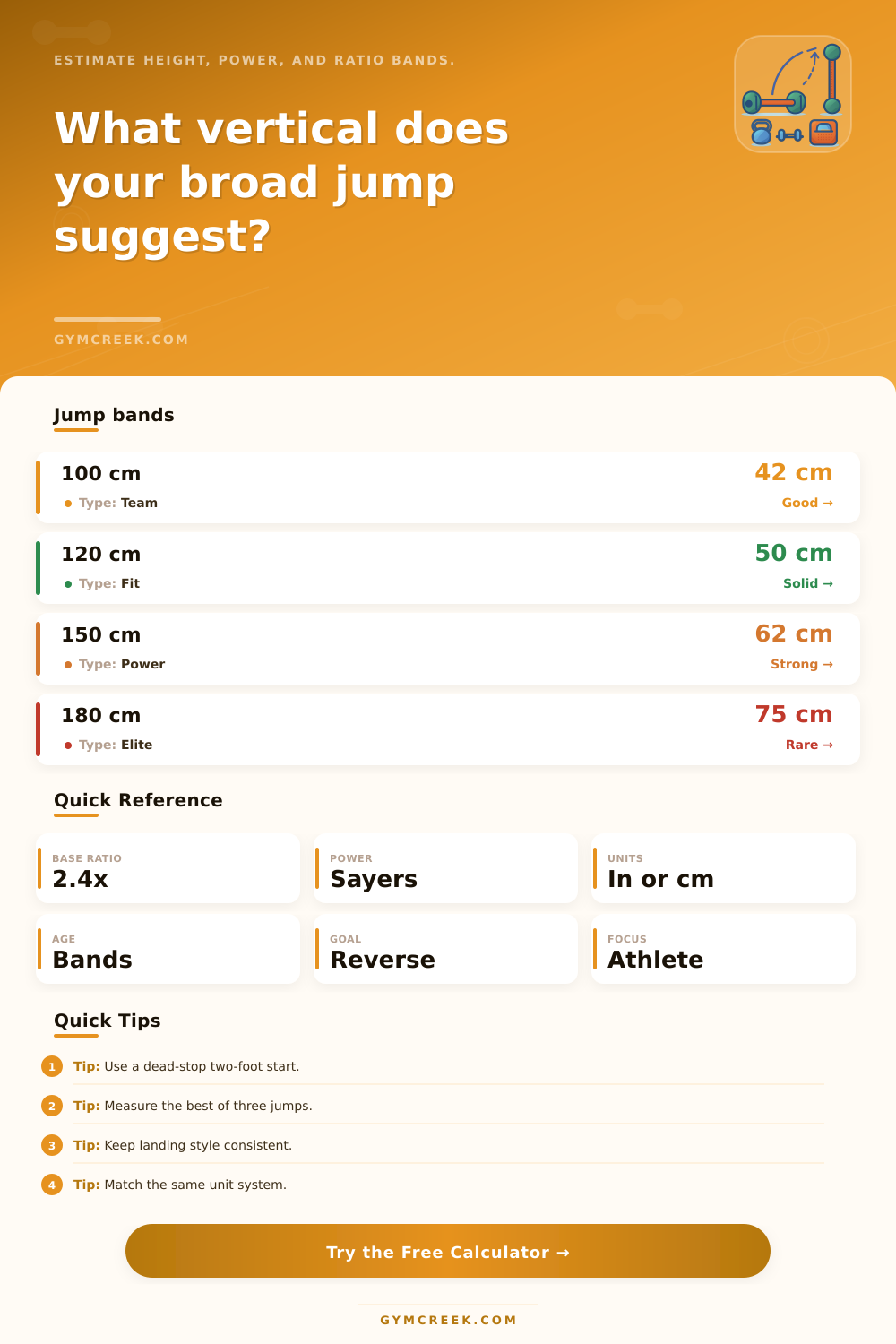
Broad Jump to Vertical Jump Calculator
Estimate standing vertical height from a broad jump, compare athlete bands, and reverse-check the broad jump needed for a target vertical.
📌Presets
Each preset loads a realistic jump profile and refreshes the estimate for a quick coaching-style check.
⚙Jump Conversion Inputs
Broad jump conversion snapshot
Enter a broad jump to estimate the matching vertical jump and target broad jump.
📊At-a-Glance Metrics
📑Reference Tables
| Broad | VJ | Type | Read |
|---|---|---|---|
| 100 cm | 42 cm | Team | Good |
| 120 cm | 50 cm | Fit | Solid |
| 150 cm | 62 cm | Power | Strong |
| 180 cm | 75 cm | Elite | Rare |
| Profile | Ratio | Use | Read |
|---|---|---|---|
| Beginner | 2.78x | Safer | Wide |
| Team | 2.56x | Common | Mixed |
| Balanced | 2.42x | Default | Solid |
| Speed | 2.24x | Fast | Lean |
| Group | Average | Good | Elite |
|---|---|---|---|
| Men | 12-17 | 18-23 | 24+ |
| Women | 9-13 | 14-18 | 19+ |
| Youth M | 10-14 | 15-19 | 20+ |
| Youth F | 8-12 | 13-16 | 17+ |
| Test | Effect | Ratio | Read |
|---|---|---|---|
| Clean | Low spread | -0.00 | Best |
| Average | Normal | +0.04 | OK |
| Rough | More spread | +0.09 | Cautious |
| Fatigued | Largest | +0.13 | Wide |
💡Tips
The broad jump is another measurement of an athlete’s power. The broad jump starts from a static start. A performer has to crouch, swing there arms, and explode forward to land on the ground.
The broad jump measure an athletes lower-body strength. The vertical jump, on the other hand, measure an individual’s upward jump, and it isolates the calf, quad, and glute muscle. The vertical and broad jump are related to each other by a mathematical relationship between the two jump.
How Broad and Vertical Jumps Are Related
The vertical jump is 2.4 times more than the distance of the broad jump. However, this number fluctuate depending on the athlete’s body composition and technique when jumping. An athletes bodyweight will impact the ratio between there vertical jump and there broad jump.
For instance, if an athlete is heavier, they will generate more raw force. However, a resistance of gravity will also impact them during there vertical jump. Because of this, the ratio may mathematicaly favor the broad jump for heavier athletes.
Another factor that will impact the ratio is the athlete’s age. As athletes age, their muscles and tendons in there body change. Young athletes may be less efficient with their movements than athletes in older age groups.
Athletic profiles also play a role in an athlete’s broad jump and vertical jump ratio. For instance, sprinters will have a better ratio between there vertical jump and there broad jump than powerlifters. Technique when performing these jump is also essential for obtaining accurate measurements for both the vertical and broad jump.
An athlete who can perform a good start and land on the ground while fatigued will have a more accurate measurement for both jump. Fatigue can negatively impact an athlete’s performance. For instance, if an athlete performs a jump after a long practice, there muscles may be fatigued and impact there vertical jump height by 10% to 15%.
Coaches often use preset profiles to account for these variable. These profiles allow coaches to compare athletes’ results to the team average. Power output during the vertical jump can be calculated from the height of an athlete’s jump and there body mass.
Power output is measure in watts. Watts indicate an athletes explosive strength. Another calculation that can be performed is relative power output.
Relative power output is the number of watts an athlete can jump per kilogram of there body weight. This calculation is another measurement of power but reveals any imbalance in an athletes body. An athlete with a strong broad jump but low power output may have lost elasticity in there body.
These calculations also allow coaches and athletes to set goals for performance. For instance, if an athlete wants to improve there vertical jump height, calculations will show the distance there broad jump must increase to meet the goal. There are some common mistakes athletes will make when performing these jumps.
Using the distance from the heel to the toe when landing sloppily will inflate an athletes broad jump measurement. Always start from a dead-stop start with both feet, and take the best of three jump. The type of surface athletes jump on can impact the outcome of the vertical jump.
Gym mats will compress more than the track. If athletes use mats, the athletes vertical jump may drop 2 to 3 inches. Lastly, the standard for youth athletes may not be the same as adults.
Ensure that the broad jump and vertical jump standard used to evaluate athletes are appropriate for there age group. An athletes training program should be based off the results of there vertical and broad jump tests. Athletes with a weak ratio between there jumps may be quad-dominant.
If this is the case, they should incorporate exercises that work there posterior chain, such as Nordic curls. Athletes with a strong ratio between there jumps but low power output should incorporate Olympic lift into there training to increase there power output. Additionally, athletes should track there vertical and broad jump ratio over a period of several months.
As there technique improves, there ratio will tighten. This measurement for athletes can identify any weakness in the body and allow athletes to adjust there training accordingly.