Vertical Jump Force Calculator
Estimate jump force from vertical height and contact time, then compare average force, peak force, impulse, and target force.
📌Presets
Each preset loads a realistic athlete profile and refreshes the force math before you calculate.
⚙Force Inputs
Jump force snapshot
Enter jump height, contact time, and bodyweight to estimate force output.
📊Force Metrics
📑Reference Tables
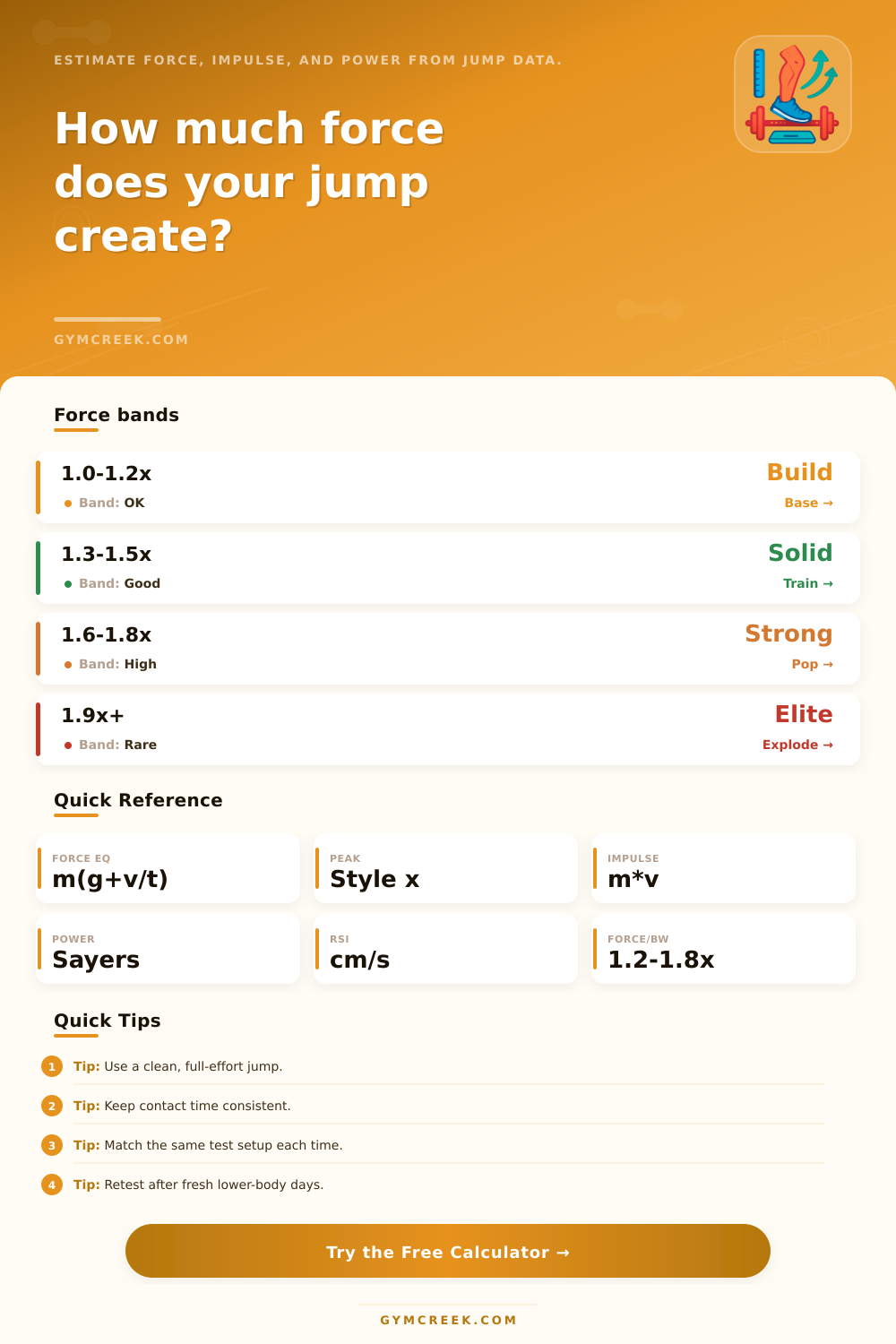
| Force | Jump | Band | Read |
|---|---|---|---|
| 1.0-1.2x | Build | OK | Base |
| 1.3-1.5x | Solid | Good | Train |
| 1.6-1.8x | Strong | High | Pop |
| 1.9x+ | Elite | Rare | Explode |
| Style | Factor | Use | Read |
|---|---|---|---|
| Standing | 1.12x | Base | Pure |
| CMJ | 1.22x | Common | Strong |
| Approach | 1.29x | Sport | Fast |
| Reactive | 1.27x | Quick | Snap |
| Method | Bias | Best fit | Note |
|---|---|---|---|
| Plate | Low | Best | Lab |
| Mat | Tiny | Good | Field |
| Video | Some | Okay | Frames |
| App | More | Check | Retest |
| Formula | Input | Output | Use |
|---|---|---|---|
| v=sqrt | Jump | Speed | Main |
| F=m(g+v/t) | Mass | AvgF | Load |
| Impulse | m*v | N*s | Push |
| Sayers | Jump | Power | W |
💡Tips
Vertical jump force refer to the physical force that a person applies against the ground while jumping. Vertical jump force is important due to the fact that vertical jump force determine how high a person can jump. Besides, a person can use vertical jump force to gain information regarding there level of explosiveness and how to improve their training methods.
In order to jump, a person must push against the ground with more force than the force of gravity pulling the person towards the ground. The net force determines the speed at which a person can take off from the ground, and the speed at which a person can take off from the ground will determine the height of the jump. A person’s body weight is an factor in vertical jump force because a person that weighs more than another person will have to produce more force in order to jump to the same height.
What Is Vertical Jump Force and How to Test It
A person’s contact time with the ground while jumping is also a factor in vertical jump force. Contact time is the length of time that a person’s feet is in contact with the ground while jumping. The shorter the contact time of a jump, the more efficient is that person in jump.
However, the longer the contact time of a jump, the more that person relies upon their strength as opposed to their jumping speed. Many people that focus on vertical jump force only measure the height of jumps made by individual. However, the force produced by individuals while jumping provides other information about how they jump.
In order to calculate a person’s vertical jump force, the person must first convert the height of their jump into velocity. To calculate velocity meters per second, the following formula can be used: velocity = square root of 2 x gravity x height. Once the person has calculated the velocity, the force can be calculated using the following equation: average force = (mass of the person x gravity x velocity) / contact time.
However, other measurements of vertical jump force exists besides average force. Peak force calculates the vertical jump force of individuals using different jump style. Other measurements include impulse, which calculates the total push that an individual produce over time, and power, which estimates the amount of work that an individual does over a specific period of time.
These measurements allow for individuals to compare their jump force to different band of athleticism. There are several bands of force-to-body weight ratios that can be used to compare an individual’s vertical jump force. For instance, a ratio between 1.0 and 1.2 times of the body weight of the individual represents the base level of force that an average person possesses.
A force-to-body weight ratio between 1.3 and 1.5 times the body weight of an individual represent the athleticism of solid athletes, as these athletes are common among High School and College athletes. A ratio between 1.6 and 1.8 times the body weight of an individual represents a strong athlete, as individuals with such force are active in sports like volleyball and football. A ratio above 1.9 times the body weight of an individual represent the athleticism of an elite athlete, as these athletes are professional player in their sports.
Strength athletes can produce a great deal of force, but use a long contact time to produce their jumps. Reactive athletes produce less force, but utilize their muscles rapid to produce high jumps with a short contact time. There are different methods for testing vertical jump force.
For instance, contact mats can provide accurate measurements of an individual’s vertical jump force. However, measurements from phone applications will introduce more variability in the measurement of vertical jump force. To ensure that an individual’s vertical jump force measurements are accurate, they should always be tested under the same condition.
Additionally, an individual should jump at various times during the day, but should always test while fresh. This is because performing jumping tests following lifting session will result in decreased force production by the individual due to fatigue. Additionally, other factors can affect vertical jump force measurements, such as arm swings.
Arm swings can increase the peak force that an individual creates with jumping. Therefore, an individual must determine whether or not they will incorporate arm swings into vertical jump test. An individual should always test on the same surface and with the same level of effort.
Another measurement of vertical jump force is the Reactive Strength Index, or RSI. The RSI is calculated by dividing a person’s jump height by their contact time. RSI is a measurement of the speed at which an individual can jump.
Additionally, high jump power is useful for sports that require individuals to jump in different direction from the direction that they jumped from. High jump power compared to squat strength indicates any mobility issues that an individual has. Many people make mistakes when measuring or improving their vertical jump force.
For instance, some individuals focus solely upon the jump height that they are able to produce. An individual that weighs less will jump higher than an individual that weighs more. A lightweight athlete may be able to jump 40 inches high while an athlete that weighs more may only jump 24 inches high.
However, the heavier individual may produce more force than the lighter individual. Additionally, many individuals dont measure their contact time. An individual with a long contact time may be strong but not fast with their jumping ability.
In this case, they may benefit from performing hypertrophy exercises. An individual with a short contact time can jump quick but may not be as strong as another individual. In this case, plyometric exercises will benefit that individual more.
An individual should base their training upon their force-to-body weight ratio. For instance, individuals within the ratio of 1.0 to 1.2 times their body weight should perform exercises such as squats and dead lifts three times each week. Individuals within the ratio of 1.3 to 1.5 times their body weight should incorporate depth jumps and bounds into their training.
Reactive drills, such as hurdle hops should be performed by individuals whose force-to-body weight ratios falls within the strong range of 1.6 to 1.8 times their body weight. Additionally, individuals whose ratio is above 1.9 times their body weight should use sport-specific loads in their training to maintain their elite strength. The strength of individuals may decrease as they age, so those individuals over the age of 30 should incorporate specific exercises to maintain their strength.
Rather than measuring vertical jump force by a single measurement, trends over time should be used to gauge the changes in an individual’s vertical jump force. By tracking their vertical jump force, individuals can spot any regression in their jumping abilities. Additionally, data on an individual’s vertical jump force will allow the individual to make better decisions in their training.
Therefore, tracking an individual’s vertical jump force will allow those individuals to turn a physical phenomenon into a systematic process for improving their jumping abilities.