🏋 Q-Points Calculator for Weightlifting
Compare meet totals across bodyweights with the published men and women Q-points curves.
| Sex | Floor | Scale | Curve and Use |
|---|---|---|---|
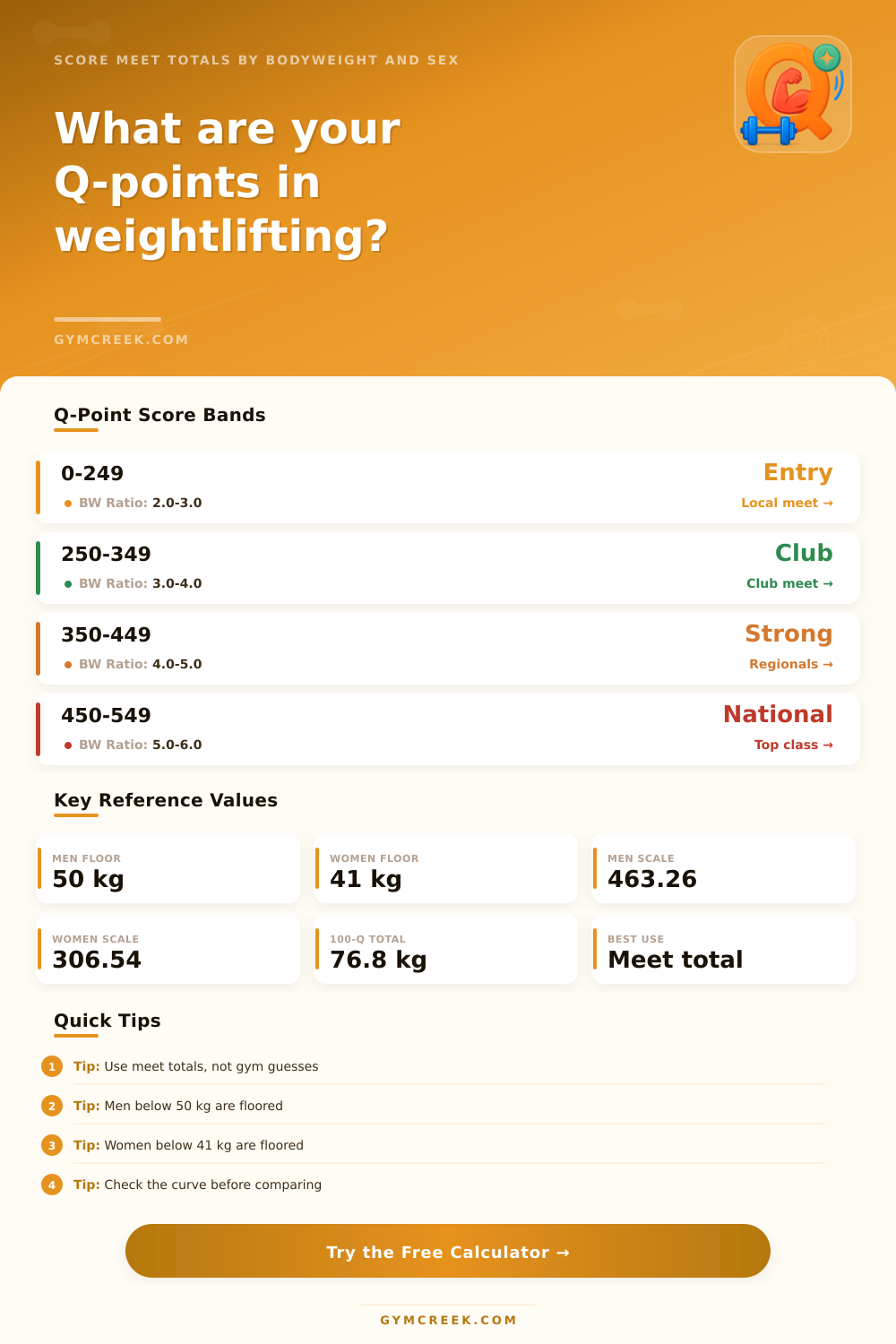
| Male | 50 kg | 463.26 | T x 463.26 / (416.70 - 47.87*b^-2 + 18.93*b^2), b = BW/100 |
| Female | 41 kg | 306.54 | T x 306.54 / (266.50 - 19.44*b^-2 + 18.61*b^2), b = BW/100 |
| Bodyweight input | Enter the athlete's bodyweight in kilograms or pounds. The calculator converts to kg before scoring. | ||
| Total input | Use the meet total if you have it. If blank, snatch + clean & jerk becomes the total used in the score. | ||
| Q-points | Level | Typical Ratio | Meet Read |
|---|---|---|---|
| 0-249 | Entry | 2.0-3.0 | First comp or rebuild phase |
| 250-349 | Club | 3.0-4.0 | Local podium range |
| 350-449 | Strong | 4.0-5.0 | Regional contender |
| 450-549 | National | 5.0-6.0 | High national score |
| 550+ | Elite | 6.0+ | Top class total |
| BW kg | Men 100-Q | Women 100-Q | Note |
|---|---|---|---|
| 50 | 49.6 | 63.1 | Men floor; women valid |
| 60 | 62.7 | 71.5 | Middle class anchor |
| 80 | 76.4 | 80.9 | Big-total reference |
| 100 | 83.7 | 86.7 | Superheavy range |
| Preset | Total | Q-points | Takeaway |
|---|---|---|---|
| 41 kg Feather Woman | 112 | 223.0 | Floor check example |
| 59 kg Junior Woman | 178 | 251.3 | Club-ready total |
| 73 kg Club Man | 284 | 390.5 | Regional strength |
| 89 kg Open Man | 327 | 408.0 | National class pace |
Q-points form a model for compare weightlifting results. They consider body size, so you can do fair comparisons. In weightlifting you estimate performance according to the total weight that you lift.
That amount comes from the best from three attempts for snatch, plus the best clean and jerk from three attempts. The Q-points scale those totals according to body size. So they stay steady through various weight categories.
Q-points: a fair way to compare weightlifters
The Q-points system comes from tested formulas. It applies statistical quantile regression… That is where the name comes from.
That method strongly resists extremes. It already successfully operates with weightlifting data. The system solves problems that others have, as Sinclair and Robi points.
While those depend on world records, Q-points base on results of Olympics and IWF Championships. Like this it makes Q-points more reliable than the old formats. Sinclair points favor certain body sizes, but Q-points operate otherwise.
There is version called Q-Masters. It scales totals for master athletes, considering body size and age. That counts for folks of 30 years upward.
Q-points calculator quickly estimates weightlifting score. The free tool helps to compare categories and trace progress, what improves training. There is website with explanations and Excel formula.
Group with Dr Marianne Huebner, David Meltzer, Asgeir Bjarnason and Aris Perperoglou issued papers about the work. The paper describes the method, compare Q-points with Sinclair and mention flaws of Robi points.
The British Masters Championships use a qualification system. Since March 14th 2025, BWL issued Q-Points for British Masters Leagues. That shows, as you apply the system in contests.
The method comes from USA work in United States, especially of statisticians. Using those points, you can scale totals according to body size, for fairly estimate lifters across weight categories.