🏃 VO2 Max Percentile Calculator
Estimate your cardio fitness level and see where you rank for your age & gender
| Age Group | Very Poor (<20th) | Poor (20–39th) | Fair (40–59th) | Good (60–79th) | Excellent (80–89th) | Superior (>90th) |
|---|---|---|---|---|---|---|
| 13–19 | <35.0 | 35.0–38.3 | 38.4–45.1 | 45.2–50.9 | 51.0–55.9 | ≥56.0 |
| 20–29 | <33.0 | 33.0–36.4 | 36.5–42.4 | 42.5–46.4 | 46.5–52.4 | ≥52.5 |
| 30–39 | <31.5 | 31.5–35.4 | 35.5–40.9 | 41.0–44.9 | 45.0–49.4 | ≥49.5 |
| 40–49 | <30.2 | 30.2–33.5 | 33.6–38.9 | 39.0–43.7 | 43.8–48.0 | ≥48.1 |
| 50–59 | <26.1 | 26.1–30.9 | 31.0–35.7 | 35.8–40.9 | 41.0–45.3 | ≥45.4 |
| 60–69 | <20.5 | 20.5–26.0 | 26.1–32.2 | 32.3–36.4 | 36.5–44.2 | ≥44.3 |
| 70+ | <17.5 | 17.5–22.7 | 22.8–28.7 | 28.8–35.0 | 35.1–40.0 | ≥40.1 |
| Age Group | Very Poor (<20th) | Poor (20–39th) | Fair (40–59th) | Good (60–79th) | Excellent (80–89th) | Superior (>90th) |
|---|---|---|---|---|---|---|
| 13–19 | <25.0 | 25.0–30.9 | 31.0–34.9 | 35.0–38.9 | 39.0–41.9 | ≥42.0 |
| 20–29 | <23.6 | 23.6–28.9 | 29.0–32.9 | 33.0–36.9 | 37.0–41.0 | ≥41.1 |
| 30–39 | <22.8 | 22.8–26.9 | 27.0–31.4 | 31.5–35.6 | 35.7–40.0 | ≥40.1 |
| 40–49 | <21.0 | 21.0–24.4 | 24.5–28.9 | 29.0–32.8 | 32.9–36.9 | ≥37.0 |
| 50–59 | <20.2 | 20.2–22.7 | 22.8–26.9 | 27.0–31.4 | 31.5–35.7 | ≥35.8 |
| 60–69 | <17.5 | 17.5–20.1 | 20.2–24.4 | 24.5–30.2 | 30.3–31.4 | ≥31.5 |
| 70+ | <15.0 | 15.0–18.0 | 18.1–22.0 | 22.1–27.0 | 27.1–31.5 | ≥31.6 |
| Sport / Activity | Male Range (ml/kg/min) | Female Range (ml/kg/min) | Notes |
|---|---|---|---|
| Elite Marathon Runner | 70–85 | 60–75 | Sub-2:10 marathoners often >80 |
| Elite Cyclist (Road) | 75–90 | 65–80 | Grand Tour contenders often >85 |
| Elite Cross-Country Skier | 80–96 | 68–78 | Highest recorded sport averages |
| Elite Rower | 65–80 | 55–70 | Upper body component lowers relative score |
| Elite Triathlete | 68–82 | 58–72 | Ironman vs. sprint distance varies |
| Recreational Runner | 45–55 | 38–48 | Training 3–4 days/week |
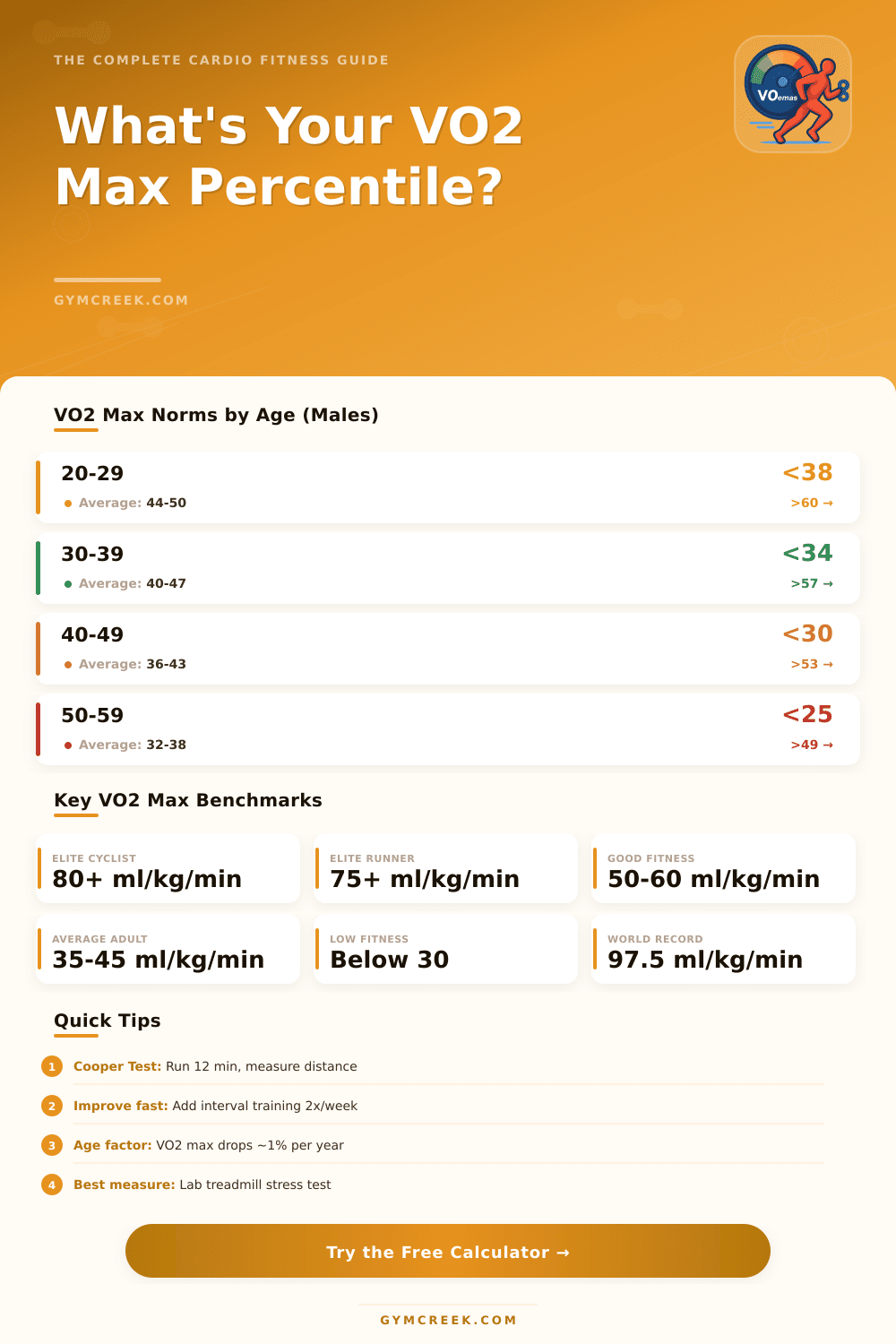
| Average Sedentary Adult | 30–40 | 25–35 | No structured aerobic training |
| World Record (Espen H. Bjerke) | 97.5 | — | Highest ever recorded VO2 max |
VO2 max estimates how much oxygen your body truly fits to use, when you work hard during physical activity. It gives reliable sight to your level of aerobic fitness. Usually one measures that value according to body weight so that one can fairly compare the fitness of one person with that of another.
DISCLOSURE: This post may contain affiliate links, meaning when you click the links and make a purchase, I receive a commission. As an Amazon Associate I earn from qualifying purchases.

Even so, age and gender play big role, what one considers good, changes a lot according to your place in those groups.
What VO2 Max Tells You About Your Fitness
The ranking of VO2 max in percentiles shows, how your value compares with folks of same age and gender. For counting it, one requires three data: your age, fresh VO2 max value from a maximum exercise test and your gender. The tool then compares it with your same age group and gives the percentile ranking.
For instance, a 44-year-old casual man with 45 mL/kg/min would reach around the 75th percentile for his group.
Healthy men on average reach between 40 and 50 mL/kg/min. Women most commonly fall in the range of 30 to 40. Top sportsmen beat those values a lot, which shows how hard they train.
For men in there twenties, reaching 45 or more is good achievement. Same age women aim at least 40.
There are standard leagues for explaining all that. “Intermediate” marks the bottom-middle zone for your age. “Good” shows that you are at the normal level.
“Excellent” puts you clearly above the average. “Superb” is almost the 95th percentile, truly the highest group. There is no universal magic number, but aiming at least the 60th percentile or higher is good goal to follow.
The ACSM gives leagues of percentiles for tested VO2 max, in 7-percent steps through age groups from the thirties to the eighties. The FRIEND study adds another league with basic reference values from walking test data. Some want even more detailed info…
For instance, what it takes to reach the top 4, 3, 2 or 1 percent for their age and gender. But really, that detail is hard to find.
Here the main point: you do not need a lab to estimate VO2 max. Various simple tests can give rough numbers… The Beep test, Bruce protocol, Rockport test or calculations from heart rate all work. Even your resting heart rate can be a rough reference.
Those methods help well for starting the journey and tracking progress, before spending money for a real lab test with mask.
VO2 max naturally drops when you age, but regular training can slow that process. Range the intensity of your exercises. For folks starting from the bottom 25 percent, thirty minutes of activity at 60 to 70 percent of maximum heart rate, three to five times weekly, can raise the level.
Weight training also matters. Men and women differ mainly because of bigger amount of lean muscle in men, there comes the gap in ability. Apps likeGarmin even show your VO2 max percentile according to age and gender directly on the phone.