🏋 NASM One Rep Max Calculator
Estimate your true 1RM using the Epley formula and get NASM-aligned training zone breakdowns
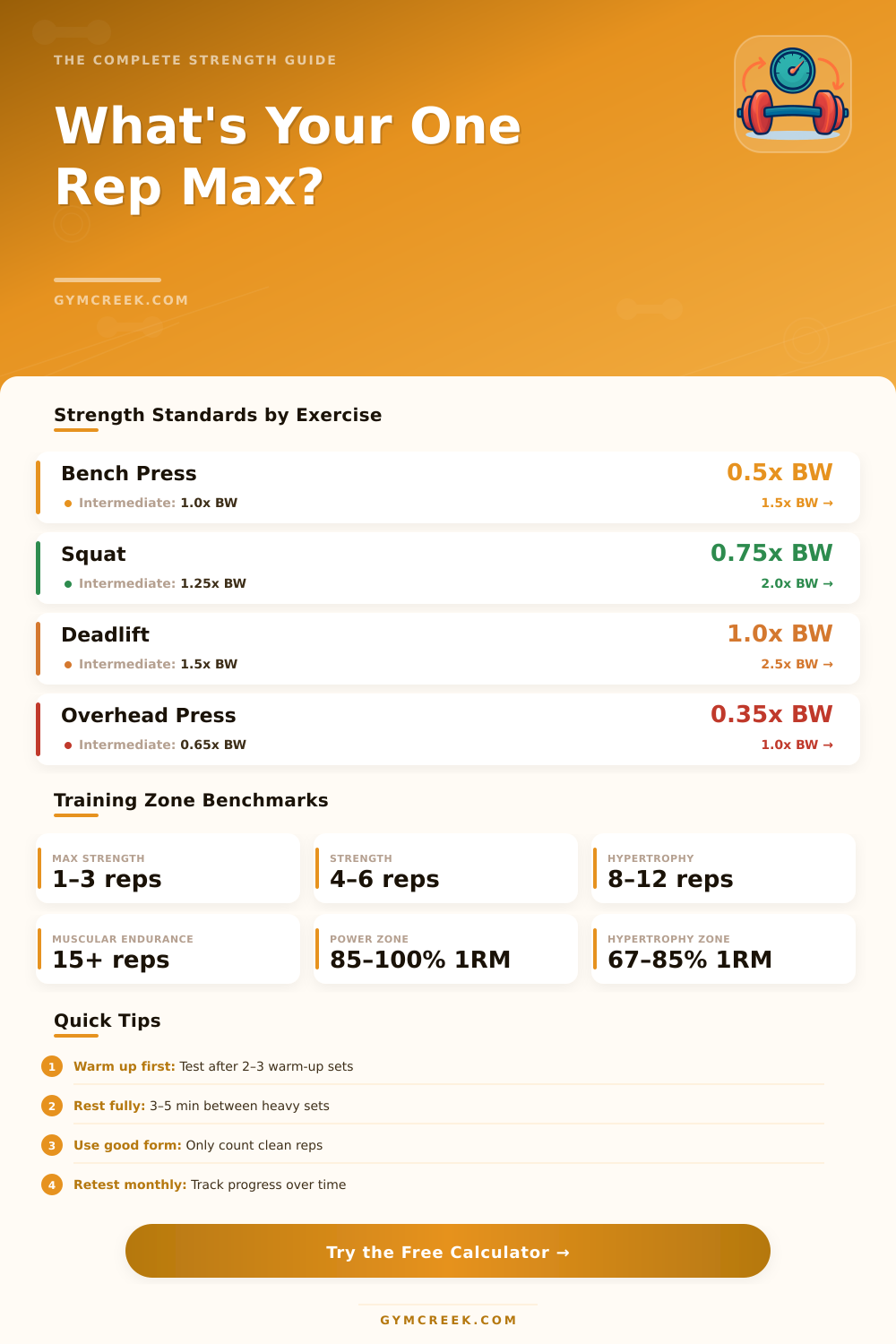
| Exercise | Beginner | Intermediate | Advanced | Elite |
|---|---|---|---|---|
| Bench Press | 0.5x BW | 1.0x BW | 1.5x BW | 2.0x BW |
| Back Squat | 0.75x BW | 1.25x BW | 2.0x BW | 2.5x BW |
| Deadlift | 1.0x BW | 1.5x BW | 2.5x BW | 3.0x BW |
| Overhead Press | 0.35x BW | 0.65x BW | 1.0x BW | 1.3x BW |
| Barbell Row | 0.5x BW | 0.9x BW | 1.3x BW | 1.7x BW |
| Front Squat | 0.6x BW | 1.0x BW | 1.6x BW | 2.0x BW |
| Power Clean | 0.5x BW | 0.85x BW | 1.2x BW | 1.5x BW |
| Incline Bench | 0.4x BW | 0.75x BW | 1.2x BW | 1.6x BW |
| Reps | % of 1RM | Training Goal | Rest Period |
|---|---|---|---|
| 1 | 100% | True Max Test | 3–5 min |
| 2 | 97% | Max Strength | 3–5 min |
| 3 | 94% | Max Strength | 3–5 min |
| 4 | 91% | Strength | 2–4 min |
| 5 | 87% | Strength | 2–4 min |
| 6 | 85% | Strength / Power | 2–3 min |
| 8 | 80% | Hypertrophy | 60–90 sec |
| 10 | 75% | Hypertrophy | 60–90 sec |
| 12 | 70% | Hypertrophy / Endurance | 45–75 sec |
| 15 | 65% | Muscular Endurance | 30–60 sec |
| 20 | 55% | Muscular Endurance | 30–45 sec |
| Phase | Sets | Reps | % 1RM |
|---|---|---|---|
| Phase 1: Stabilization Endurance | 1–3 | 12–20 | 50–70% |
| Phase 2: Strength Endurance | 2–4 | 8–12 | 70–80% |
| Phase 3: Muscular Development | 3–5 | 6–12 | 75–85% |
| Phase 4: Maximal Strength | 4–6 | 1–5 | 85–100% |
| Phase 5: Power | 3–6 | 1–10 | 30–45% (explosive) |
- Warm up with 5–10 min light cardio
- Perform 2–3 progressive warm-up sets (50%, 70%, 85% of expected max)
- Choose a weight you can lift for 3–5 clean reps
- Rest 3–5 minutes between heavy sets
- Record only reps with full range of motion and good form
DISCLOSURE: This post may contain affiliate links, meaning when you click the links and make a purchase, I receive a commission. As an Amazon Associate I earn from qualifying purchases.

The One Rep Max, or 1RM, if you like the term, simply shows the biggest weight that you can lift for one single rep, while you keep right form. It marks the absolute upper limit, where you push yourself to full effort for one pure rep. Whether you talk about squats, bench press, deadlifts or any exercise with a barbell, that idea works everywhere equally.
The One Rep Max is used most commonly for big movements with a barbell, like deadlifts, bench press and squats, instead of for smaller exercises like bicep curls. The main benefit of its calculation is showing where your real strength sits, so, what weight you could move for one rep, if everything would go perfectly.
How to Find Your One Rep Max Safely
But here the problem: truly testing your One Rep Max is not something to gamble with. You will have to change your training some days to a week before, dropping the weight and the volume so that your body rests. That is called deloading, and it is important.
During the testing you work right at the limits of failure, where your technique commonly fails and injuries can happen. After that? Expect to feel quite a lot tired for some days.
You will find yourself with more lightwegiht loads or fewer reps during the rest.
The good news is, that you do not necessarily need to test your real maximum, if you do not want. Calculators for One Rep Max can estimate it based on the reps that you already did with less heavy load. Those ratings best work when you work between one and ten reps.
There are several formulas, Brzycki, Epley and Wendler among the main ones. The formula of Wendler goes like this: take the weight that you lifted, multiply it buy the reps, multiply that by 0.0333, then add your original weight.
If you build a solid five rep max for your main lifts, that gives you good sign about your One Rep Max also. Strength is mainly because of the nervous system, so you must stay at reps around six or less, with load around 85 percent of your 1RM and pauses between sets of three to five minutes. Many training programs need you to work from percentages of your maximum (for instance 70 percent)…
So that you know what weight toput on the barbell.
Your One Rep Max is not set forever. It changes from day to day based on the quality of your sleep and how well you rested after last sessions. Movements that involve more muscles.
Like squats compared to curls, allow you to reach more reps at the same percentage. If you are new to lifting, it matters much more to perfect the technique than to chase heavy single reps. Always testing maxima is not wise, because your central nervous system needs two to three weeks to fully rest after a real maximum attempt.
First build your base, then test when you truly want that, and it only makes more sense.