Hexagon Agility Test Calculator
Score clockwise and counter-clockwise trials, normalize the result to the standard 66 cm course, and see how your agility compares with sport-ready bands.
📌Preset Scenarios
Each preset loads a realistic athlete profile, fills both directional trial pairs, and immediately refreshes the score.
⚙Test Inputs
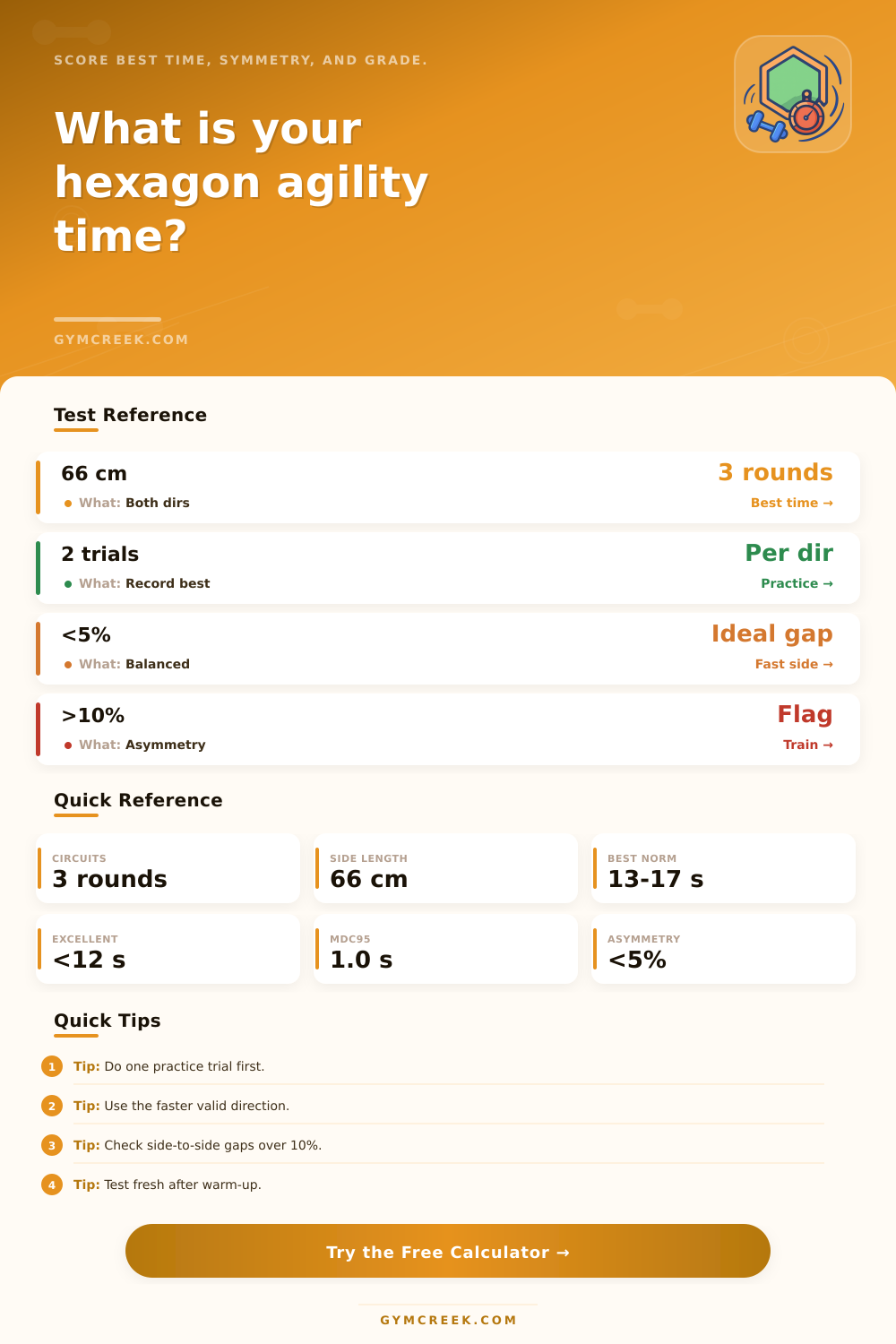
Enter both directions when you can. The calculator uses your best valid time per direction, then standardizes the score back to a 66 cm hexagon and 3 circuits.
Hexagon agility snapshot
Enter your trials to see the best score, age-adjusted grade, directional symmetry, and sport-fit estimate.
📊Fitness Metrics
📑Reference Tables
| Step | Standard | Why it matters | Watch for |
|---|---|---|---|
| Course | 66 cm sides | Matches common norms | Keep corners exact |
| Trial count | 2 per dir | Reduces noise | Use the best valid time |
| Score basis | 3 circuits | Official benchmark | Use equal circuit count |
| Direction | Both ways | Shows symmetry | Track dominant side bias |
| Group | Excellent | Good | Fair / Poor |
|---|---|---|---|
| Male 16-19 | <11.2 | 11.2-13.3 | 13.4-17.8+ |
| Female 16-19 | <12.2 | 12.2-14.3 | 14.4-18.8+ |
| Under 16 | -0.6 s adj. | Same shape | Coach watch |
| 20+ | +0.3 to +1.8 | Age offset | Compare with care |
| Gap | Meaning | Score impact | Action |
|---|---|---|---|
| <5% | Very balanced | Minimal | Maintain |
| 5-9% | Mild bias | Small | Train both ways |
| 10-14% | Clear bias | Moderate | Add weaker-side reps |
| 15%+ | Large gap | High | Review mechanics |
| Sport | Target time | Asym tol. | Movement emphasis |
|---|---|---|---|
| Tennis | 12-13 s | <5% | Rapid reruns |
| Soccer | 13-14 s | <7% | Cut and recover |
| Basketball | 13-14 s | <7% | Short bursts |
| General fitness | 14-16 s | <8% | Balanced control |
💡Tips
Always record a practice trial first.
Use the faster valid direction for rank.
Keep asymmetry under 10% when possible.
Retest fresh after warm-up and rest.
The hexagon agility tests is used to measure agility. Agility, in general, is the ability of an individual to redirect there body quick. Similarly, requiring that individuals move around a marked hexagon shape tests the ability to change the direction of an individuals body.
Furthermore, sports laboratories have used the test since the 1990s, and is a simple test that can reveal any weakness in an individual’s movements. The test requires that an individual stand within the center of a hexagon that has sides of approximately two foot in length. Furthermore, the individual is to move around the perimeter of the hexagon by performing side shuffle and pivots.
How to Do the Hexagon Agility Test
Each individual can move around the hexagon in either a clockwise or counter clockwise direction. This test does not measure an individual’s top running speed, but it does help to measure the individual’s change of direction efficiency, a critical component of sports like soccer, tennis, and hockey. The most common standard for the test is for the sides of the hexagon to be 66 centimeter in length.
Each individual are to perform three circuit in one direction around the hexagon, and perform two trials in the opposite direction. Each side of 66 centimeters in length force the individuals to make tight turns, which challenges the individuals hip control and ankle stability. Additionally, the performance of multiple circuits allow for the assessment of an individual’s fatigue.
Professional athletes can typically perform the test in between 12 and 17 seconds. However, the time for each individual to complete the test can vary with the size of the hexagon and the number of loop performed by that individual. It is recommended that each individual perform the test in both directions.
By performing the test in both directions, you can test the symmetry of an individuals movements. Symmetry is the state of being equal in relation to each side of the body. In contrast, asymmetry is the state of having one side of the body perform better then the other.
Therefore, if an individual takes significantly less time to complete the circuit in one direction than the other, they have an asymmet
Before you begin the test, warm up your muscles. Perform a practice trial of the test before you perform the actual test. Begin the test by standing tall in the center of the hexagon.
Keep your arms loose during the test. If you lose your balance or step on the lines of the hexagon, restart the trial. Record your time to the hundredth of a second.
Perform the test after warming up but before performing heavy lifting. There are several common mistake that a person can make while performing the test. For instance, a person may rush the first circuit of the test; when a person rushes the first circuit, they tend to perform more slow on the remaining circuits.
A person may also overstride on some of the turns of the test; instead, a person should stay as low as possible while shuffling tight on the court. A person should not ignore the non-dominant side of the court, as ignoring it can cause lopsided power from the leg. Additionally, taller individuals may benefit from lowering their center of gravity during the test; leaner individuals may find it easier to perform the pivots on the court required for the test.
Depending upon the sport that an individual plays, they can expect different result from performing the test. For instance, tennis players aim to finish the test in 13 seconds or less with very low asymmetry of leg power. Soccer midfielder aim for between 13 and 14 seconds.
Basketball player aim for times similar to soccer midfielder, while hockey and martial arts players aim to complete the test in under 13 seconds. Choose a focus in your training with this test to determine whether your agility is sufficient for your sport. Novices aim for 15 seconds or more to complete the test; elite athlete aim for 12 seconds.
Based off the tests result, training program can be created for that individual. For instance, if asymmetry of leg power is identified as 12%, the athlete should incorporate plyometric ladder drill into their training to even out leg strength. If the athlete’s time to complete each circuit varies by half a second, they should incorporate tempo shuffle into their training.
Additionally, other test, such as a vertical jump or a broad jump test, can be performed to provide a more complete picture of the athlete’s physical ability. Finally, the test can be reperformed every four week to assess the athlete’s improvement over time.