🏋 Bench Press Strength Level Calculator
Find your strength level, compare to standards, and discover your next milestone
🏆 Your Bench Press Results
| Level | 132 lb BW | 148 lb BW | 165 lb BW | 181 lb BW | 198 lb BW | 220 lb BW |
|---|---|---|---|---|---|---|
| Beginner | 66 | 75 | 83 | 91 | 100 | 110 |
| Novice | 116 | 132 | 148 | 161 | 174 | 191 |
| Intermediate | 160 | 183 | 205 | 224 | 242 | 264 |
| Advanced | 214 | 244 | 274 | 299 | 323 | 353 |
| Elite | 270 | 309 | 346 | 379 | 409 | 447 |
| Level | 97 lb BW | 110 lb BW | 123 lb BW | 137 lb BW | 148 lb BW | 165 lb BW |
|---|---|---|---|---|---|---|
| Beginner | 34 | 40 | 46 | 51 | 56 | 63 |
| Novice | 58 | 67 | 77 | 86 | 93 | 104 |
| Intermediate | 85 | 99 | 113 | 126 | 136 | 152 |
| Advanced | 116 | 135 | 153 | 171 | 185 | 207 |
| Elite | 152 | 176 | 200 | 223 | 241 | 269 |
| Level | 60 kg BW | 67 kg BW | 75 kg BW | 82 kg BW | 90 kg BW | 100 kg BW |
|---|---|---|---|---|---|---|
| Beginner | 30 | 34 | 38 | 41 | 45 | 50 |
| Novice | 53 | 60 | 67 | 73 | 79 | 87 |
| Intermediate | 73 | 83 | 93 | 102 | 110 | 120 |
| Advanced | 97 | 111 | 124 | 136 | 147 | 160 |
| Elite | 123 | 140 | 157 | 172 | 186 | 203 |
| Level | 44 kg BW | 50 kg BW | 56 kg BW | 62 kg BW | 67 kg BW | 75 kg BW |
|---|---|---|---|---|---|---|
| Beginner | 15 | 18 | 21 | 23 | 25 | 29 |
| Novice | 26 | 30 | 35 | 39 | 42 | 47 |
| Intermediate | 39 | 45 | 51 | 57 | 62 | 69 |
| Advanced | 53 | 61 | 69 | 78 | 84 | 94 |
| Elite | 69 | 80 | 91 | 101 | 109 | 122 |
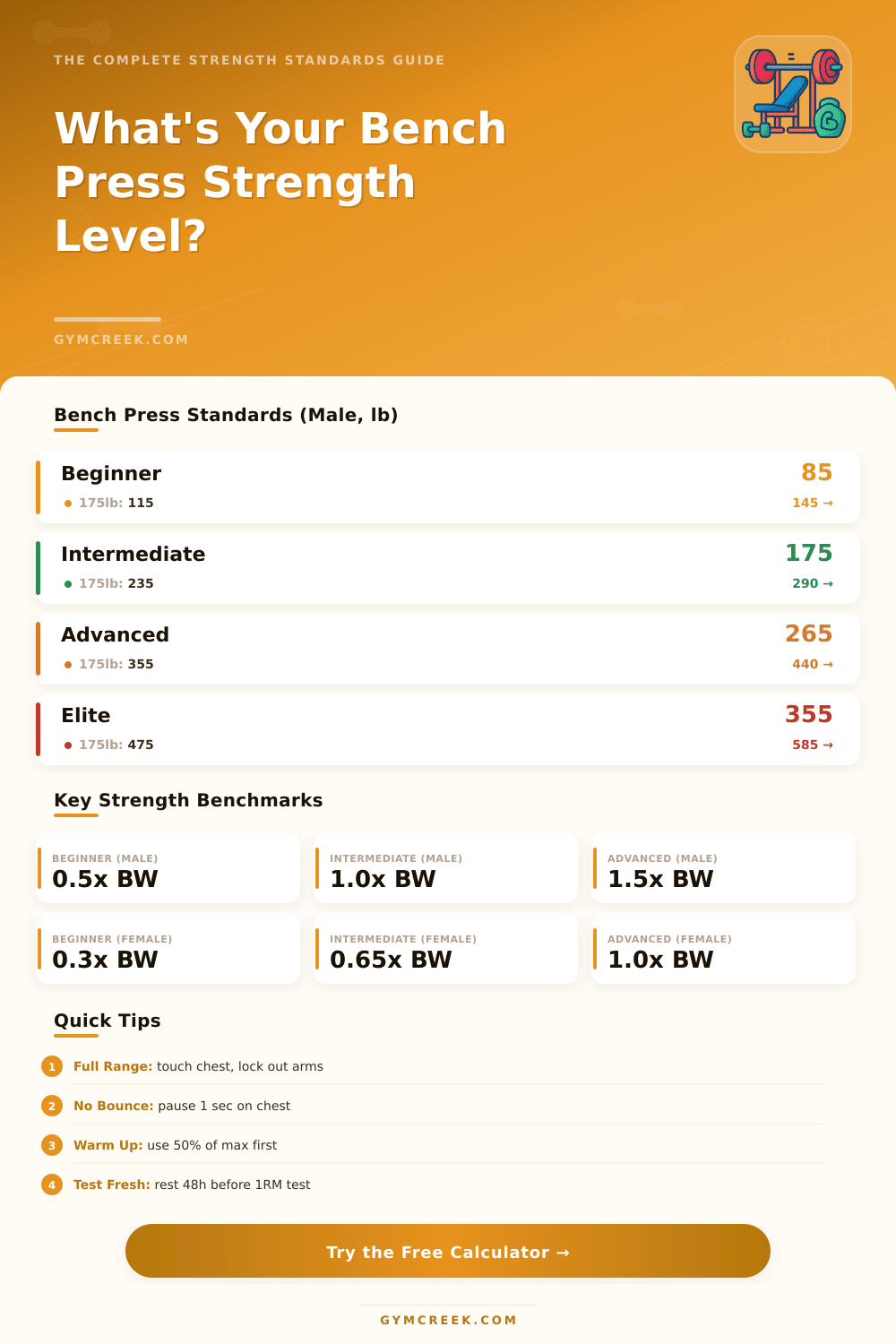
| Level | Male BW Ratio | Female BW Ratio | Description |
|---|---|---|---|
| Beginner | 0.5x BW | 0.3x BW | Less than 6 months training |
| Novice | 0.75x BW | 0.5x BW | 6 months – 1 year training |
| Intermediate | 1.0x BW | 0.65x BW | 1 – 3 years consistent training |
| Advanced | 1.5x BW | 1.0x BW | 3+ years dedicated training |
| Elite | 2.0x BW+ | 1.4x BW+ | Competitive / top 5% of lifters |
| Reps | % of 1RM | Example (225 lb) | Use Case |
|---|---|---|---|
| 1 | 100% | 225 lb | True max test |
| 2 | 97% | 218 lb | Near-max effort |
| 3 | 94% | 212 lb | Strength focus |
| 5 | 87% | 196 lb | Strength-hypertrophy |
| 6 | 85% | 191 lb | Strength-hypertrophy |
| 8 | 80% | 180 lb | Hypertrophy |
| 10 | 75% | 169 lb | Hypertrophy / endurance |
| Age Range | Typical Peak | Strength Factor | Notes |
|---|---|---|---|
| 18 – 25 | Building phase | 0.90 – 1.00 | Near peak potential |
| 26 – 35 | Peak years | 1.00 | Optimal strength period |
| 36 – 45 | Maintaining | 0.95 – 1.00 | Minor decline with training |
| 46 – 55 | Masters I | 0.88 – 0.95 | Standards slightly adjusted |
| 56 – 65 | Masters II | 0.80 – 0.88 | Technique > volume |
| 65+ | Masters III | 0.70 – 0.80 | Maintain with consistent work |
Warm up properly: Start with bar-only, then 50%, 70%, 85%, and finally your max attempt.
Rest fully: Take 3 – 5 minutes between heavy sets.
Use a spotter: Never attempt a true 1RM without a spotter or safety bars.
Proper form: Flat back, feet on floor, full range of motion — touch chest, lockout at top.
Test rested: Do not test 1RM after a hard training session. Rest 48 hours beforehand.
The Bench Press is exercise for Strength, in that one presses weight upward, while one lies on a bench. That move is compound so it works several muscles at the same time. Main muscles involved is the big chest muscle, the front shoulders and the triceps.
DISCLOSURE: This post may contain affiliate links, meaning when you click the links and make a purchase, I receive a commission. As an Amazon Associate I earn from qualifying purchases.

In the process, one lowers the weight until the level of the chest, later one presses it upward while one extends the arms. One can use a barbell or pair of dumbbells.
How to Do the Bench Press
The Bench Press probably works more muscle mass in the upper body than any other exercise for that part. Although it mainly targets the chest, it also trains the shoulders, the triceps and the core. It ranks between the best moves for building muscle and Strength.
Briefly, during the press, the body creates a pushing moment at the elbow, where muscles pull on bones, that work as levers.
Bench Press station forms basic part of gear in every gym. Good training bench deliver firm support and must give solid impression. Between variants are benches of middle beam, olympic weight benches, average weight benches and regular benches.
Form is key. Before lifting the bar, one must arrange himself well. One pulls back and press the shoulder blades, arch the back and use the feet for push against the bench, for help to climb.
Leaving the back and chest loose beside the bottom of the move, that is typical mistake. On the first repetition, one should well hold the wait. Controlled repetitions matter a lot.
Bounce repetitions or push too strongly without control can brake the progress for years.
For train the Bench Press three times weekly with different sets of repetitions and big volume is good strategy. It is possible that one day focus on heavy sets, other day focus on helpful work as incline press and chest flies for two sets of five until eight repetitions, and the third day involves fast heavy training with eight until ten sets of one until three repetitions in about fifty-five until sixty-five percent of the one-rep max, moving the weight as quickly as it is possible. Changing sets, repetitions and weights help the body and beat plates.
Failing in middle of the press commonly show weak shoulders. Failing beside the chest probably point weak chest muscles or back muscles, and adding dumbbell Bench Press with heavier sets can benefit. Moves as JM-presses and skull crushers mostly give better carryover to the Bench Press than triceps pushdowns.
Combine flat bench with incline barbell Bench Press and decline dumbbell Bench Press hit the chest from various directions and train the upper, middle and bottom parts of the chest muscles.
Dumbbells well replace the barbell, but one must expect to raise less weight, because the move is less stable. Stronger chest and triceps from the Bench Press also can makeeasier progress in push-ups and other close exercises.