🏋 Bench Press Warm-Up Calculator
Generate progressive warm-up sets, plate math, and 1RM estimate for your bench press session
| Set | % | Weight | Reps | Plates Per Side |
|---|
| Set | % of Working Weight | Reps | Purpose |
|---|---|---|---|
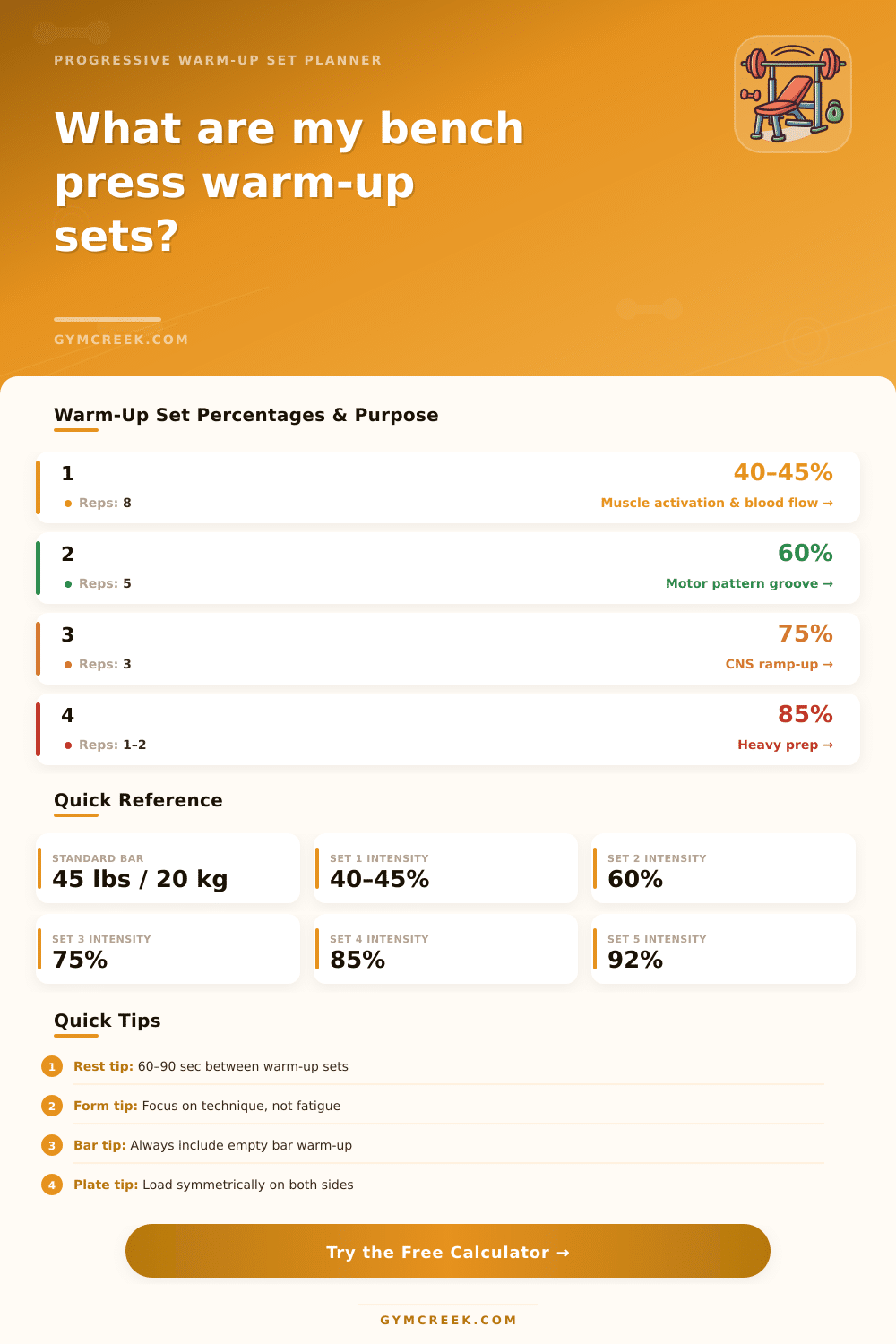
| 1 | 40–45% | 8 | Muscle activation & blood flow |
| 2 | 60% | 5 | Motor pattern groove |
| 3 | 75% | 3 | CNS ramp-up & technique |
| 4 | 85% | 1–2 | Heavy preparation |
| 5 | 92% | 1 | Competition feel (optional) |
| Plate (lbs) | Plate (kg) | Color (standard) | Use |
|---|---|---|---|
| 45 lbs | 20 kg | Blue / Silver | Primary loading |
| 35 lbs | 15 kg | Yellow | Secondary loading |
| 25 lbs | 10 kg | Green | Mid loading |
| 10 lbs | 5 kg | White | Fine adjustment |
| 5 lbs | 2.5 kg | Black | Micro-loading |
| 2.5 lbs | 1.25 kg | Red / Chrome | Fractional loading |
The Bench Press is an exercise for strength training, where you press weight upward while lying on a bench. The move is made up of lowering the weight to chest level and then pushing it upward while extending the arms. You can use a barbell or a pair of dumbbells for this activity.
That exercise is compound. It mainly works the big chest muscle, the front shoulder and the tricep muscles. Also the core engages itself.
Bench Press: How to Do It and Stay Safe
Because it hits many muscles of the upper body at once, it ranks among the most useful for building muscle and strength. Also it is the upper body move where you can raise the biggest weight, so it well builds strength.
In gyms there are usually different kinds of benches. There are flat benches and adjustable benches. They both work for the standard Bench Press.
For versions with incline or decline though, you need an adjustable bench. The benches for training must feel sturdy and stable, because they give a safe base during heavy lifts.
Good form is important. The back must stay pressed, the shoulders drawn together and the feet flat on the floor. The legs push against the bench during the upward push.
Letting the back and chest sag at the bottom of the move is a typical mistake. On the first rep, the weight should be well locked. About foot position, narrower stance and the legs around the bench increase the stability.
Turning the feet out helps also for side balance.
Controlling the weight matters more then raising heavy. Good muscle work comes from lighter weight, done with good form. Skipping reps or using sloppy moves leads to stopped progress.
When the weight can not be handled in a controlled way, better to lower it.
Do the Bench Press three times weekly, with different numbers of reps, works well for progress. Changing the sets, reps and weights is a good way to shock the body to beat plateaus. For muscle growth, ranges of eight to twelve reps each set is a good target.
Moves like overhead presses and JM presses better help Bench Press strength than tricep pushdowns.
Failing in the middle of the press commonly shows weak shoulders. Failing at the chest level points to weak chest or back muscles. Dumbbell work and heavier exercises can help beat that.
Switching the barbell Bench Press with incline and decline versions hits the chest from different directions and works the upper, middle and bottom parts of the chest. A spotter should always be around while you press heavy weights. Having one beside you is helpful, incase something fails.
Better Bench Press strength also is useful for push-ups and other pushing moves.
Warm-up well before every session.