🚶 6-Minute Walk Test VO₂ Max Calculator
Estimate your cardiorespiratory fitness using the validated 6MWT formula
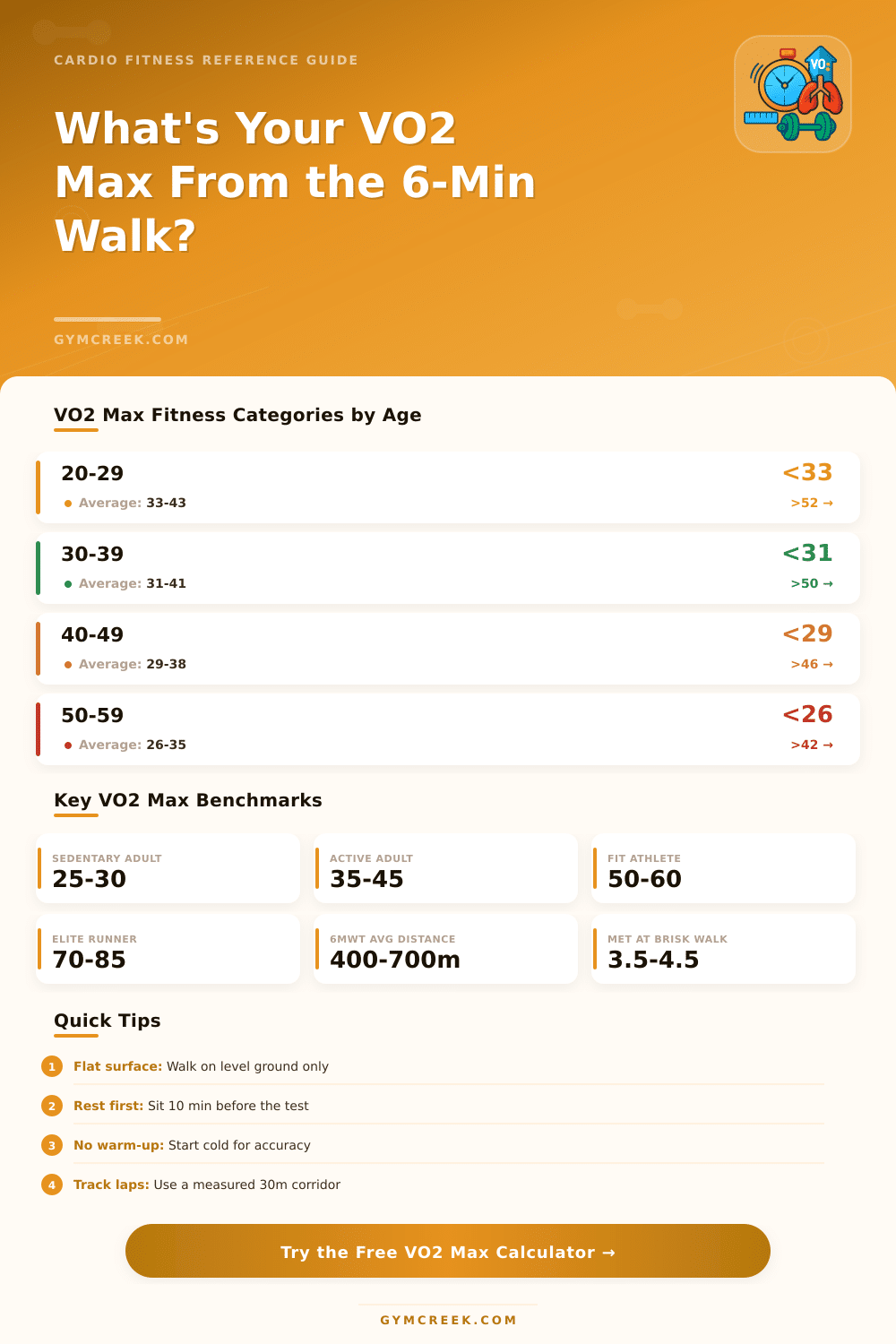
| Age Group | Poor | Fair | Good | Excellent | Superior |
|---|---|---|---|---|---|
| Men 20–29 | < 33 | 33–36 | 37–41 | 42–52 | > 52 |
| Men 30–39 | < 31 | 31–35 | 36–40 | 41–49 | > 49 |
| Men 40–49 | < 30 | 30–33 | 34–38 | 39–47 | > 47 |
| Men 50–59 | < 26 | 26–30 | 31–35 | 36–44 | > 44 |
| Men 60–69 | < 23 | 23–27 | 28–31 | 32–40 | > 40 |
| Women 20–29 | < 28 | 28–31 | 32–36 | 37–46 | > 46 |
| Women 30–39 | < 26 | 26–29 | 30–34 | 35–43 | > 43 |
| Women 40–49 | < 24 | 24–27 | 28–32 | 33–41 | > 41 |
| Women 50–59 | < 22 | 22–25 | 26–30 | 31–38 | > 38 |
| Women 60–69 | < 20 | 20–23 | 24–27 | 28–35 | > 35 |
| Age Group | Men (m) | Men (ft) | Women (m) | Women (ft) |
|---|---|---|---|---|
| 20–29 | 699–762 | 2293–2500 | 648–710 | 2126–2329 |
| 30–39 | 670–744 | 2198–2441 | 620–695 | 2034–2280 |
| 40–49 | 645–710 | 2116–2329 | 590–665 | 1936–2182 |
| 50–59 | 615–680 | 2018–2231 | 556–628 | 1824–2060 |
| 60–69 | 560–640 | 1837–2100 | 510–588 | 1673–1929 |
| 70–79 | 480–560 | 1575–1837 | 440–520 | 1444–1706 |
| 80+ | 380–480 | 1247–1575 | 340–440 | 1115–1444 |
| Formula / Source | Equation Basis | Population Validated | Accuracy |
|---|---|---|---|
| Enright & Sherrill (1998) | Distance, age, weight, height, gender | Healthy adults 40–80 yrs | ± 8–12% |
| Burr et al. (2011) | Distance, resting HR, gender | Cardiac patients | ± 10% |
| Camarri et al. (2006) | Age, gender, height | COPD & elderly | ± 9% |
| Rikli & Jones (2001) | Distance only, 6MWT | Older adults 60–94 yrs | ± 11% |
| ATS Guidelines (2002) | Multi-variable regression | Clinical populations | ± 7–15% |
| Condition | MCID (meters) | MCID (feet) | Clinical Significance |
|---|---|---|---|
| COPD | 25–35 m | 82–115 ft | Meaningful functional improvement |
| Heart Failure | 43–50 m | 141–164 ft | Functional status change |
| Pulmonary Hypertension | 33–41 m | 108–135 ft | Treatment response indicator |
| Post Cardiac Surgery | 30–50 m | 98–164 ft | Recovery benchmark |
| Healthy Older Adults | 20–30 m | 66–98 ft | Fitness change detection |
• Measure walking distance precisely using a calibrated corridor (ideally 30 m marked) or a GPS walking app.
• Wear your usual walking shoes and clothing — no athletic sprint gear.
• Measure resting heart rate in the morning before getting out of bed for best accuracy.
• Re-test under identical conditions every 4–8 weeks to track fitness progress reliably.
VO2 Max is basically the biggest amount of oxygen that your body can take in and use during hard exercise. The word itself breaks down easily: “V” means volume, “O2” means oxygen, and “max” simply means the upper limit. That measure stands at the top of the list for rating aerobic fitness and heart health.
Picture your VO2 Max level as the power of a car in horsepower. It reveals basic info about your skill, namely, how much oxygen you can put to work during a session of exercise. The more oxygen you manage to use in movement the less heavy feels the effort and the more you can keep it up.
What VO2 Max Is and How You Can Improve It
Athletes with high VO2 levels have bodies that simply better take oxygen from the air and move it over to where it is needed.
VO2 Max truly depends on how well your heart pumps blood to the muscles and how well those muscles take oxygen from the flowing blood. When you breathe in oxygen, it joins in a chemical process deep in your muscles that creates the energy for movement. The actual value measures in milligrams of oxygen per kilo of body mass each minute.
The most reliable test is done in a lab. You work at full force on a treadmill, fixed bike or rowing device, wearing a mask or tube linked to a device for oxygen. There is also the Cooper test, in which you run or walk as quickly as it is possible during exactly 12 minutes, and the covered distance gives a notion about your VO2 Max.
Fitness watches and smart clocks also try to estimate it. They consider your weight, the distance that you cover and your speed, to estimate the energy that your body must use for movement, then compare that with your pulse. The idea is quite simple: lower pulse for the same task points to better level.
Do not hope that those tools are fully precise, but they help to have a general notion of your place.
When your VO2 Max grows, usually your resting pulse drops. At exercises of same intensity, you will find that your usual heart rhythm is lower. Training with high interval intensity best helps to expand VO2 Max. The ideal interval rounds range from one to six minutes, with almost equal parts of active work and rest.
Varying the intensity of your sessions also improves the results.
Genetics play a big role hear. The upper VO2 levels commonly show up among Nordic cross-country skiers, then come elite marathon runners and Olympic cyclists. The hard part is that VO2 Max can quickly grow, but also quickly disappear.
Too much push in VO2 training can lead to overload.
VO2 Max matters for performance in long-range sports, of course, but it is only one part of a bigger picture. Aerobic threshold and lactate threshold setting are better measures for predicting your actual performance. Maximum pulse drops an average of 0.6 to 0.8 beats each year as you age.
What is hopeful is that older adults who were inactive can expand their VO2 Max by around 20 percent after nine months to a year ofregular training.