🏃 Threshold Running Pace Calculator
Find your lactate threshold pace & all training zones from a recent race time
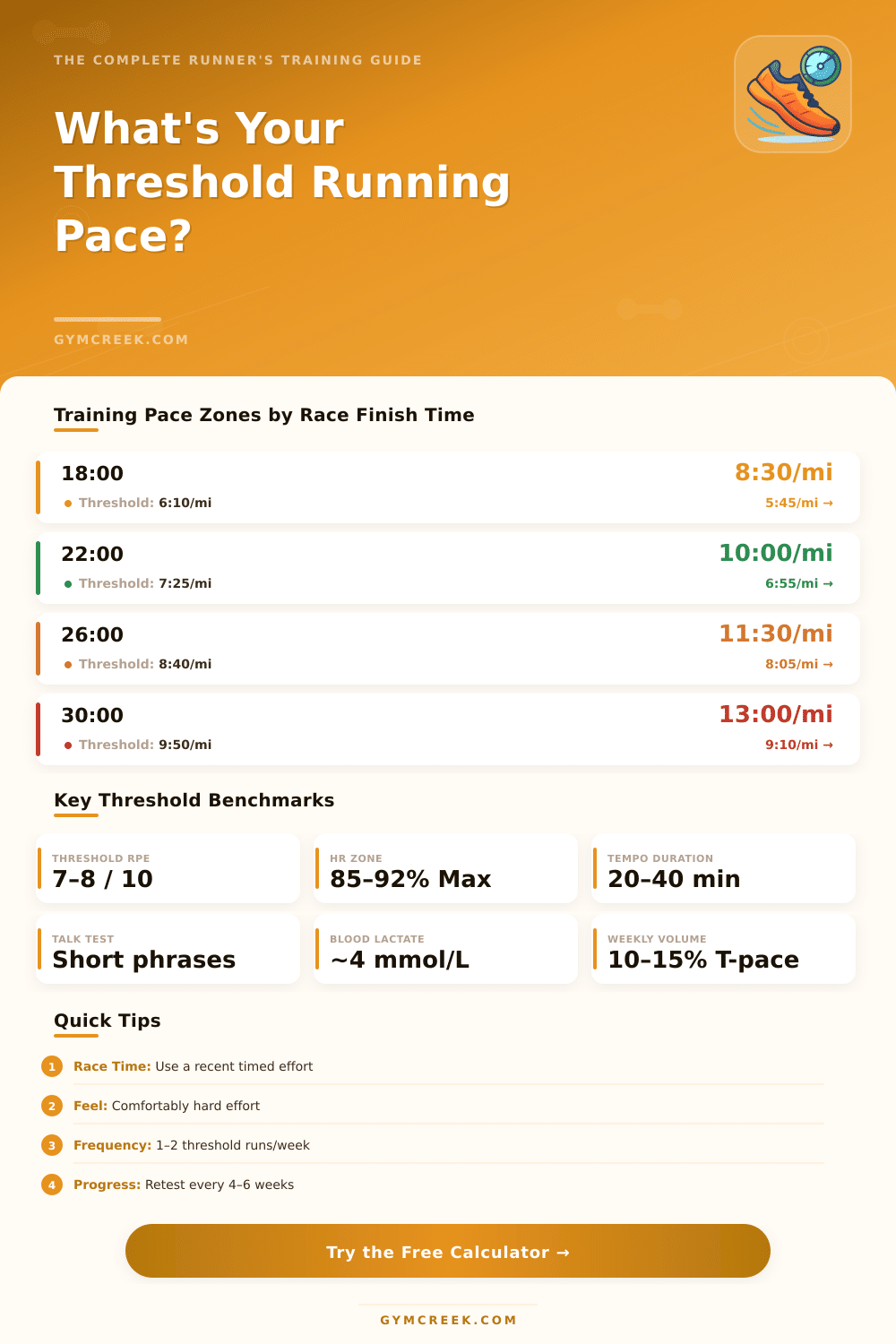
| Zone | Name | % of T-Pace | % Max HR | Duration / Purpose |
|---|---|---|---|---|
| Z1 | Recovery | ≥120% | 60–65% | Easy recovery runs, 20–45 min |
| Z2 | Aerobic / Easy | 110–120% | 65–75% | Base building, long runs, 30–120 min |
| Z3 | Tempo / Threshold | 100–105% | 85–92% | Lactate threshold work, 20–40 min |
| Z4 | VO2 Max | 88–95% | 92–97% | Intervals, 3–8 min repeats |
| Z5 | Anaerobic | <88% | 97–100% | Speed, 30–90 sec repeats |
| 5K Time | Easy Pace (mi) | Threshold (mi) | VO2 Max (mi) | 5K Race (mi) | Fitness Level |
|---|---|---|---|---|---|
| 16:00 | 7:41/mi | 5:33/mi | 5:10/mi | 5:09/mi | Elite |
| 18:00 | 8:31/mi | 6:10/mi | 5:44/mi | 5:47/mi | Competitive |
| 20:00 | 9:18/mi | 6:43/mi | 6:16/mi | 6:26/mi | Intermediate+ |
| 22:00 | 10:02/mi | 7:16/mi | 6:47/mi | 7:05/mi | Intermediate |
| 25:00 | 11:06/mi | 8:02/mi | 7:30/mi | 8:03/mi | Recreational |
| 28:00 | 12:05/mi | 8:45/mi | 8:10/mi | 9:01/mi | Recreational |
| 30:00 | 12:49/mi | 9:17/mi | 8:40/mi | 9:39/mi | Beginner+ |
| 35:00 | 14:22/mi | 10:24/mi | 9:43/mi | 11:17/mi | Beginner |
| Metric | Beginner | Intermediate | Advanced |
|---|---|---|---|
| Threshold HR (% Max) | 83–87% | 85–90% | 88–92% |
| RPE at T-Pace | 6–7 / 10 | 7–8 / 10 | 7–8 / 10 |
| T-Pace Run Duration | 15–25 min | 20–35 min | 30–50 min |
| T-Pace Frequency | Once/week | 1–2x/week | 2x/week |
| Blood Lactate Level | ~3.5 mmol/L | ~4.0 mmol/L | ~4.5 mmol/L |
| Talk Test | Short sentences | Short phrases | Single words |
| Workout | Structure | Level | Goal |
|---|---|---|---|
| Tempo Run | 20–40 min continuous at T-pace | All levels | Raise lactate threshold |
| Cruise Intervals | 3×10 min at T-pace, 1 min rest | Intermediate+ | More T-pace volume |
| Threshold Ladder | 6–8–10–8–6 min at T-pace | Advanced | Sustained threshold stress |
| Long Tempo | 45–60 min at just below T-pace | Advanced | Race-specific endurance |
| Mixed Tempo | 10 min easy + 20 min T + 10 min easy | Beginner | Introduction to tempo |
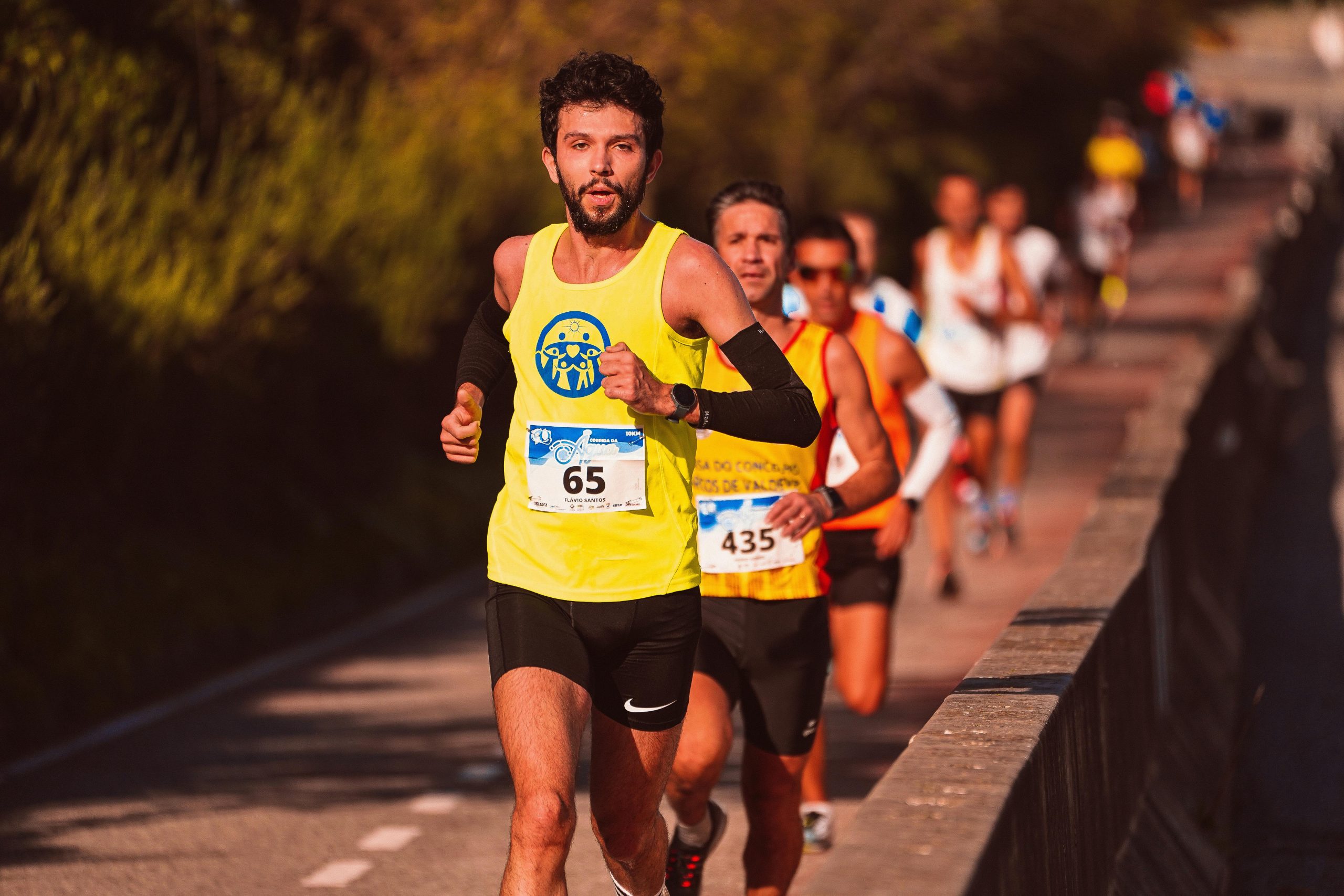
Running Pace sits between the most efficient training kinds for long-range runners. Running at this pace helps to avoid overtraining and leads to more joyful training sessions with more stable quality through the time. In short words it marks the highest pace that the body fits to keep during a steady metabolic state.
Imagine it as the maximum pace that a well prepared runner could keep during almost one hour.
What Is Running Pace and How to Find It
At Running Pace the body produces lactate, but at the same time removes it in almost the same rhythm. The muscles work hard, even so there exists a balance between them. When the pace passes the limit, the oxygen no longer is enough to follow the tension.
This moment is closely linked to the lactate threshold. Training under this limit, the body learns to better use oxygen during severe effrots and reduce the lactate. Because of long practice, the highest pace under this threshold becomes higher.
A good metaphor for it is a bucket with an opening in the bottom. Training at the lactate threshold expands the bucket and also the opening below. Like this the body fits to last bigger tension before it overflows.

Running Pace sits around 83 to 88 percent of VO2max, or around 88 to 92 percent of the maximum heart frequency. It belongs to the zone of comfortably hard running. The breaths our heavy, but still controlled.
It seems difficult at first, but becomes more bearable over longer time. After around 15 minutes it starts to truly hurt. In 30 minutes it requires strong will to maintain.
Failure usually happens between 45 and 60 minutes.
For shorter races like 5K or 10K, the Running Pace is widely slower than the race pace, if the 10K ends under one hour. For expert marathon runners, the Running Pace and the intended marathon pace could be quite a lot near.
A common way to find the Running Pace without a lab test is to run hard alone during 30 minutes. Then one takes the middle pace or heart rate of only the last 20 minutes. These values give a good guess of the lactate threshold.

Some devices can also automatically count the threshold value using real data from training and running.
Threshold training sessions can range based on the targets. Steady running of three to four miles at Running Pace works well. Repeated runs of 5 to 15 minutes with 1 to 3 minutes of rest between them also work.

Interval runs cover various sides. Running 20 to 30 minutes near the pace of a one-hour run, or 45 to 75 minutes more beside the marathon pace, both belong to interval style. When the fitness improves, the Running Pace naturally rises.
The speedendurance grows, and so does the confidence to keep pace during hard training.