VO2 Max Altitude Calculator
See how elevation reduces your aerobic capacity, adjusts your race times, and how acclimatization can restore performance
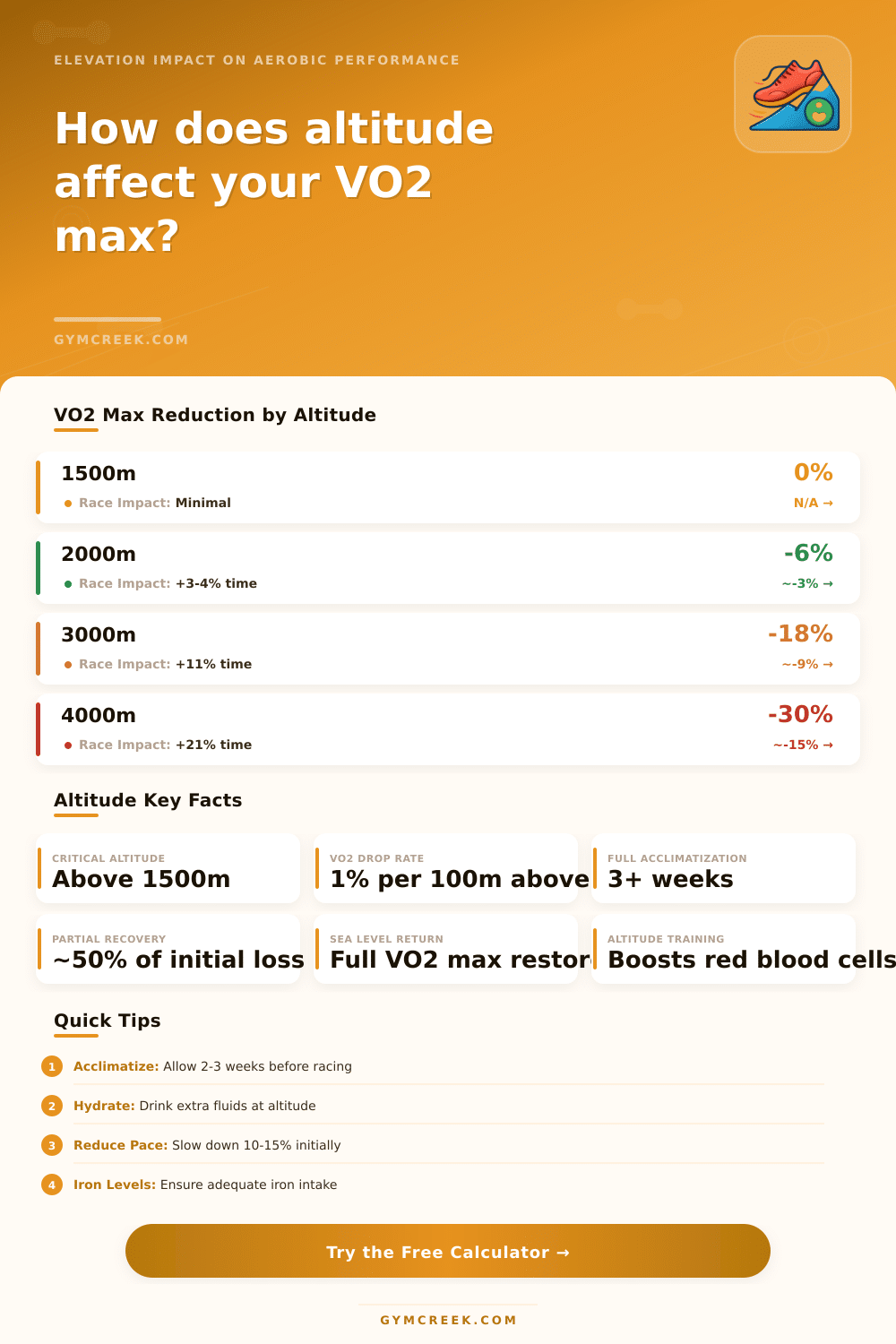
| Elevation | Altitude (ft) | VO2 Max Drop | Race Time Impact | After Acclimatization |
|---|---|---|---|---|
| 500m | 1,640 ft | 0% | Negligible | N/A |
| 1000m | 3,281 ft | 0% | Minimal (<1%) | N/A |
| 1500m | 4,921 ft | 0% | Threshold | N/A |
| 2000m | 6,562 ft | ~6% | +3-4% slower | ~-3% (3 wks) |
| 2500m | 8,202 ft | ~12% | +7-8% slower | ~-6% |
| 3000m | 9,842 ft | ~18% | +11-12% slower | ~-9% |
| 3500m | 11,483 ft | ~24% | +15-17% slower | ~-12% |
| 4000m | 13,123 ft | ~30% | +20-22% slower | ~-15% |
| Time at Altitude | VO2 Max Recovery | Key Adaptation | Performance Notes |
|---|---|---|---|
| Day 1-3 | None — worst phase | Increased breathing rate | Feel most impaired |
| Day 4-7 | ~10-20% of loss | Plasma volume increases | Slight improvement |
| Week 2 | ~25-35% of loss | Red blood cell production begins | Noticeable improvement |
| Week 3+ | ~50% of loss | Increased hemoglobin mass | Near plateau reached |
| 4-6 weeks | ~60-70% of loss | Full hematological adaptation | Optimal performance window |
| Race / City | Altitude | Est. VO2 Drop | Typical Adjustment |
|---|---|---|---|
| Denver, Colorado | 1,609m (5,280 ft) | ~1.3% | +1-2% pace |
| Albuquerque, NM | 1,619m (5,312 ft) | ~1.4% | +1-2% pace |
| Mexico City | 2,240m (7,349 ft) | ~9% | +5-6% pace |
| Bogota, Colombia | 2,640m (8,661 ft) | ~13.6% | +8-9% pace |
| La Paz, Bolivia | 3,640m (11,942 ft) | ~25.5% | +16-18% pace |
| Cusco, Peru | 3,399m (11,152 ft) | ~22.6% | +14-15% pace |
VO2 max stands for the biggest amount of oxygen that the body is able to use during strong physical work. Think of it like the power of an engine in a car. It measures the ability of the body to take oxygen during physical exercise.
The more oxygen one can process, the more efficient is the aerobic fitness.
VO2 Max: What It Is and Why It Matters
One usually looks at it as the most reliable mark for heart fitness and aerobic endurance. High VO2 max means that the body well takes oxygen from the air and carries it to the muscles. It shows how effectively the heart pumps blood to the muscles and how well those muscles pull oxygen from the blood.
That oxygen helps to create reactions in the muscle cells, that drive the moves.
One measures VO2 max by means of milliliters of oxygen for every kilo of body weight for one minute. A scientist would say that it is the biggest amount of oxygen, that the body can pick, transport and use during one minute of hard working. It serves as a baseline for measuring the aerobic endurance of athletes before or during their traning sessions.
An efficient lab test method for aerobic fitness involves exercise on a treadmill, fixed bike or rowing machine. One attaches to the face a mask or tube, that is bound to a device for reading oxygen, during the person works at full force. One can also measure it outside the lab.
For instance, the Cooper test requires to run or walk as quickly as possible while exactly 12 minutes. The covered distance later feeds into a calculation for VO2 max value.
Genetics play a lead role in setting VO2 max. Also age, training and overall health affects it. The maximum heart rate drops by around 0.6 to 0.8 beats per year during aging. Probably the most key role has the energy content in the active muscles.
In past studies, healthy older adults that trained during nine months to a year, raised there VO2 max on average by 20 percent.
High intensity interval training is among the best ways to strengthen VO2 max. Intervals of one to six minutes with equal work and rest times one usually considers as VO2 max training. Training in zone 2 is also useful. When VO2 max grows, the resting heart rate tends to drop, and for the same effort the normal heart rate during exercise should be lower.
Even so VO2 max does not give the whole picture. The pace at the aerobic threshold or lactate threshold commonly better predicts the real endurance action. VO2 max is only one part of the puzzle.
One can quickly train it, but also quickly lose it. Too much high intensity work can lead to overtraining. Athletic coaches and trainers measure VO2 max, although the accuracy differs.
Even so, following its changes overtime truly helps to observe the progress in fitness.