🥩 Protein Intake Calculator for Weight Gain
Calculate your optimal daily protein target to build muscle and gain weight effectively
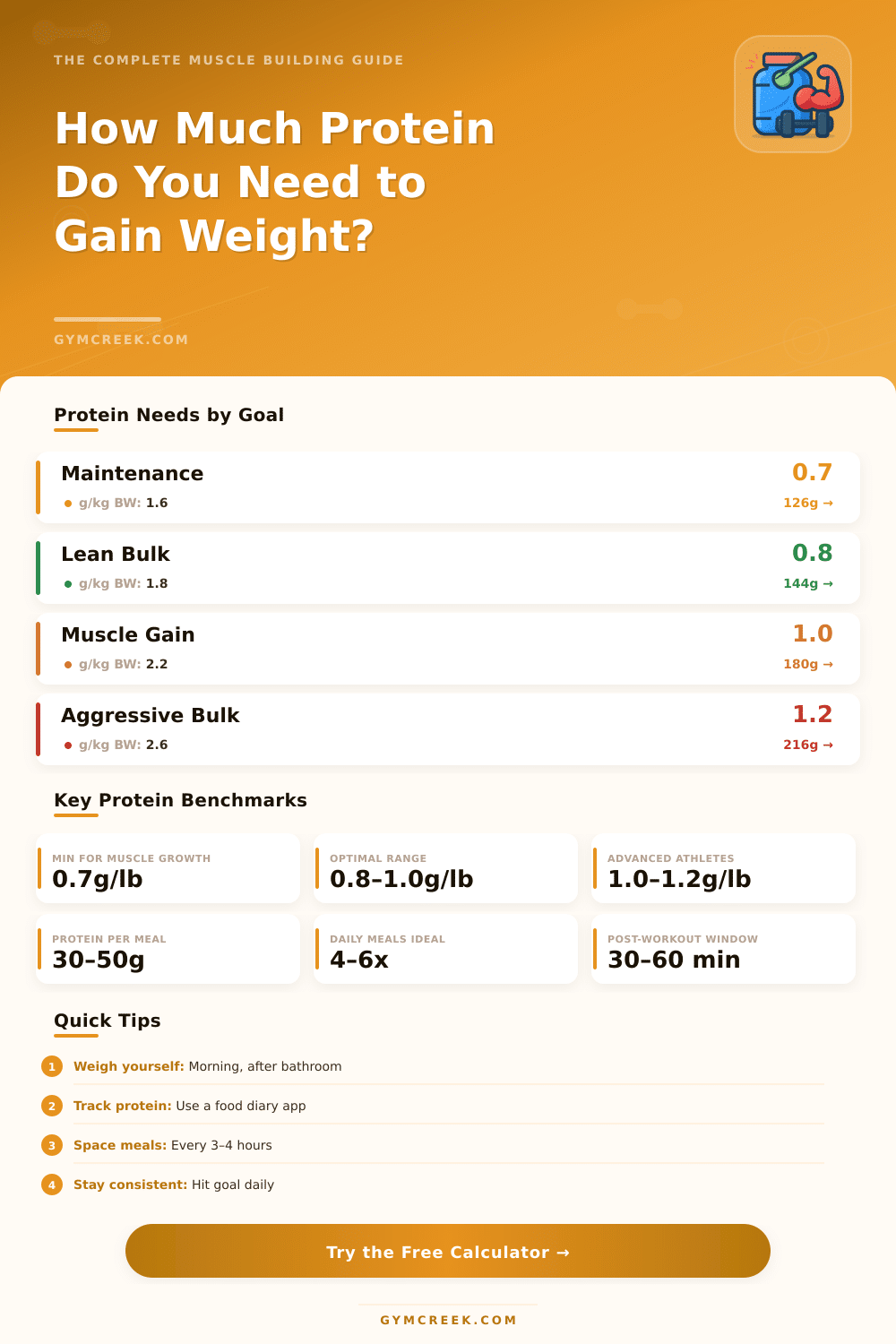
| Goal / Level | g per lb BW | g per kg BW | Example (165 lb / 75 kg) | Notes |
|---|---|---|---|---|
| General Health | 0.36 | 0.8 | 59g / 60g | RDA minimum — not optimal for gain |
| Maintenance (Active) | 0.6–0.7 | 1.4–1.6 | 99–116g | Preserve muscle mass |
| Lean Bulk (Beginner) | 0.7–0.8 | 1.6–1.8 | 116–132g | Best novice range for hypertrophy |
| Muscle Gain (Intermediate) | 0.8–1.0 | 1.8–2.2 | 132–165g | Most studied optimal range |
| Aggressive Bulk (Advanced) | 1.0–1.2 | 2.2–2.6 | 165–198g | Supports heavy training volume |
| Older Adults (50+) | 0.9–1.1 | 2.0–2.4 | 149–182g | Higher need due to anabolic resistance |
| Food (100g / Standard Serving) | Protein (g) | Calories | Source Type |
|---|---|---|---|
| Chicken Breast (cooked, 100g) | 31g | 165 kcal | Animal |
| Lean Ground Beef 95% (100g) | 26g | 152 kcal | Animal |
| Canned Tuna in Water (100g) | 26g | 116 kcal | Animal |
| Whole Eggs (2 large) | 13g | 143 kcal | Animal |
| Non-fat Greek Yogurt (170g) | 17g | 100 kcal | Dairy |
| Low-fat Cottage Cheese (100g) | 12g | 98 kcal | Dairy |
| Tofu, firm (100g) | 9g | 76 kcal | Plant |
| Lentils, cooked (100g) | 9g | 116 kcal | Plant |
| Edamame, shelled (100g) | 11g | 121 kcal | Plant |
| Whey Protein Powder (1 scoop ~30g) | 24g | 120 kcal | Dairy-derived |
| Experience Level | Muscle Gain / Month | Muscle Gain / Year | Protein Priority |
|---|---|---|---|
| Beginner (0–1 yr) | 1.5–2.5 lbs | 18–27 lbs | Moderate–High |
| Intermediate (1–3 yrs) | 0.5–1.5 lbs | 6–18 lbs | High |
| Advanced (3–5 yrs) | 0.25–0.5 lbs | 3–6 lbs | Very High |
| Elite (5+ yrs) | 0.1–0.25 lbs | 1–3 lbs | Very High |
| Timing Window | Recommended Amount | Why It Matters |
|---|---|---|
| Pre-Workout (1–2 hrs before) | 20–40g | Primes muscle protein synthesis |
| Post-Workout (0–2 hrs after) | 25–50g | Peak MPS response window |
| Before Sleep | 30–40g | Slow-digesting protein (casein ideal) |
| Per Meal (General) | 25–50g | Maximizes MPS per feeding |
| Meal Frequency | 4–6 meals/day | Evenly distributes protein for MPS |
Protein deserves much more credit than it commonly receives in discussions about food. Here the basic standard: adults require at least 0.8 grams for every kilo of body mass daily to simply escape shortage. Like this, if someone weighs around 75 kilos, that means around 50 to 60 grams as a day minimum.
On the other hand if they live actively, they probably require much more than that basic level.
How Much Protein You Need and Where to Get It
The ideal range for Protein in the diet falls between 10% and 35% of the whole everyday calories. In the United States, the average is around 16%, which technically shows that they reach only the bottom limit. Even so there is a big difference between simply meeting the need and genuinely helping what your body is able to reach.
For folks that mostly stay home, around 1.0 gram per kilo works well. If you get into middle or moderate activity, you want more like 1.3 grams per kilo. For hard exercise?
Here 1.6 grams per kilo becomes the mainstream mark. Studies show that that amount supports muscle growth and improves the genreal feeling of wellness. Many that care for more muscles find the right amount around that 1.6 level.
Bodybuilders work in an entirely other range. Outside the season of competitions, 1.6 grams per kilo forms the bottom, but many athletes notice better results when they push to 2.2 grams per kilo. The highest safe base stays around 2 grams for every kilo per day.
The way you spread Protein through the day genuinely matters. Aim for around 15 to 30 grams for every meal, because that seems the most effective way. Going past 40 grams in one sitting does not give extra benefits compared too that 15-30 gram range.
Weird, but spreading it through several meals can be more useful than stuffing in the whole everyday amount. Including Protein in most of your meals beats the idea of packing it all during breakfast.
On the other hand, the whole amount that you reach daily, ultimately matters. Timing and frequency of meals help a bit, naturally, but reaching the everyday target is the mainstream cause.
The needs for Protein are not the same for all, naturally. A pregnant woman requires something entirely different than a young male athlete. Children growing up, just like pregnant or nursing mothers, require more than a typical adult.
Your own targets, state of health and the intensity of your training all affect that calculation.
Great sources of Protein are everywhere… Meat, fish and eggs deliver all eight essential amino acids that your body itself can not produce. Chicken, lentils, Greek yoghurt, eggs, black beans and peanut butter all give good amounts.
Do not forget about seeds or similar foods. Milk, casein, paneer and cheeses provide natural Protein without extra work. Whey supplements work well also, although they commonly are not required, unless food does not cover enough forany.
Here is something that easily gets missed: those Protein amounts include everything together, foods, supplements, whatever. Not only supplements alone.