🏋 Olympic Weightlifting Calculator
Calculate Sinclair score, training percentages, and competition attempt recommendations
| Zone | % | Snatch | Clean & Jerk | Purpose |
|---|
| Men Category | Women Category | Sinclair A (Men) | Sinclair A (Women) |
|---|---|---|---|
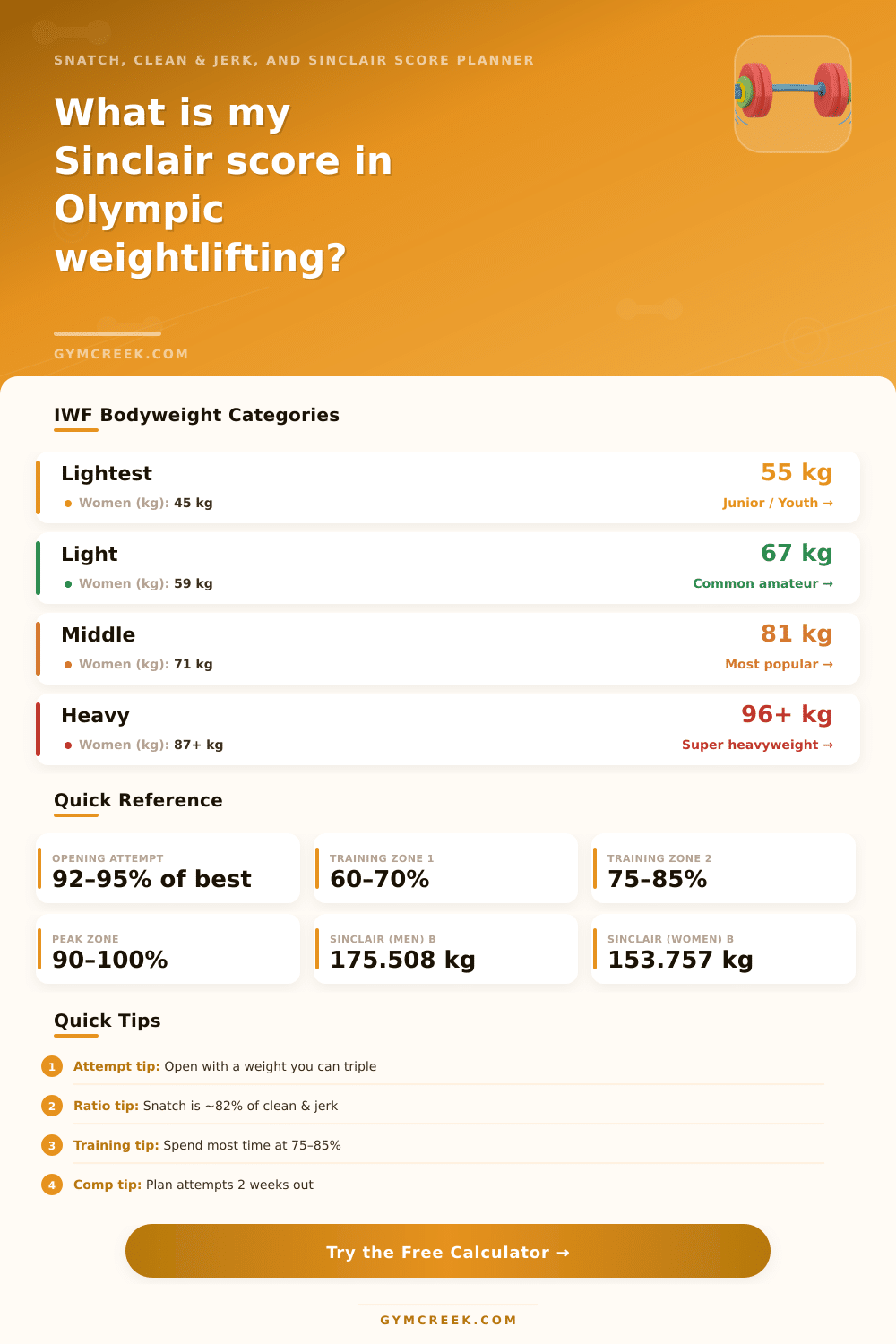
| 55 kg | 45 kg | 0.722762521 | 0.787004341 |
| 61 kg | 49 kg | ||
| 67 kg | 55 kg | ||
| 73 kg | 59 kg | ||
| 81 kg | 64 kg | ||
| 89 kg | 71 kg | ||
| 96 kg | 76 kg | ||
| 102 kg / 109 kg+ | 81 kg / 87 kg+ |
| Zone | % of Max | Sets × Reps | Goal |
|---|---|---|---|
| Technique | 60–70% | 5–6 × 2–3 | Motor pattern, speed |
| Strength-Speed | 75–85% | 4–5 × 2 | Power development |
| Intensity | 85–95% | 3–4 × 1–2 | Strength, competition prep |
| Maximal | 95–100% | 2–3 × 1 | Peak & testing |
Olympic Weightlifting is an intense sport where athletes sharply raise a heavy barbell from the ground to the highest spot. The main target is to reach the biggest possible weight. This activity requires both raw strength and precise movement and it belongs to the summer Olympic games already since 1920.
In modern Olympic Weightlifting contests there happen only two kinds of lifts: the snatch and the clean and jerk. All those actions push the human bodies to the limits of force, speed and flexibility. Their key features come from the need for explosive motion (the weight must fly upward very quickly).
What Is Olympic Weightlifting?
Rather than powerlifting, that includes the squat, the bench press and the deadlift, Olympic Weightlifting focus only on those two main actions.
Those lifts are much more complex than other kinds of strenght exercise, like deadlifts or bench presses. They involve excellent teamwork of parts of the body and a mix of energy and speed. Good method means to use every muscle well, so that one does not depend only on pure muscle mass.
To master them, you must pass years with careful practice. It truly pays to learn right form, because bad form can cause injuries. But here the surprising part: Olympic Weightlifting has one of the lowest risks four wounds among the strength sports.
The training in this sport differs from most other strength activities. One does fewer reps, but with bigger weights and more special motions. For instance snatches, cleans and pulls, squats and carries, usually for one to five reps in some working sets.
It is difficult, takes lot of time and is very precise. Rest is also important as the lifting itself, so good meal andsleep is not optional.
This sport helps to build power, that does not match to simple force. Power deals about using force quickly during certain distances. Also, Olympic Weightlifting helps balance, coordination and mobility.
It shows how well your physical parts work, especially while you keep the barbell in intense positions. For athletes in other sports, this is useful too, because many athletic actions require speed and sudden power, not only simple force.
CrossFit certainly opened the doors of Olympic Weightlifting to a broader public. In its programs one finds snatches and their variations, hanging positions, stronger forms, everything mixed in. On the other hand, it is best to learn those lifts by means of careful practice before entering a typical CrossFit session.
CrossFit intends to form everyday readiness for everything, so if you want to truly progress in Olympic Weightlifting, focus on intended training.
For example starting more late in life? Fully possible. This activity can serve as a fun hobby, that adds new challenge to your everyday routine.
There is something magic-like in the motions, that seem superhuman, and this is a big part of what attracts folks.