VO2 Max Step Test Calculator
Estimate aerobic fitness using the Queens College or Forestry Step Test — enter your post-test heart rate for instant VO2 max results
| Age | Poor | Below Avg | Average | Good | Excellent |
|---|---|---|---|---|---|
| 20-29 | <33 | 33-38 | 39-43 | 44-52 | >52 |
| 30-39 | <31 | 31-35 | 36-41 | 42-49 | >49 |
| 40-49 | <28 | 28-32 | 33-38 | 39-47 | >47 |
| 50-59 | <25 | 25-28 | 29-35 | 36-43 | >43 |
| 60+ | <21 | 21-25 | 26-32 | 33-40 | >40 |
| Age | Poor | Below Avg | Average | Good | Excellent |
|---|---|---|---|---|---|
| 20-29 | <28 | 28-33 | 34-38 | 39-45 | >45 |
| 30-39 | <24 | 24-29 | 30-34 | 35-42 | >42 |
| 40-49 | <20 | 20-25 | 26-31 | 32-38 | >38 |
| 50-59 | <17 | 17-22 | 23-28 | 29-36 | >36 |
| 60+ | <15 | 15-20 | 21-26 | 27-33 | >33 |
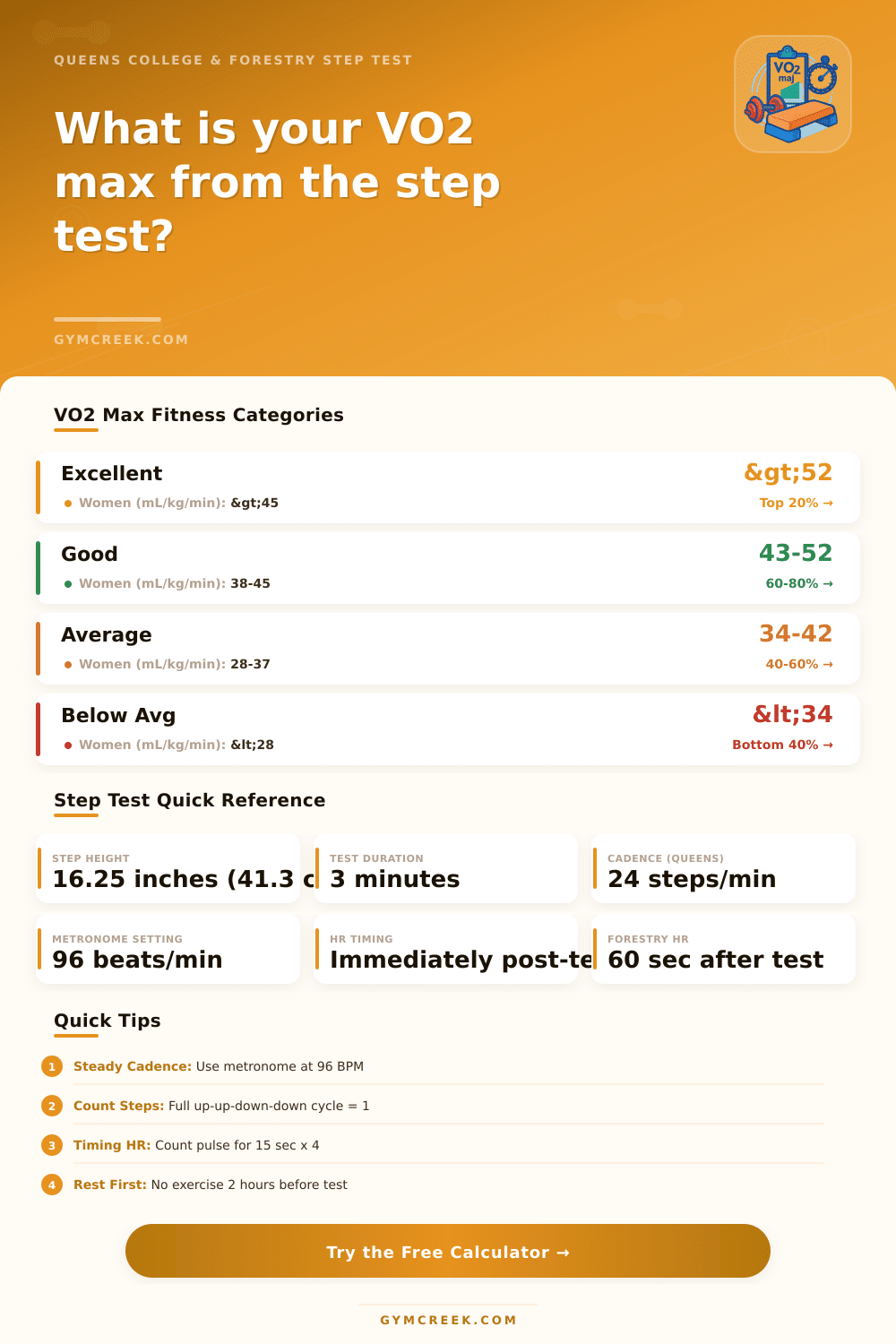
| Protocol | Step Height | Cadence | Heart Rate Timing | Formula |
|---|---|---|---|---|
| Queens College (Men) | 16.25 in / 41.3 cm | 24 steps/min | Immediately post-test | 111.33 - (0.42 × HR) |
| Queens College (Women) | 16.25 in / 41.3 cm | 22 steps/min | Immediately post-test | 65.81 - (0.1847 × HR) |
| Canadian Forestry (Men) | 15.75 in / 40 cm | 22.5 steps/min | 60 sec after test | 42.166 - (0.1498 × HR) |
| Canadian Forestry (Women) | 13 in / 33 cm | 22.5 steps/min | 60 sec after test | 22.776 - (0.0769 × HR) |
VO2 max shows the biggest amount of oxygen that the body can absorb, transport and use during hard physical activity. One can imagine it as the engine of a car. It measures the physical ability to use oxygen in moments of biggest effort.
The words in the name explain themselves: “V” shows volume, “O2” means oxygen, and “max” means the upper limit. The value is measured in millilitres of oxygen for each kilogram of body mass per minute.
What is VO2 Max and How to Improve It
That measure is widely accepted as the most reliable mark for heart and blood vessel fitness and long duration in aerobic sports. The more oxygen one manages to use during work, the better. High VO2 max helps the body effectively take oxygen from the air and deliver it to the muscles.
It shows how strongly the heart pumps blood to the muscles and how well they pull oxygen from this blood. Later, the oxygen in muscles drives processes in the cells, that gives energy for the moves.
Between athletes of long duration, as swimmers, cyclists, runners and skiers through land, the VO2 max commonly reaches its peak. It gives a fair rating about the skill of people. Even so, it forms only part of the whole picture.
Actually, the speed at aerobic threshold or lactate threshold commonly predcit more well the results in continuous sports, because they consider several elements at once, not only the oxygen use.
In a lab the precise method to measure VO2 max is work at maximum effort on a treadmill, fixed bike or rowing machine. One wears a mask or tube, that connects to a device for analysing the breath, while the person pushes as hard as possible. Simpler ways to estimate it exist also.
The Cooper Test requires to run or walk at the biggest speed during exactly 12 minutes, and the covered distance relates to the VO2 max. Some training programs estimate it on there own, although such calculations sometimes err.
Genetics play a lead role for VO2 max. Even so, almost every person can improve it by means of quite a lot of hard exercise. One of the real ways to rush it is the high-intensity interval training. Typical intervals last between one and six minutes, with equal pauses for rest, and one considers them ideal for VO2 max. Training in zone 2 helps also.
If one mixes zone 2 work with intervals for three to four days in a week, one should see results.
VO2 max rises quickly because of training, but drops likewise quickly. Too much high-intensity work during the whole year can lead to overload. As the VO2 max grows, the resting heart rate usually drops.
At the same level of effort, the usual heart rate drops. Things as age, past training and general health all limit the possibilities. The maximum heart rate drops by 0.6 to 0.8 beats for every year.
In a study, older adults that trained during nine months to a year onaverage raised their VO2 max by 20 percent.