🏃 Running Pace Percentage Calculator
Calculate your pace as a percentage of your best, and find your ideal training zones
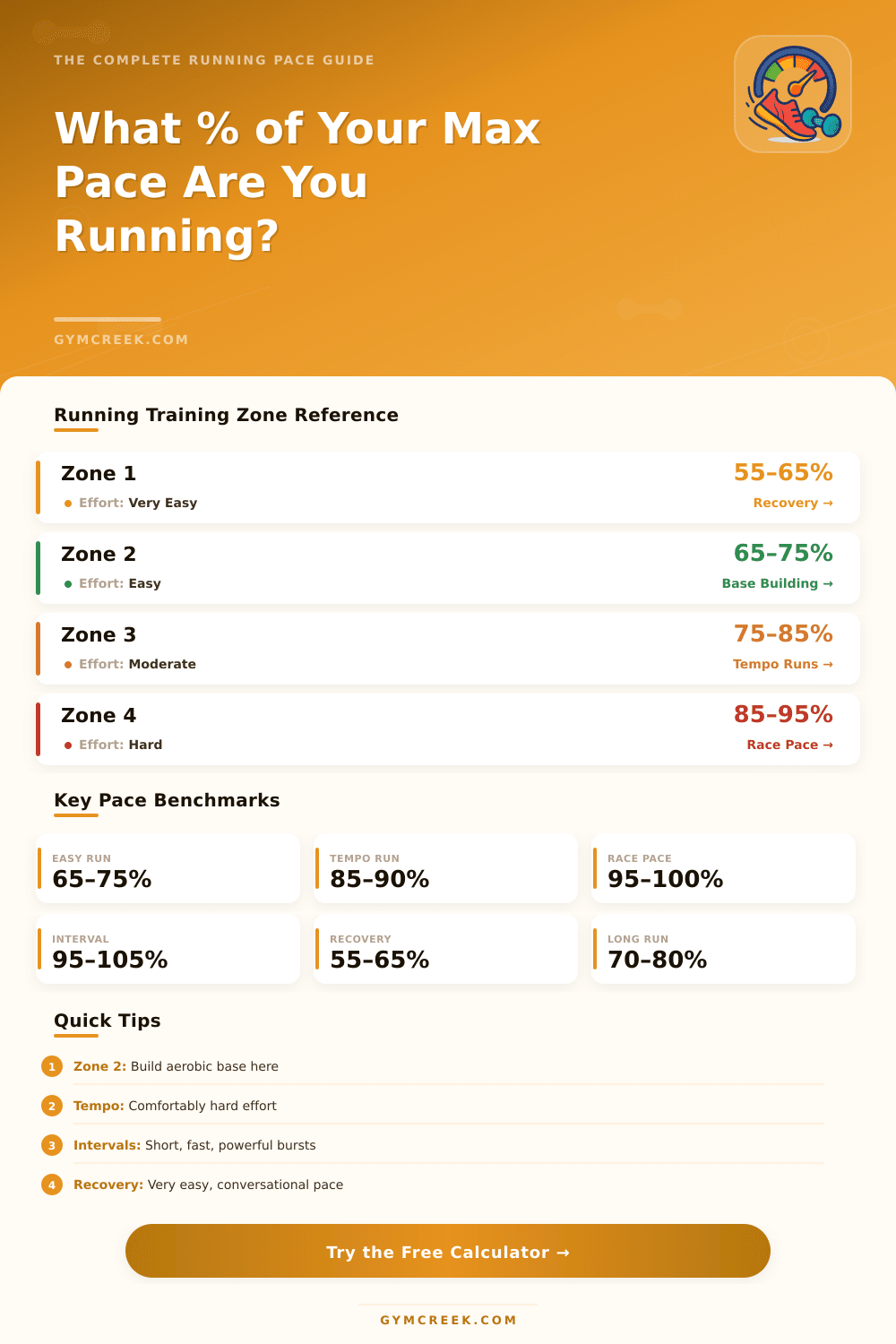
| Zone | % of Best Pace | Effort Level | Purpose | Weekly Volume |
|---|---|---|---|---|
| Zone 1 – Recovery | 55–65% | Very Easy | Active recovery, warm-up | 10–15% of total |
| Zone 2 – Aerobic | 65–75% | Easy / Conversational | Base building, fat burn | 60–70% of total |
| Zone 3 – Tempo | 75–85% | Moderate / Steady | Lactate threshold work | 10–20% of total |
| Zone 4 – Threshold | 85–95% | Hard / Uncomfortable | Race-pace endurance | 5–10% of total |
| Zone 5 – VO2 Max | 95–105% | Very Hard / Max | Speed, intervals, power | 3–7% of total |
| Race Distance | % of 5K Best Pace | Typical Slowdown | Recommended HR Zone |
|---|---|---|---|
| 1 Mile / 1.6 km | 103–107% | Faster than 5K pace | Zone 5 (95–100% max HR) |
| 5K | 100% | Reference pace | Zone 4–5 (90–100%) |
| 10K | 92–96% | ~4–8% slower | Zone 4 (85–92%) |
| Half Marathon | 85–90% | ~10–15% slower | Zone 3–4 (80–90%) |
| Marathon | 78–83% | ~17–22% slower | Zone 3 (75–85%) |
| 50K Ultra | 65–72% | ~28–35% slower | Zone 2–3 (65–80%) |
| % of Best Pace | What It Means | Talk Test | Recommended For |
|---|---|---|---|
| Below 60% | Very slow / walking pace | Full sentences easily | Warm-up, cool-down, injury recovery |
| 60–70% | Easy aerobic | Comfortable conversation | Long runs, base miles, recovery |
| 70–80% | Moderate / steady state | Short sentences | Progression runs, general fitness |
| 80–90% | Tempo / threshold | Brief words only | Tempo runs, marathon pace work |
| 90–100% | Race effort | Cannot speak | Races, 5K/10K pace intervals |
| Over 100% | Faster than best pace | Maximum effort | Short intervals, speed drills |
Intermediate pace shows how many time one requires to cover a certain distance. The mainstream formula is easy: it matches to time divided by distance. So, if one runs 5 km in 30 minutes, the average pace becomes 6 minutes each kilometer.
That helps to estimate how quickly the runner advances, and serves to plan training and control achievements.
How to Find and Use Your Running Pace
Running Pace does not deal only about speed. It concerns the management of energy. If one starts too quickly in a contest, that can lead to fast tiredness.
Start too slowly and one cannot reach the best result. Balance helps to preserve energy and end strong. The key for a good contest is to run the second part more quickly than the first.
A calculator for Running Pace helps to find pace, time or distance, when one knows two from those values. It is useful for projcet final times, keep a steady Running Pace and prepare more efficient training for distances as 10 km., half marathon or full marathon. Charts with conversions also help to see pace in kilometers and miles, and what pace one must have to reach particular targets.
The Running Pace changes according to the distance. Pace for 5 km. Contest probably beats that of longer ways.
Run in 5 km. Pace is almost without oxygen, while 10 km. Pace mixes steady effort with higher effort.
For instance, if standard 5 km. Pace is 8:30 each mile, then for 10 km. It could be around 8:50, and for half marathon approximately 9:10.
Those values are not strict. Add 10 ore 20 seconds is perfectly fine. Run too quickly risks to injure yourself.
Easy run matters also a lot. It forms a strong base, on that one can add more hard training. A runner can range until 20 seconds each mile more slowly or quickly than the intended easy pace in any day.
The mainstream point is, that it feels light and pleasant. It works well to run 80 percent of the miles in slow easy rhythm and 20 percent in more challenging fast work.
For newcomers it does not help to stress growth of pace or too early distance growth. That comes naturally with time. Slow yourself helps to truly build the ability for longer distances.
Start with a mix of run and hiking works well. Choose quite a slow rhythm, to not lose breath, is important at first. Breathing becomes more natural over time.
Steady run with balanced training gives weekly progress.
Think about training amount according to time instead of distance seems logical. A faster runner reaches more miles during an hour than a slow one. Pace changes according to age, training level and physical weight.
Hard training can burden the body, whatoccasionally slows the rhythm.