🏋 Squat Pyramid Calculator
Build ascending, descending, or full pyramid squat programs with volume tracking
| Set | % 1RM | Weight | Reps | Volume | Rest |
|---|
| Set | % of 1RM | Standard Reps | Rest Time |
|---|---|---|---|
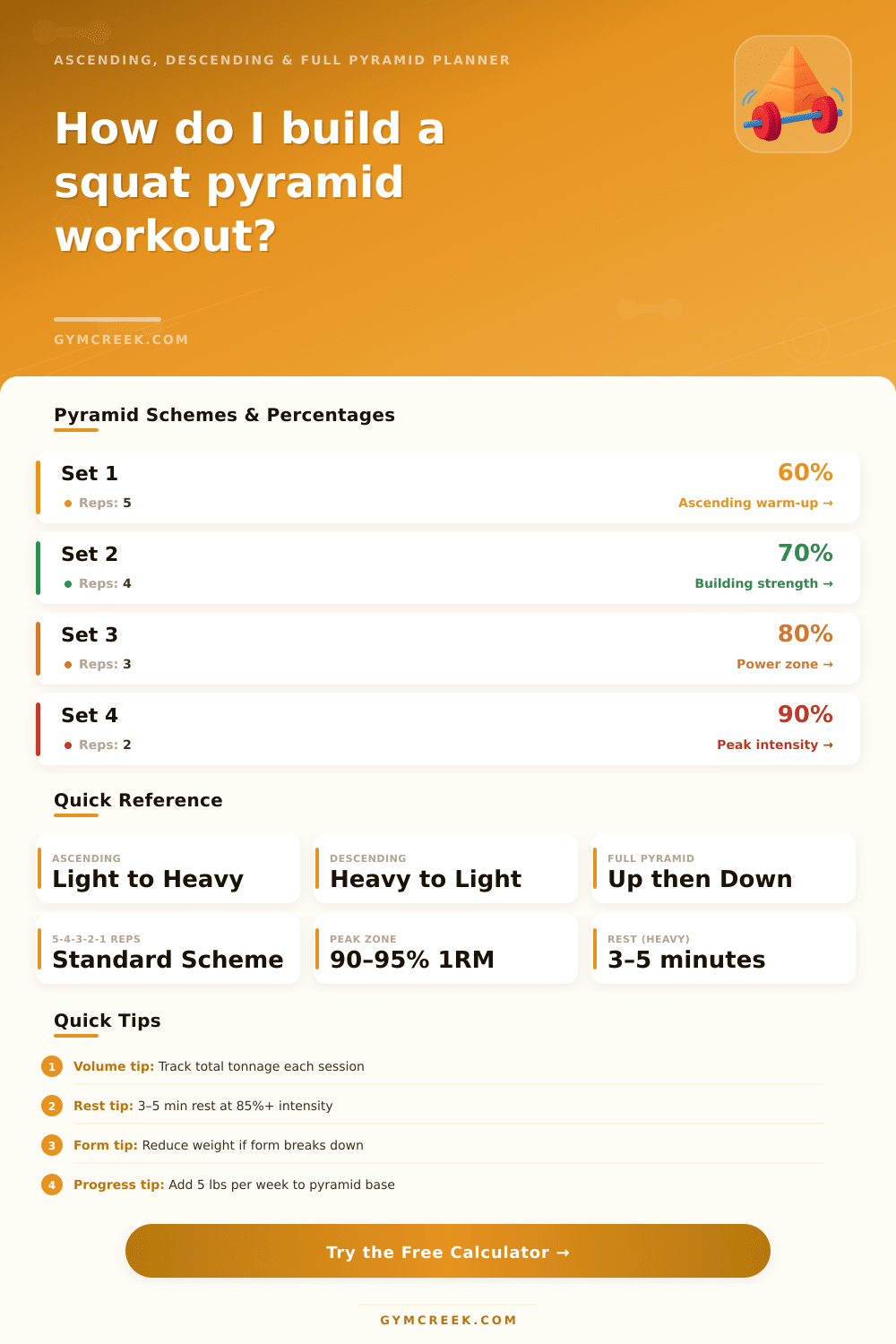
| Set 1 | 60% | 5 reps | 90 sec |
| Set 2 | 70% | 4 reps | 2 min |
| Set 3 | 80% | 3 reps | 3 min |
| Set 4 | 90% | 2 reps | 4 min |
| Set 5 | 95% | 1 rep | 5 min |
| Type | Structure | Best For | Volume |
|---|---|---|---|
| Ascending | Light → Heavy | Strength, peaking | Moderate |
| Descending | Heavy → Light | Hypertrophy, pump | High |
| Full Pyramid | Up then Down | Max volume, endurance | Very High |
| 5-3-1 | 3 sets, low rep | Strength cycles | Low–Moderate |
The Pyramid is simply a training system that centers around one main exercise in one session. The idea is easy: one starts with heavy weights in every set, while one lowers the reps or swaps them a bit and uses lighter loads with more reps during progress. Think about a Pyramid on a mountain…
The base forms with light weights and high numbers of reps. While one climbs to the peak, the weights grow and the reps drop. Later one comes down the same way, lowering the weight until return to the starting point.
Simple Guide to Pyramid Training
Pyramid sets really are useful for growing your max one-rep weight in Squat exercises. What makes them effective is the sorted system, each set grows in weight by percentages of your max one-rep ability. The intensity depends on that percentage, which one can estimate roughly with various formulas and tables.
Exercises with a bar, especially Squat, bench press, deadlifts and overhead presses, work well with taht upward method.
One range that gets much interest follows this pattern: 40 reps, later 20, 10, 5, 3, 2 and finally only 1. The weights climb until the heaviest one at the top, later the order flips and one works down. It gives big volume and honestly quite a lot of tiring experience.
Another usual version is made up of sets of 10, 8, 6, 4 and 2 with weight that grows every time. One aims for around 30 total reps, which is like a typical 5×5 program. The first set of 10 seems almost too simple, but when one gets too the last of 2?
It becomes really cruel.
There is also a reverse method, where one starts with only one rep in the first set, later two in the second, three in the third and so on upward. Pauses between sets stay short, almost only a minute. For most Pyramid training even so three minutes between sets work well, or as much time as needed to catch your breath and let muscles rest before the next effort.
Reverse Pyramid fully overturns the order. One starts with heavy weights when one is still fresh, later lowers the weight by around 10 to 15 percent for the next sets with more reps. Many lifters like that, because handling the heaviest load without tiredness feels more doable.
One way to set it up could be: 185 for 8 reps, later 225 for 8, then 275 for 4 to 6, 315 for only 1 or 2, before dropping to 225 for two sets of 6 to 8.
The downside is that going through those warmup sets uses energy. That building tiredness can stop one from reaching a real max one-rep when one finally gets there. For beginners or folks that train not too seriously, Pyramid sets work well.
More skilled lifters gain from knowing their real strengths and limits. Doing sissy Squat at the end of a normal four-set Pyramid makes legs later really painful.
Pyramid sets help in everything, strength, big gains, muscle growth. Combining exercises like bench press, Squat and deadlifts in Pyramid sessions keeps everything simple and effective. The mainadvantage is that one finishes the whole training a bit more quickly every time.