Free Intermittent Fasting Calculator
Map your fast, eating window, and next meal timing with presets built for real daily rhythms.
📌Preset Schedules
Each preset loads a real fasting rhythm, meal cadence, and training slot before you calculate.
⚙Fasting Planner
Intermittent fasting snapshot
Enter your schedule and calculate your current fast, window, and next meal timing.
📊Fasting Metrics
📑Reference Tables
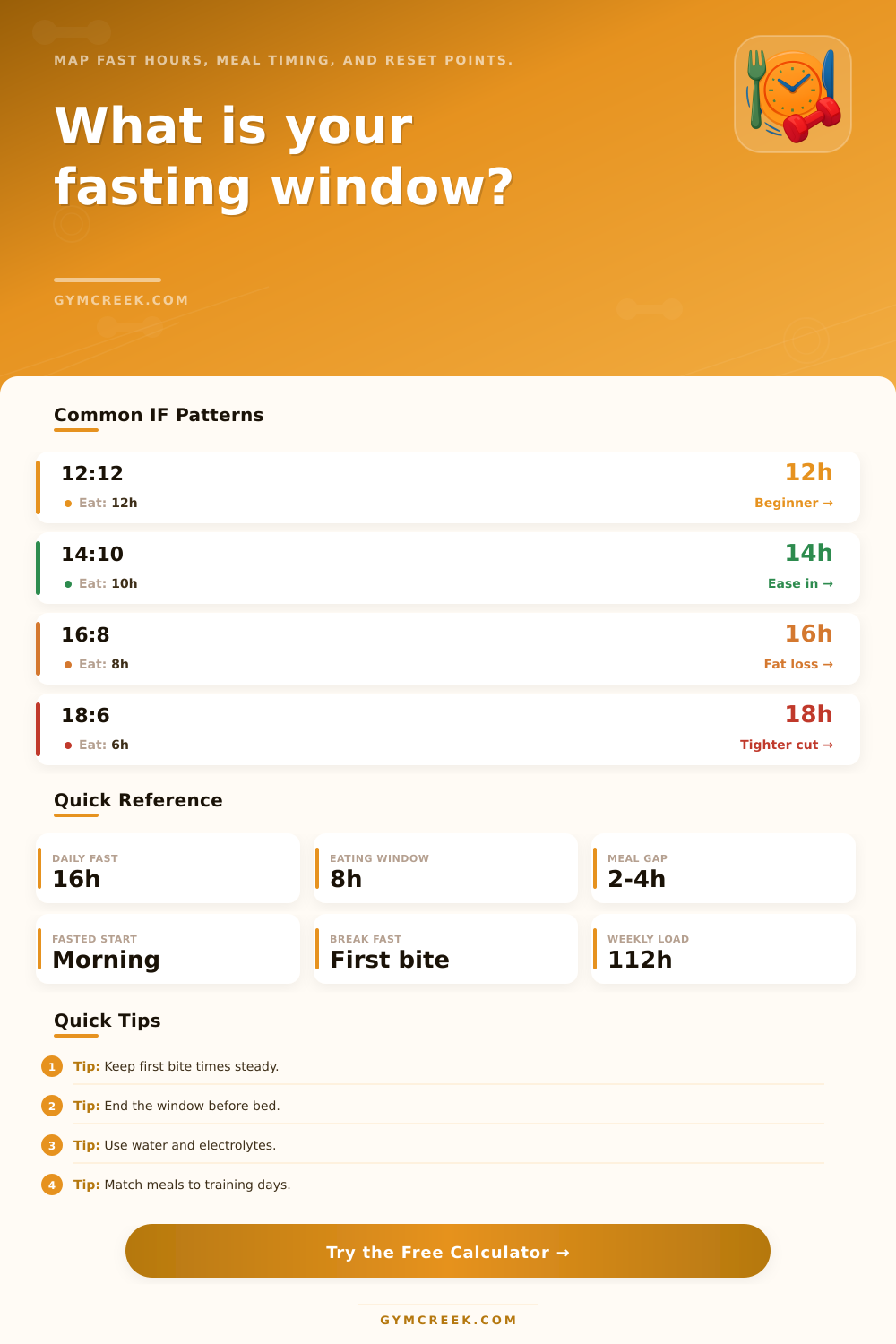
| Protocol | Fast | Eat | Use |
|---|---|---|---|
| 12:12 | 12h | 12h | Easy entry |
| 14:10 | 14h | 10h | Steady cut |
| 16:8 | 16h | 8h | Most common |
| 18:6 | 18h | 6h | Tighter focus |
| Stage | Clock | What to expect | Training note |
|---|---|---|---|
| Fed | 0-4h | Digestion | Lift as planned |
| Shift | 12-16h | Appetite wave | Hydrate early |
| Deep fast | 16-20h | Stable focus | Keep pace easy |
| Extended | 24h+ | Strong hunger | Respect recovery |
| Schedule | Best for | Meal slots | Notes |
|---|---|---|---|
| Early bird | AM energy | 3 bites | Finish early |
| Noon cut | Office days | 2-3 bites | Simple rhythm |
| Night shift | Late work | 2 bites | Anchor sleep |
| Weekly reset | Long reset | 1-2 bites | Plan recovery |
| Formula | Inputs | Output | Why it matters |
|---|---|---|---|
| Fast span | Last to first | Hours | Shows drift |
| Window span | 24 minus fast | Hours | Meal room |
| Weekly load | Fast x days | Hours | Weekly volume |
| Meal gap | Window / meals | Hours | Spacing target |
💡Tips
Intermittent fasting is a method of eating that involves alternating between periods of eating and fasting. Due to the potential for an individual’s schedule to change, or to not align with the fasting protocol template that is prescribed to them, there may be instances in which an individual drift from there fasting protocol. Drifting from the protocol template is the change in fasting due to life event.
To avoid drifting from there fasting protocol, individuals must model that protocol upon there own daily routine. Intermittent fasting works because fasting changes the way that an individual’s body process the food that they consume. During fasting periods, an individual’s body shifts from a digestive mode to a reparative mode for their cells, a process known as autophagy.
How to Stick to Your Intermittent Fasting Plan
Autophagy occurs after an individual go twelve to sixteen hours without food. Furthermore, fasting also causes shifts in the hormones that the human body releases. During fasting periods, growth hormone increase while insulin levels decrease.
These changes aid in fat burning while preserving muscle mass if the individual performs it correctly. Many individuals fail at fasting protocols because they do not associate the fasting protocol to any components of their body or daily routine, their wake times, workouts, or bedtime. For example, if an individual eats there last meal of the day near there bedtime, the body will be digesting food while they are sleep.
Similarly, breaking a fast in the middle of a meeting will cause an individual to feel hunger. The time of the first meal that an individual consumes during the eating period is more important than the number of hours that an individual fasts. By establishing a time for the first meal, subsequent meals will naturaly occur during the bodys routine.
Furthermore, by establishing a time for the first meal, an individual can more easily schedule there workouts to see the best results from fasting. Additionally, by establishing a time for the first meal, an individual can manage there coffee consumption because coffee should not increase the insulin levels of the individual. By creating a tool that calculates the gap between the last meal and the first meal, an individual can determine if they are drifting from there fasting protocol.
This tool can account for the individual’s wake up time, training time, and bedtime so that the individual avoids fasting after midnight. Presets allow an individual to more easily apply intermittent fasting to there daily routine. For example, those who sit at there desks all day can use a preset protocol that involves fasting for sixteen hour and eating for eight hours beginning at noon to allow time to lift weights after work.
Night shift workers can use a fasting protocol that begins later in the day to allow them to retain there sleep cycle. Individuals who are on recovery days can use a 12:12 fasting protocol to allow for more time to eat meals. Each preset protocol comes with a full fasting rhythm that includes the number of meals that should be consumed during the eating period and the timing of coffee consumption.
For individuals who are consistent with there fasting protocol, the fast totals will increases each week. These fasting totals each add up to potential fat loss. One of the common mistake with intermittent fasting is ignoring fasting constraints.
An eight-hour eating window is large enough for three meals and pre-workout drinks. An individual should aim to allow two-to-four hour between meals. An individual can calculate the spacing of meals by dividing the total number of fasting hours by the total number of meals.
An individual who ignores meal spacing may eat too much or not enough which may lead to low energy level. Individuals need to drink water when fasting. An individual should drink water upon waking to begin the fast, but should wait twenty minutes to consume anything else.
To blunt the headaches that may occur during fasting periods beyond fourteen hours, the individual should incorporate electrolytes into there fasting routine. Prior to consuming there first bite of food, an individual should stop drinking coffee to allow there fasting coffee to remain black and calorie free. These habit are important for the sustainability of an intermittent fasting routine.
An individual should lift weights while they are fed. However, fasting in the morning can help to build the grit that is necessary for an individual to succeed in fasting. Tables can break down the different fasting protocols for different uses.
For example, a 12:12 protocol is beneficial for beginners because it mimics the bodys natural fasting pattern overnight. A 14:10 protocol is an alternative fasting protocol that is steady and does not demand much fasting effort from the individual. A 16:8 protocol is most common for fat loss.
An 18:6 protocol is more demanding and can be used when an individual is plateauing in there fat loss protocol. An individual can also track the stage of fasting. The zero to four hour mark after a meal is the digestion stage.
Between twelve and sixteen hours after the meal is the stage when appetite wave occur. After sixteen hours is the stage when an individual can reach there peak focus level. An individual’s fasting protocol should vary according to there life events.
Those who rise early should eat there last meal after six pm while night owls can adhere to there eating protocol later in the day. Formulas can display the calculation of an individual’s weekly fast total. The weekly fast totals can be calculated by multiplying the fast hours by the number of fasting day per week.
There are trade-offs to intermittent fasting protocols. For example, a 20:4 fasting protocol will burn body fat rapidly but could also result in muscle loss if not careful about the timing of protein meals. One meal a day protocols are beneficial for individuals that are short on time but require high nutrient density in there meals.
Twenty-four hour fasting protocols can be used to clear mental fog but require planning for the recovery of the body. An individual’s fasting protocol should be matched to there training protocol. For example, high training days could include a larger eating window while rest days could include less.
Women may need to alter there fasting protocol during the luteal phase. Individuals with diabetes or those that use insulin or other medications to manage there diabetes should consult there doctor prior to attempting intermittent fasting. Consistency is more important than the intensity of fasting protocols.
An individual should not attempt to fast for the longest amount of time but depth of fast after sixteen hours. Individual should track protocol drift on a weekly schedule and adjust the time of the first meal according to there bedtime shifts. An individual should end the eating period at least two hours before bedtime to allow for bodily recovery.
By setting a time for the first meal, an individual makes it easier to adhere to there fasting protocol. Using a planner that incorporates variables like wake up time, training, and meal times will reveal fasting gap and hours. Using such a planner will allow an individual’s eating rhythm to become sharpened and there drifting from the protocol to vanish.