Cycling Power Zones Calculator
Map FTP into training zones, W/kg targets, and ride-specific power ranges for endurance, tempo, threshold, and VO2 work.
📌Presets
Each preset loads a rider profile and fills the FTP test inputs before you calculate.
⚙Calculator
Cycling power zones snapshot
Enter a FTP source and the calculator will map it into zones, W/kg, and ride targets.
📊Zone Benchmarks
📑Reference Tables
| Zone | %FTP | Watts | Use |
|---|---|---|---|
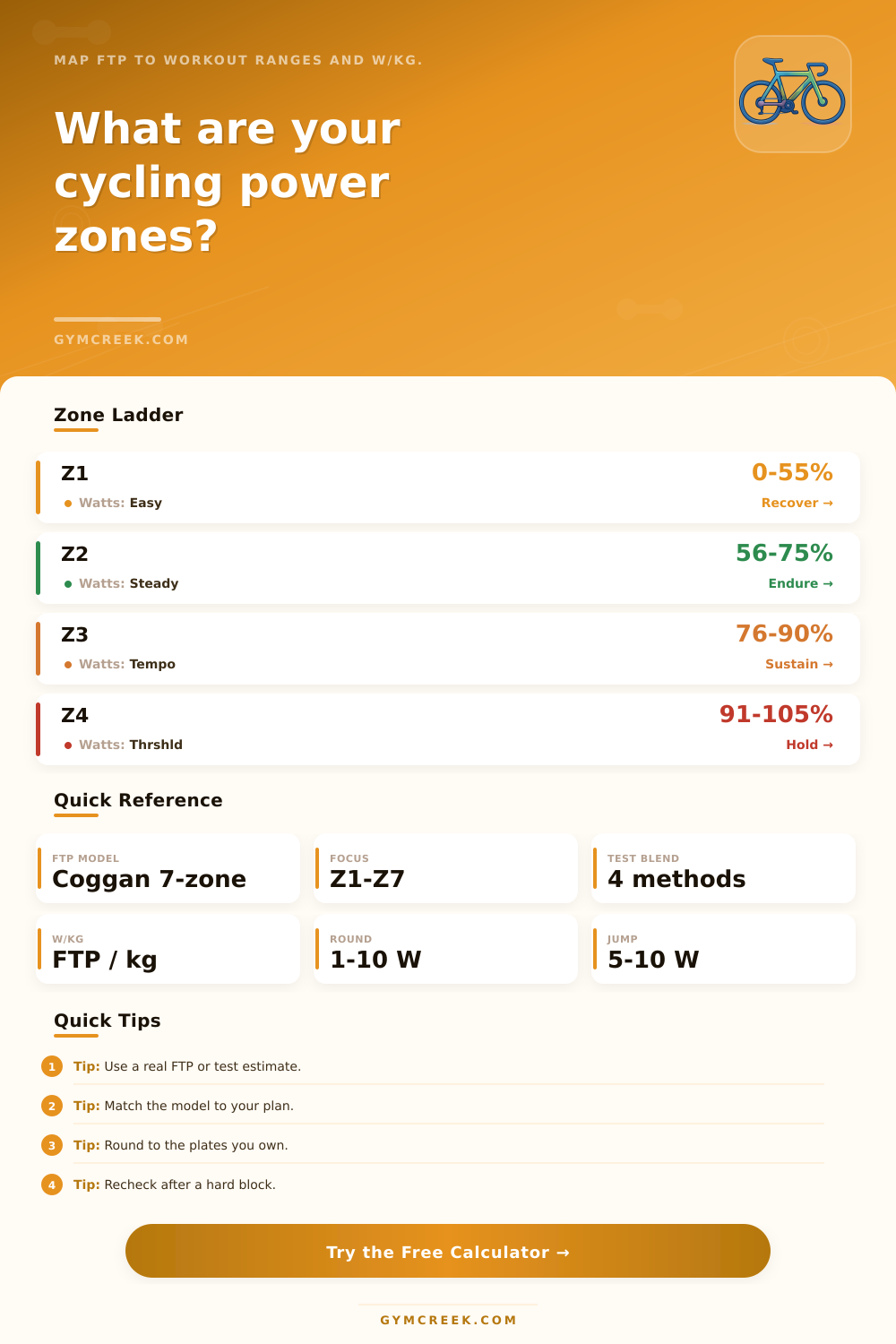
| Z1 | 0-55% | Easy | Recover |
| Z2 | 56-75% | Steady | Endure |
| Z3 | 76-90% | Tempo | Sustain |
| Z4 | 91-105% | Thrshld | Hold |
| Z5 | 106-120% | VO2 | Attack |
| Z6 | 121-150% | Anaer | Punch |
| Z7 | 151%+ | Sprint | Max |
| Focus | Zone | Range | Use |
|---|---|---|---|
| Recovery | Z1 | 0-55% | Fresh |
| Endurance | Z2 | 56-75% | Base |
| Tempo | Z3 | 76-90% | Build |
| Threshold | Z4 | 91-105% | Lift |
| Model | Shape | Best For | Note |
|---|---|---|---|
| Coggan | 7 bands | All round | Most common |
| Sweet spot | 5 bands | Block work | Mid focus |
| Polarized | 3 bands | Easy hard | Simple split |
| Recovery | 4 bands | Back ease | Soft return |
| Method | Factor | Valid if | Use |
|---|---|---|---|
| Manual | 100% | Known FTP | Direct |
| 20 min | 95% | Steady | Classic |
| Ramp | 75% | Fresh legs | Quick |
| 2x8 | 90% | Repeatable | Blend |
| 60 min | 100% | Best test | Exact |
💡Tips
Cycling power zones are specific ranges of power outputs that an individual use when cycling. Cycling power zones allow individuals to understand their fitness level and to utilize that information to determine their power output for a specific type of cycling efforts. If an individual does not use cycling power zones, they may feel that their cycling efforts is guesswork.
However, if they use cycling power zones, they will be able to ensure that every stroke of their pedal has a specific purpose. The first piece of information that an individual must obtain to create there cycling power zones is their Functional Threshold Power (FTP). This is the power output that an individual can sustain for one hour of cycling in a race or other effort.
How to Find and Use Cycling Power Zones
The FTP is an essential value because if an individual creates the wrong value for their cycling power zones, their zone will be incorrect. Cycling power zones that are incorrectly create can lead to the individual becoming either undertrained or overtrained. There are test that can be performed for individuals to find their FTP.
For instance, one test can take place over the course of 20 minutes at an all-out effort. Another test include ramping up an individual’s power output from easy levels to a peak level over time; when completed, this test allows an individual to find their FTP at approximately 75% of their peak minute. An individual’s fitness level will change over time.
Therefore, testing for FTP should be performed at regular interval. For example, during one week an individual may feel particularly freshly and have high FTP numbers. However, during the next week they may feel fatigued and have low FTP numbers.
In order to account for these difference in performance, individuals can use blending tests to find their FTP. These tests include averaging the results of a 20-minute test, ramp test, or eight-minute test. Additionally, dividing an individual’s FTP by their body weight in kilograms will create a value of watts per kilogram (W/kg).
This measurement is another method of determining an individual’s climbing ability. Now that an individual has determined their FTP, they can create their cycling power zones. Power zones can be created by dividing an individual’s FTP into specific ranges.
For example, an individual’s recovery zone will be between 0 and 55% of their FTP. This zone can be used to recover from rides. Additionally, an individual’s endurance zone can be created between 56% and 75% of their FTP; this zone is used to create an individual’s aerobic engine.
The tempo zone exist between 76% and 90% of an individual’s FTP; it allows them to progress toward more challenging efforts. The threshold zone exists between 91% and 105% of their FTP. It is used to increase an individual’s FTP.
Finally, the higher zones, such as the VO2 max and anaerobic zones, are used for short bursts of effort. An individual should not strictly use their cycling power zones for cycling efforts because cycling power zones are meant to be guide. For example, an individual may perform a threshold session, but their power may go to 110% of their FTP for short periods because the goal is to reach that 110% level.
An individual should also listen to their body. For example, when an individual is fatigued, or when they are sick, their cycling power output may not match up with their cycling power zones. In these situation, they can use condition bias to make small adjustments to their cycling power zones according to their physical condition.
In order to test an individual’s FTP, there are procedures that must be followed for the results to be accuracy. First, an individual should warm up properly before beginning the test; otherwise, their legs will be tired when they begin the test. Furthermore, an individual should conserve their energy during the test; the last third of the test will reveal their true FTP.
An individual should also retest their FTP after completing a period of hard training to determine if their FTP has increased by ten or twenty watts as a result of that training. Using the correct cycling power zones will prevent an individual from making several mistake in their cycling training. For example, if an individual chooses to skip the recovery zone, they may experience chronic fatigue; it is during these days that individuals has to perform the hardest training efforts.
If an individual utilizes too many threshold cycling efforts without developing a strong aerobic base, they may erode that aerobic base. An individual can choose to train using different training models to allow for increased development of the specific skill that they wish to improve. For example, an individual can use the Coggan training model to develop different cycling skills, or they can use the polarized training model that suggests 80% of cycling efforts should be at an easy pace, with only 20% of those rides at higher intensities.
By using cycling power zones, whether for developing strength, speed, or endurance, an individual can ensure that their training rides include efforts that will lead to more gains in those specific areas.