Lean Bulk Calorie Calculator
Use your body stats, steps, and training load to map a lean surplus and macro split that supports steady muscle gain.
📌Presets
Each preset loads a realistic lean bulk setup and updates the unit labels before calculation.
⚙Calculator
Lean bulk snapshot
Enter your details and calculate a controlled calorie surplus.
📊Fitness Metrics
📑Reference Tables
| Formula | Uses | Inputs | Output |
|---|---|---|---|
| Mifflin | BMR base | Age, sex | Rest kcal |
| Katch | Lean mass | BF%, lbm | Rest kcal |
| Activity | Daily load | Steps, days | TDEE |
| Surplus | Bulk target | Pace, BF% | Goal kcal |
| Pace | Surplus | Gain | Best fit |
|---|---|---|---|
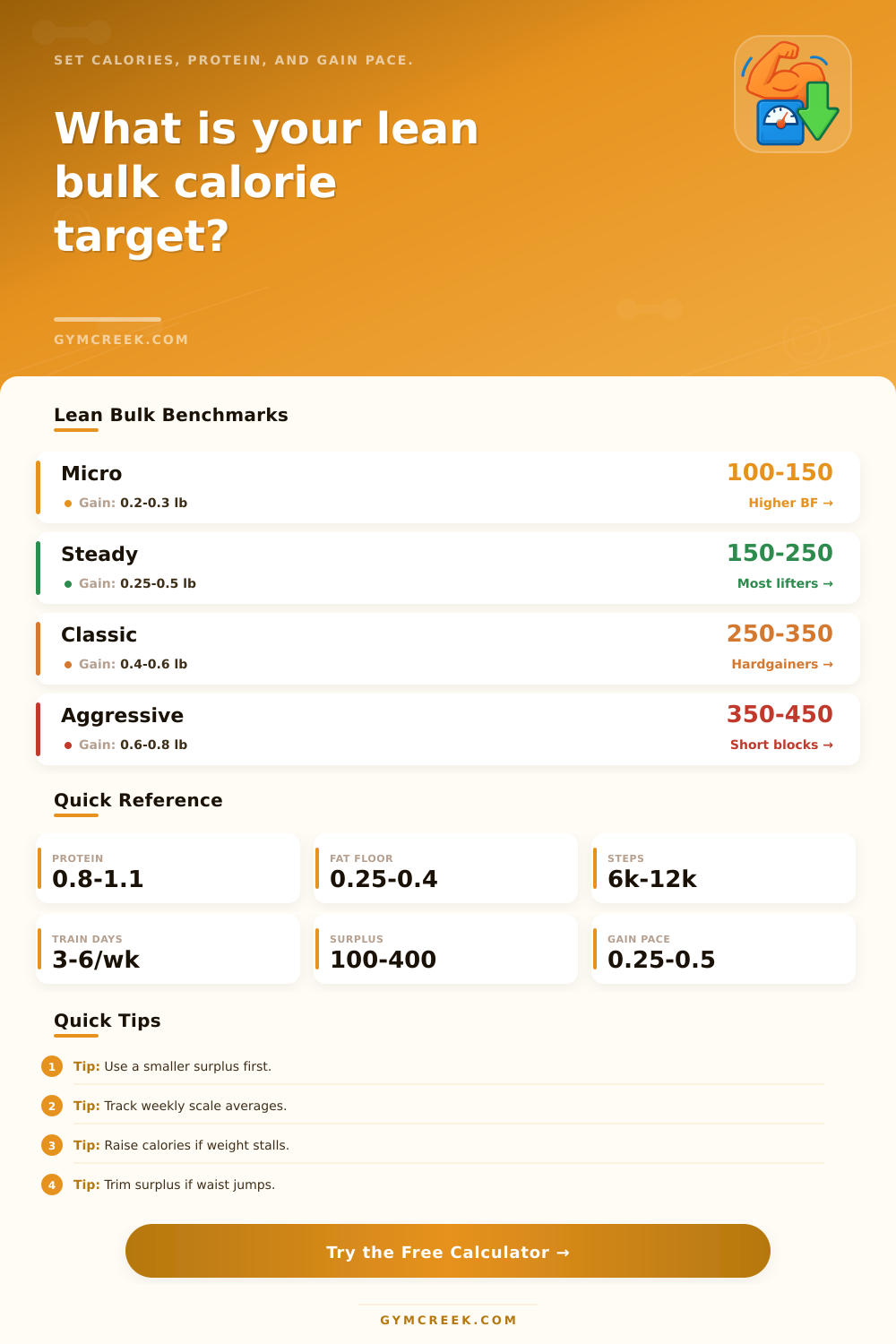
| Micro | 100-150 | 0.2-0.3 lb | Higher BF |
| Steady | 150-250 | 0.25-0.5 lb | Most lifters |
| Classic | 250-350 | 0.4-0.6 lb | Hardgainers |
| Aggressive | 350-450 | 0.6-0.8 lb | Short blocks |
| Macro | Low | Standard | High |
|---|---|---|---|
| Protein | 0.8 g/lb | 0.9-1.0 | 1.1 g/lb |
| Fat floor | 0.25 g/lb | 0.3-0.35 | 0.4 g/lb |
| Carbs | After P | Fill rest | Train focus |
| Fiber | 18 g | 25-35 g | 40 g |
| Scenario | Inputs | Calories | Note |
|---|---|---|---|
| Desk job lifter | 176 lb, 4 d | 2,850 | Small surplus |
| High-step hybrid | 165 lb, 10k | 3,050 | Burns more |
| Post-cut rebound | 184 lb, 5 d | 3,150 | Start steady |
| Hardgainer build | 148 lb, 3 d | 3,250 | Faster ramp |
💡Tips
A lean bulk are a method of gaining body mass by consuming a surplus of calorie. Whereas the traditional bulk method focus on gaining both muscle and body fat, the lean bulk method is focused on gaining muscle mass but minimizing the gain of body fat. Many individuals attempt to gain weight by consuming a high number of calories.
However, consuming to many calories will lead to the gain of body fat. Using lean bulk method will allow an individual to ensure that the weight the body gains is primarily from the gain of muscle mass. To perform a lean bulk, an individual must first calculate the number of calories that an individual burn in a day to maintain their current body weight.
How to Do a Lean Bulk
This number is referred to as an individual’s maintenance calories. A number of factors, such as their age, their height, their weight, and the activity level that they perform each day, influence the number of maintenance calories that an individual burns. Activity level for this calculation include the number of lifting session that an individual performs each week, as well as the number of steps that they walk each day.
For example, an individual that walk a high number of steps per day will have a more higher number of maintenance calories then an individual that does not walk as much. An individual’s body fat percentage can also impact the number of maintenance calories that they requires each day. An individual with a lower body fat percentage may have a different number of maintenance calories than an individual with a higher body fat percentage.
Once an individual determine their maintenance calories, they will add a surplus of calories to that number to reach their target for their bulk period. There are different pace at which an individual can consume the surplus of calories. For instance, an individual can use a micro pace in which they consume a small surplus of calories, which is beneficial for an individual that has a higher body fat percentage.
A steady bulk calorie surplus can be between 150 and 250 calories per day, and this is the most common bulk for strength athlete (lifters). An aggressive or classic bulk method involve adding a higher surplus of calories to the diet than the steady bulk method, and individuals that gain little weight (hardgainers) typically use this. After establishing the surplus of calories that an individual will consume during a lean bulk, an individual must ensure that they provide macronutrients to their body.
The macronutrients to consume include protein, fat, and carbohydrates. An individual should consume between 0.8 and 1.1 grams of protein per pound of body weight to ensure adequate muscle protein repair and growth. Fat should be consumed between 0.25 and 0.4 grams of fat per pound of body weight.
The remainder of an individual’s calories should be satisfied by carbohydrates to ensure that an individual has the energy required to perform their lifting and walk the steps that they need to burn to support their body fat percentage. An individual must track the body’s progress during a lean bulk period. They should track their weight, but the average of their weight over a seven-day period should be calculated to account for the water weight that can fluctuate within the body over time.
If an individual find that their seven-day average of their weight does not increase after two weeks, they should increase their calories by 100 to 200 calories per day to allow for the increase of their body weight. However, if an individual’s waist measurement increase too quickly, they should decrease the number of calories that they consume to avoid the gain of body fat. Lean bulking method require some degree of patience and consistency.
Every few months an individual may want to adjust the number of calories that is consumed each day. This is due to the fact that an individual’s maintenance calories may change. For instance, if their body fat percentage changes, they may need to adjust the number of calories that is consumed with their lean bulk.
By following these methods and consuming a surplus of calories while also hitting the protein targets and lifting weights regular, an individual will gain muscle mass in a controlled manner.