E1RM Calculator
Estimate a true one-rep max, compare formulas, and see the training max and rep equivalents from any real working set.
📌Presets
Each preset loads a realistic strength test and updates the unit labels before you calculate.
⚙Calculator
E1RM snapshot
Enter a working set to calculate the projected max and strength band.
📊Strength Metrics Grid
📑Reference Tables
| Formula | Bias | Best use | Note |
|---|---|---|---|
| Epley | Mid | 3-8 reps | Fast check |
| Brzycki | Low | 1-6 reps | Strict feel |
| Mayhew | Blend | 2-10 reps | Even curve |
| Lombardi | High | 5-12 reps | Rep-friendly |
| Set feel | RPE | RIR | Signal |
|---|---|---|---|
| Fresh | 6-7 | 3-4 | More room |
| Working | 7-8 | 2-3 | Solid set |
| Hard | 8-9 | 1-2 | Near limit |
| Grinder | 9-10 | 0-1 | Fatigued |
| Lift | Novice | Strong | Elite |
|---|---|---|---|
| Bench | 0.75x | 1.25x | 2.0x |
| Squat | 1.0x | 1.75x | 2.5x |
| Deadlift | 1.25x | 2.0x | 3.0x |
| Press | 0.5x | 0.9x | 1.5x |
| Reps | Bias | Best use | Caution |
|---|---|---|---|
| 1-3 | Low | Heavy test | Small spread |
| 4-6 | Balanced | Top sets | Good range |
| 7-8 | Higher | Work sets | Form matters |
| 9-12 | Highest | Volume work | More error |
💡Tips
An estimated one-rep max, or e1RM, are a calculation that uses your working set to calculate the one-rep max that you can lift. By performing a set with a specific weight, you can calculate the e1RM for that exercise. By calculating your e1RM, you can use that number to plan your future training without having to calculate your true one-rep max every training session.
Performing a one-rep max will leave you very fatigue, but calculating your e1RM allows you to plan your training such that you dont experience excessive fatigue. To calculate your e1RM, there are a few different variables that need to be account for in order to ensure your e1RM reflects your strength accurate. These variables includes the weight that you used for your set, the number of repetitions that you performed, the rate of perceived exertion for your set, and your number of repetitions in reserve.
How to Calculate Your Estimated One-Rep Max
If you used a high RPE with a low RIR for your set, your e1RM will reflect a high level of effort for that set. Conversely, if your RPE was low with a high RIR, your e1RM will reflect that you had more strength during your set than your e1RM suggest. A few different mathematics formulas can calculate your e1RM.
Some formula are used for sets with specific repetitions. For example, the Epley formula is used for sets with between three and eight repetitions. Additionally, people consider the Brzycki formula more accurately for sets with between one and six repetitions.
Because neither of these formulas will provide an exact measurement for your e1RM, a blended projection of these two e1RMs is best. Using a blended projection will provide a more accurate e1RM for training suggestion because it will account for the errors in each of the individual formulas. The type of lift that you perform will also affect the accuracy of your e1RM.
For example, performing a deadlift with a deadstop is a different lift than a touch and go deadlift. Dead-stop exercises are considered to be more difficult to perform, thus resulting in a lower e1RM for the same weight as a touch-and-go deadlift. To account for these different styles of performing lift, you must adjust your e1RM accordingly for accurate determination of your e1RM.
If you do not adjust for the style of the lift when calculating 1RM, then your 1RM may be too high or too low. As discussed above, strength is also relative to the bodyweight of the individual. Therefore, it is also possible to compare a 1RM to bodyweight to determine if the strength of an individual is appropriate to there level of experience with weightlifting.
For instance, an individual could compare their bench press 1RM to their bodyweight to determine if they are a novice, intermediate, or advanced weightlifter. Their bodyweight is one means of providing context to the raw 1RM strength figure of an individual. Once an individual calculates their 1RM, they should use a training max to plan their training cycle.
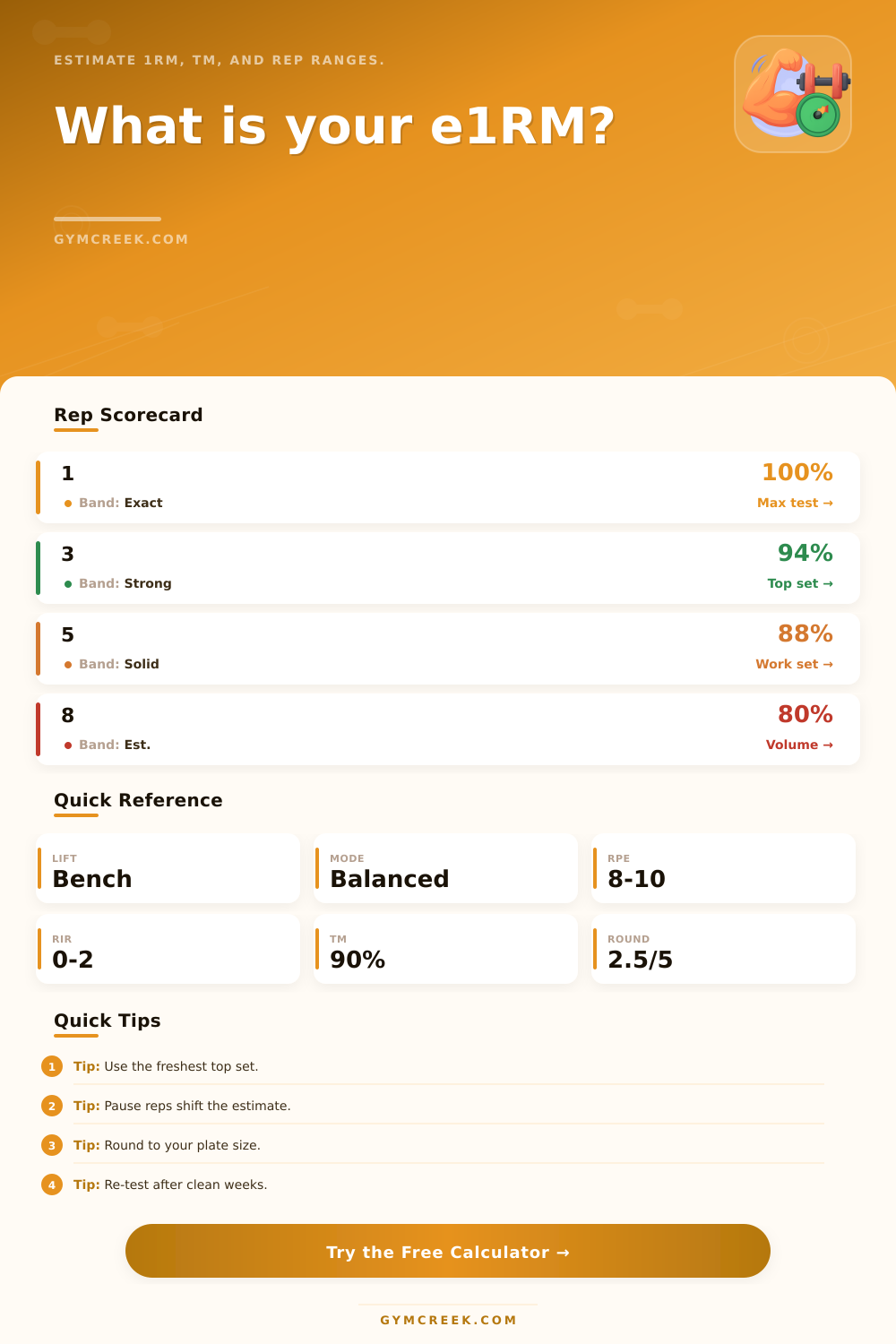
Training max is typically 90% of an individuals 1RM. The training max will ensure that the individual does not lift weights that are too heavy for their current strength. Training cycles can be build with the training max of an individual using percentages of that 1RM strength.
In addition to calculating the training max of an individual, it is also important to monitor their levels of fatigue. An individuals e1RM may drop due to fatigue, even if their actual strength has not changed. Fatigue level are cumulative during a training cycle.
By tracking an individuals e1RM over a period of time, it is possible to determine if their strength is increasing, or if their fatigue is negatively impacting their performance. An individual’s e1RM can be verified by performing a set of five repetitions; if the number of repetitions performed with difficulty decline to the same number as calculated for e1RM, then the e1RM for that lift is accurate. An individual should also ensure that their technique is consistent with their sets.
Poor technique will result in an inaccurate 1RM strength figure. An inaccurate technique can change the 1RM of an individual by a significant percentage. Therefore, individuals should ensure that they are performing their sets with proper technique to ensure that their calculated 1RM is accurate for future training cycles.
By calculating an accurate 1RM strength figure for each individual, it is possible to create training programs for those individuals based off the truth of their strength, and to allow for even the development of steady rate of strength progression.