Goal Weight Date Calculator
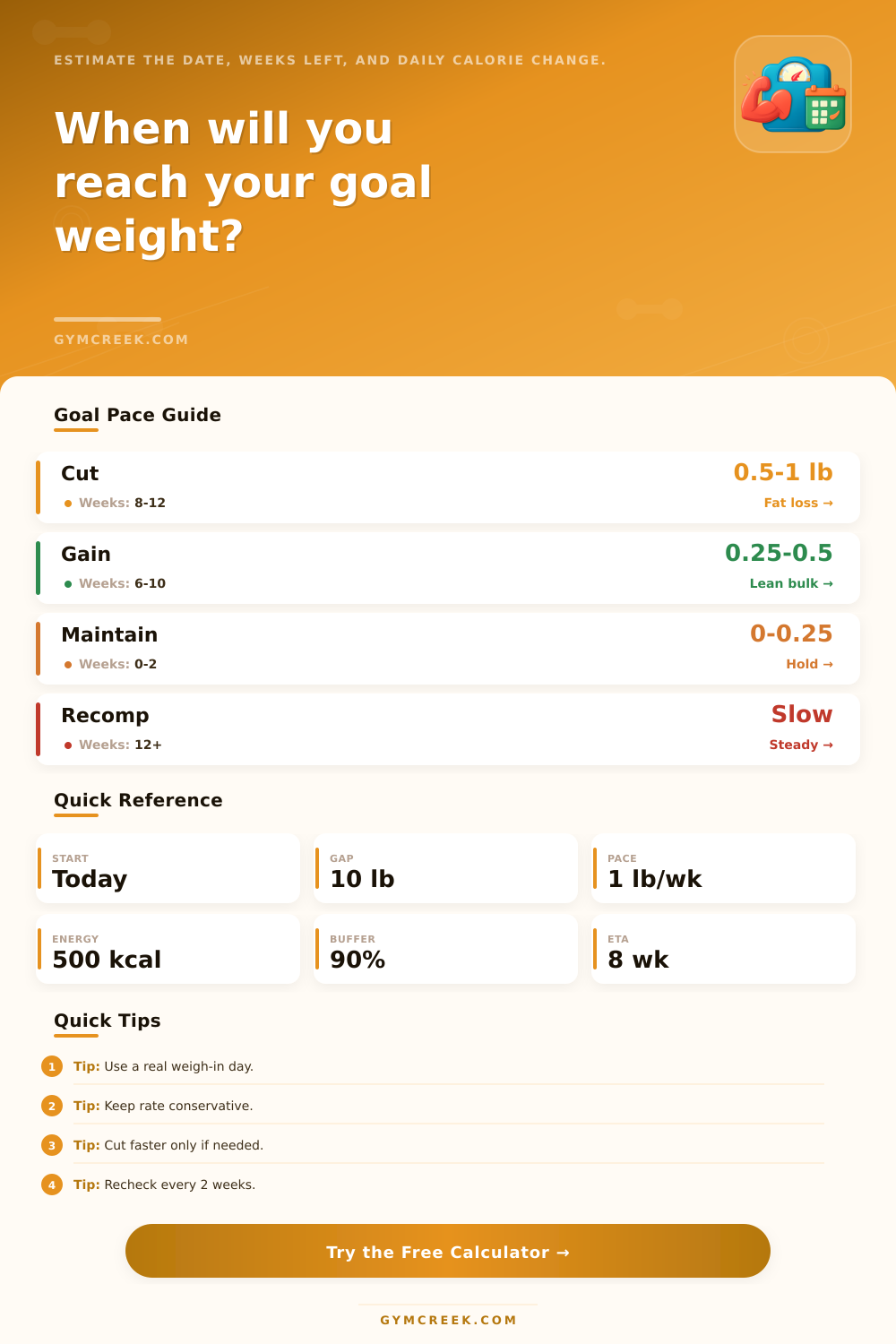
Estimate the date, weeks left, and daily calorie change needed to reach your target weight at a realistic pace.
📌Presets
Each preset loads a realistic bodyweight goal and recalculates the timeline immediately.
⚙Calculator
Goal date snapshot
Enter a current weight, goal weight, and pace to project your target date.
📊Goal Metrics Grid
📑Reference Tables
| Goal type | Typical pace | Fast pace | Use |
|---|---|---|---|
| Cut | 0.5-1 lb | 1-1.5 lb | Fat loss |
| Gain | 0.25-0.5 | 0.5-0.75 | Lean bulk |
| Maintain | 0-0.25 | 0-0.1 | Hold |
| Recomp | 0.25-0.5 | 0.5-0.75 | Slow |
| Unit | 1 week | Daily | Example |
|---|---|---|---|
| lb | 3500 kcal | 500 kcal | 1 lb/wk |
| kg | 7700 kcal | 1100 kcal | 1 kg/wk |
| Cut | Deficit | Negative | Down |
| Gain | Surplus | Positive | Up |
| Target | Rate | Weeks | Notes |
|---|---|---|---|
| 10 lb cut | 1 lb/wk | 10 | Simple |
| 5 lb cut | 0.5 lb/wk | 10 | Slow |
| 5 kg cut | 0.5 kg/wk | 10 | Metric |
| 4 kg gain | 0.25 kg/wk | 16 | Lean |
| Cadence | Check-in | Best use | Note |
|---|---|---|---|
| Weekly | 7 days | Hard cut | Fast adjust |
| Biweekly | 14 days | Normal cut | Stable trend |
| Monthly | 28 days | Maintenance | Slow trend |
| Any | Avg 7-14 | Recomp | Use averages |
💡Tips
In order to reach a goal weight, individuals must create a timeline for their weight loss or weight gain. A timeline for weight loss or gain will tell individuals the number of weeks it will take to reach the desired goal weight. Using a timeline allows individuals to see the rate of weight loss or gain that is realistic for that individual.
Because weight does not change instant, and only changes with a consistant calorie deficit or surplus, individuals can use a timeline to determine a safe weight loss or gain rate. Too fast of a rate can result in the loss of muscle for individuals attempting to lose weight, while too slow of a rate can result in the loss of motivation for individuals attempting to lose weight. By mapping the goal weight to a specific date, individuals can plan for potential mistake along the way.
Plan to Reach Your Goal Weight
The rate at which an individual lose weight can depend on a variety of different factors. One factor is the weight of the individual. An individual that weighs less will lose weight at a different rate than an individual that weighs more.
An individual that weighs more will lose more weight each week without losing muscle mass. Another factor is the gender of the individual. Because men and women typically has different metabolisms and muscle mass, there gender can affect the rate at which an individual loses weight.
Finally, the goal that the individual has can impact the rate at which they lose weight. Individuals that wish to lose weight has a calorie deficit, while individuals that wish to gain weight has a calorie surplus. The weekly change rate for an individual is arguably the most important factor within the plan to lose or gain weight.
Since one pound of weight contains 3,500 calories, individuals can use this to calculate the amount of calories that they need to consume daily in order to gain or lose weight at the rate that they desires. If an individual desires to lose half a pound of weight per week, they would need to consume 250 calories less daily. If they desire to lose one pound of weight per week, they would need to consume 500 calories less daily.
Consistency is the most important factor to losing or gaining weight. It is better for an individual to have a plan that they follow 90% of the time than to have a perfect plan that is followed 0% of the time. An individual should weigh themselves at regular intervals to ensure that they are following their plan for weight gain or loss.
The check-in cadence that an individual sets for themselves is the number of times that they will weigh themselves each week in order to track their weight. During weight cut plans, individuals should weigh themselves once each week. Weighing themselves once each week will allow them to catch any increase in their weight.
For maintenance plans, individuals should weigh themselves once each month. During maintenance plans, the changes to the individual’s weight is very slow. For individuals in both cutting and maintenance plans, weighting themselves every two weeks is often the best plan for maintaining mental health as well as tracking their weight.
Individuals should always weigh themselves at the same time each morning and on the same scale to avoid any mistakes in their tracking of weight. A variety of different factor can impact the number that an individual weighs themselves. Sleep deprivation can increase the amount of cortisol in an individual’s body.
High level of cortisol can stall the fat loss that the individual is trying to achieve. The amount of training that an individual participates in will make them gain muscle. The weight gain will make it seem like the fat loss is not occurring.
High levels of sodium and carbohydrates cause water retention in the body. Water retention can make the weight gain appear as though it is plateauing. Women may gain water weight due to their hormonal cycle.
Men may gain weight due to the intense training that they perform. Because an individual’s weight can change daily, individuals should weigh themselves weekly to determine the true change in their weight. In addition to the weekly weight measurements, the individual can also use body measurements and body fat percentage measurements to confirm the changes that are occurring in their body.
There are a variety of common mistake that could lead to an individual’s failure in meeting their weight goals. One of the most common mistakes is attempting to lose weight too quickly. Eventually, the body will adapt to the changes that an individual is making, and the rate at which an individual loses weight will slow.
Another mistake that individuals make is ignoring the consistency in which they adhere to their plan. Ignoring the consistency will lead to an individual’s timeline to gain or lose weight to be longer than they should. For individuals attempting to lose weight for a specific event, they may attempt to lose the most weight in the shortest period of time.
Losing weight too fast can lead to weight rebound. Finally, individuals must understand that weight loss is not a straight line. If an individual’s weight gain or loss plan is not working as well as they would like, they must make adjustments in either the calories that they consume or the amount of exercise that they perform.
By following the plan that they created for themselves, at a realistic rate, individuals will eventually reach their goal weight.