🏋 Incline Bench Press Max Calculator
Estimate your 1-Rep Max using your working weight & reps — with strength standards & training zone breakdowns
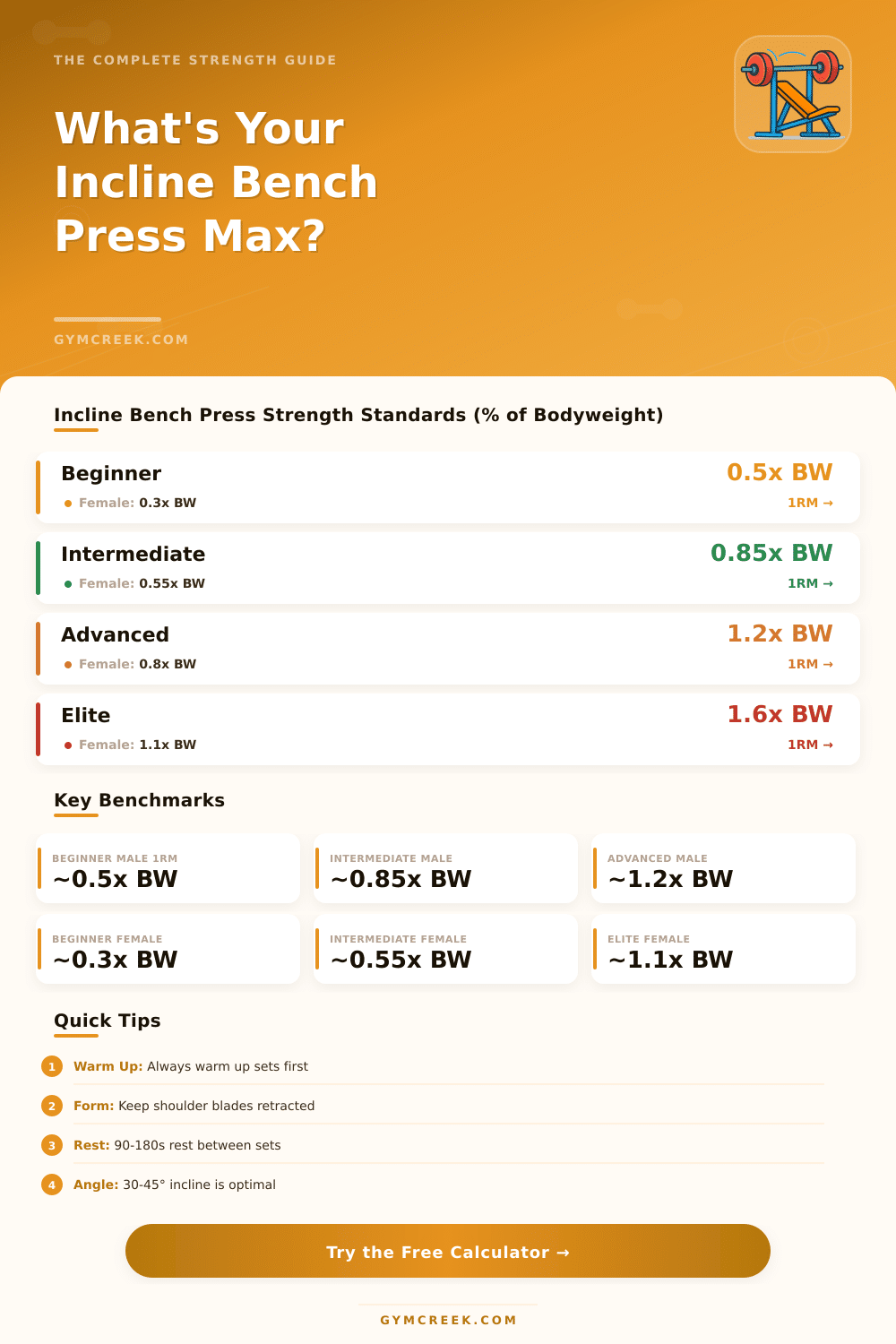
| Level | Male (x BW) | Female (x BW) | Male Example (175 lbs) | Female Example (135 lbs) |
|---|---|---|---|---|
| Untrained | 0.35x | 0.20x | 61 lbs | 27 lbs |
| Beginner | 0.55x | 0.35x | 96 lbs | 47 lbs |
| Novice | 0.75x | 0.50x | 131 lbs | 68 lbs |
| Intermediate | 0.95x | 0.65x | 166 lbs | 88 lbs |
| Advanced | 1.25x | 0.85x | 219 lbs | 115 lbs |
| Elite | 1.60x | 1.10x | 280 lbs | 149 lbs |
| Reps | % of 1RM | Training Goal | RPE Range |
|---|---|---|---|
| 1 rep | 100% | Max Strength Test | RPE 10 |
| 2 reps | 97% | Maximal Strength | RPE 9.5–10 |
| 3 reps | 94% | Maximal Strength | RPE 9–9.5 |
| 4 reps | 92% | Strength | RPE 8.5–9 |
| 5 reps | 89% | Strength / Power | RPE 8–9 |
| 6 reps | 86% | Strength / Size | RPE 8 |
| 8 reps | 81% | Hypertrophy | RPE 7.5–8 |
| 10 reps | 75% | Hypertrophy | RPE 7–8 |
| 12 reps | 70% | Hypertrophy / Endurance | RPE 7 |
| 15 reps | 65% | Muscular Endurance | RPE 6.5–7 |
| 20 reps | 55% | Endurance | RPE 6 |
| Formula | Equation | Best For | Accuracy Note |
|---|---|---|---|
| Epley | w x (1 + r/30) | General use, most popular | Slight overestimate at high reps |
| Brzycki | w x 36 / (37 – r) | 1–10 rep range | Most accurate under 10 reps |
| Lombardi | w x r^0.10 | Higher rep ranges | Conservative estimate |
| Mayhew | 100 x w / (52.2 + 41.9 x e^(-0.055 x r)) | Athletic populations | Good for trained athletes |
| O'Conner | w x (1 + r/40) | Beginners | Lower estimate, safer starting point |
| Goal | % of 1RM | Rep Range | Rest Between Sets | Sets |
|---|---|---|---|---|
| Max Strength | 90–100% | 1–3 | 3–5 min | 3–5 |
| Strength | 80–90% | 3–5 | 2–4 min | 4–6 |
| Power | 55–75% | 2–5 (explosive) | 2–3 min | 3–5 |
| Hypertrophy | 67–80% | 6–12 | 60–90 sec | 3–5 |
| Endurance | 50–65% | 12–20+ | 30–60 sec | 2–4 |
The Incline Bench Press is a kind of usual bench press. One uses this exercise to strengthen the chest muscles. The main advantage of the Incline Bench Press is that it focuses more on the upper chest.
DISCLOSURE: This post may contain affiliate links, meaning when you click the links and make a purchase, I receive a commission. As an Amazon Associate I earn from qualifying purchases.

The main benefit of that move is building the upper part of the chest muscles. It also trains the deltoids and triceps as secondary muscles.
Incline Bench Press to Build Your Upper Chest
When one inclines the bench the shoulders receive more work, because the position is like a shoulder press. The higher the incline, the more the shoulder muscles engage. A good angle to choose is between 30 and 45 degrees.
Some like the ideal incline around 30 to 34 degrees. After you chose the angle, stay at it is good strategy.
The Incline Bench Press on an incline bench is more key than on flat. The way of the bar becomes much more narrow in depth, and that shows more with the steepness of the incline. Usually one must use less weight for the Incline Bench Press than for flat.
That is entirely normal, so do not worry about that. Only a bit more lightweight load is needed, but for goals of bodybuilding it does not really matter.
Good position is very important. The head, upper back, lower back and both feet should press flat against the bench. Set the feet on the floor, press the glutes against the bench, tighten the abs and draw the shoulders back to the pad to create stability.
A pair of safety bars, placed just under the upper chest level, will catch the bar if it would slip.
One should push the bar upward fast. The slow and controlled lowering is key. Bringing the bar down high on the chest, at the collarbones, allows deep stretch for the chest muscles.
If the way of the bar is too close too the collarbones, though, it can start feeling more like a shoulder press.
The Incline Bench Press can work as the main chest exercise or as a helpful move to the flat bench press. It gives a more complete chest, that looks more attractive. Working with incline exercises helps to remove chest imbalances, that come from too much flat pressing.
Upper and incline training commonly helps to fill gaps in flat pressing. Incline pressing also limits cheating and shows real pressing strength. If one does it wrong, though, it can injure the rotator cuff, so good form is really key.
The incline position naturally moves the shoulderblades differently than on a flat bench, which canbe useful for many lifters.