⚡ HIIT Heart Rate Zone Calculator
Calculate your work and rest interval heart rate targets for any HIIT protocol using simple percentage and Karvonen methods.
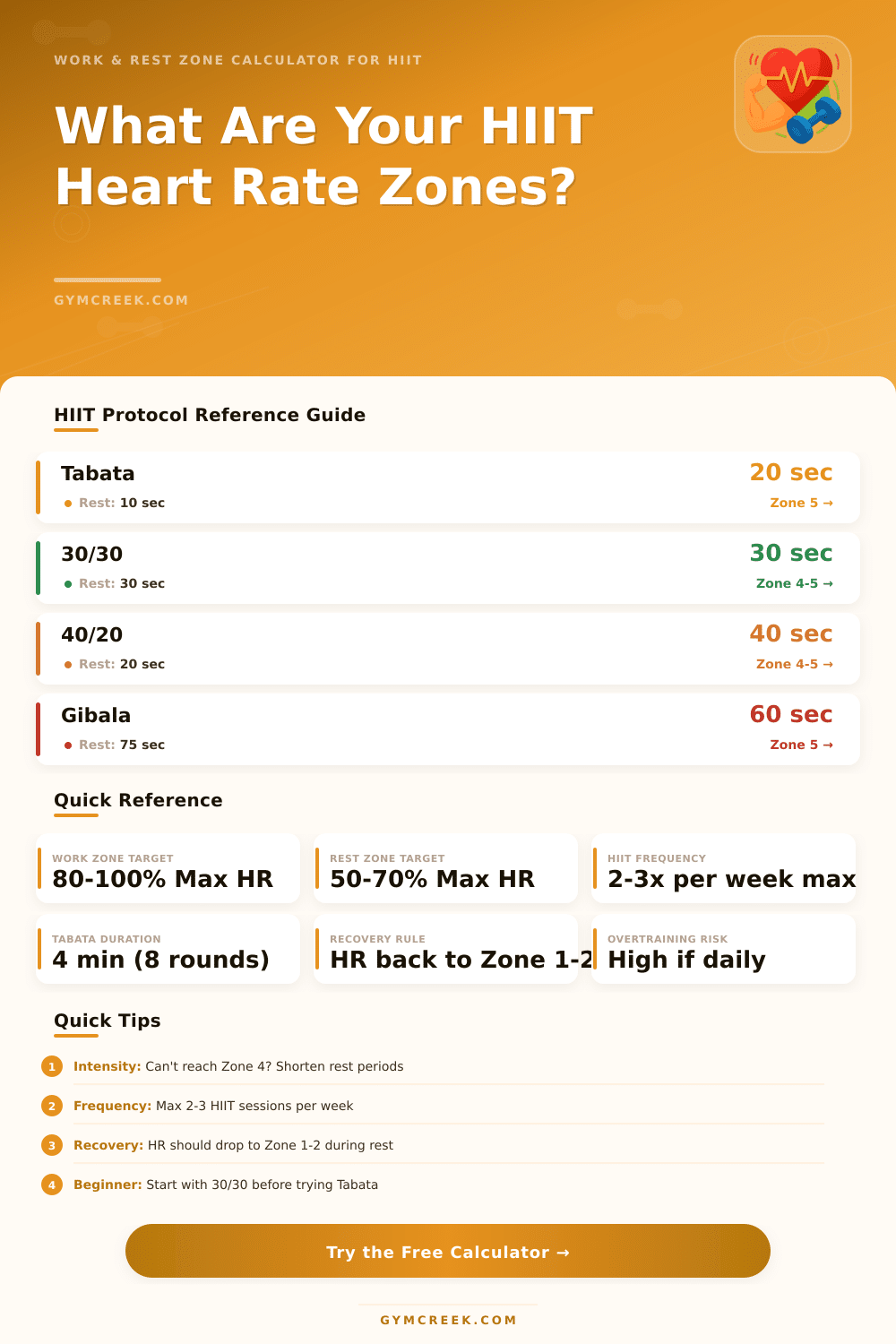
| Protocol | Work | Rest | Rounds | Target Zone | Best For |
|---|---|---|---|---|---|
| Tabata | 20 sec | 10 sec | 8 | Zone 5 (90–100%) | Advanced athletes |
| 30/30 | 30 sec | 30 sec | 10–20 | Zone 4–5 (80–95%) | Intermediate |
| 40/20 | 40 sec | 20 sec | 10–15 | Zone 4–5 (80–95%) | Intermediate–Advanced |
| Gibala | 60 sec | 75 sec | 8–12 | Zone 5 (90–100%) | Advanced athletes |
| Custom | Variable | Variable | Variable | Zone 4–5 | All levels |
| Zone | % Max HR | bpm (Age 30) | HIIT Phase | Purpose |
|---|---|---|---|---|
| Zone 1 | 50–60% | 94–112 | Warm-up / Cool-down | Prepare body, flush lactate |
| Zone 2 | 60–70% | 112–131 | Active rest target | Fat burning, aerobic recovery |
| Zone 3 | 70–80% | 131–150 | Light work / transition | Aerobic power development |
| Zone 4 | 80–90% | 150–169 | Work interval floor | Lactate threshold, race pace |
| Zone 5 | 90–100% | 169–187 | Peak work interval | VO2 max, speed, power |
HIIT is made up of repeated cycles with high effort, followed by short rest moments. Those strong phases last from some seconds up to eight minutes. In them, one tries to reach 80 to 95 percent of the almost maximum Heart Rate Zone.
Maximum Heart Rate Zone means the biggest number of beats that the heart can have in a minute, without overworking itself.
HIIT and Heart Rate Zones
A common way to count the maximum heart rate is 220 minus the age. Like this, a 45-year-old person would have an estimated 175 beats in a minute. Even so that method is not entirely reliable.
It works more as a landmark. Think of it: someone that ends the day before his birthday and the next, would not change sharply his real maximum. Between the intended and the actually reached maximum can lie a big gap.
Average cardio training happens usually at 50 to 80 percent of the maximum Heart Rate Zone. HIIT brings a much higher level, normally 80 to 95 percent during the work intervals. In rest times the Heart Rate Zone drops to around 40 to 50 percent.
The Heart Rate Zone does not jump right away to 80 percent, because the buildup of carbon dioxide in the blood is not immediate. Here is why one calls it interval training: one slowly strengthens the heart, then lets it fall.
A typical HIIT session starts with a five-minute warm-up, followed by six to ten circles with around 30 seconds of strong effort and 15 seconds of light movement. Some favor intervals of two minutes and 30 seconds at medium speed, with 30 seconds of run. Eight such circles are enough too feel tired.
At the end of the session, everyone’s Heart Rate Zone will probably differ from that of the others. Age, fitness level and personal metabolism all affect that. For a healthy 42-year-old man, reaching 170 to 182 beats in a minute during intervals is commonly normal and not naturally dangerous.
During HIIT the Heart Rate Zone can stay behind the real effort, which makes follow-up hard. Wrist-based monitors commonly show too low values in HIIT sessions. Chest-based optical devices tend to be more precise than wrist sensors.
HIIT strengthens the lungs and the cardiovascular system. It raises the heart to the range good for cardiovascular growth, around 60 to 80 percent of the maximum. Studies point out that the maximum oxygen uptake grows more effectively with high intensity movement than with steady movement.
HIIT even beats steady high intensity training for improving VO2max, because short intervals allow reaching even higher intensity. Low physical activity is a risky factor for cardiovascular diseases, and the range of Heart Rate Zone can improve after full-body HIIT training.
Too much HIIT hurts results, while it grows tiredness andwounds. If one does it well, it can push the heart past the limit. The order and timing of the exercises are key for reaching the maximum benefit from it.