Relative Intensity Calculator
Turn a working set into a clean %1RM estimate, account for RPE and reps in reserve, and map the result to the next training phase.
📌Presets
Each preset loads a real lifting scenario, updates the unit labels, and recalculates immediately.
⚙Calculator
Relative intensity snapshot
Enter a working set to calculate %1RM, the adjusted max, and the next target load.
📊Intensity Metrics
📑Reference Tables
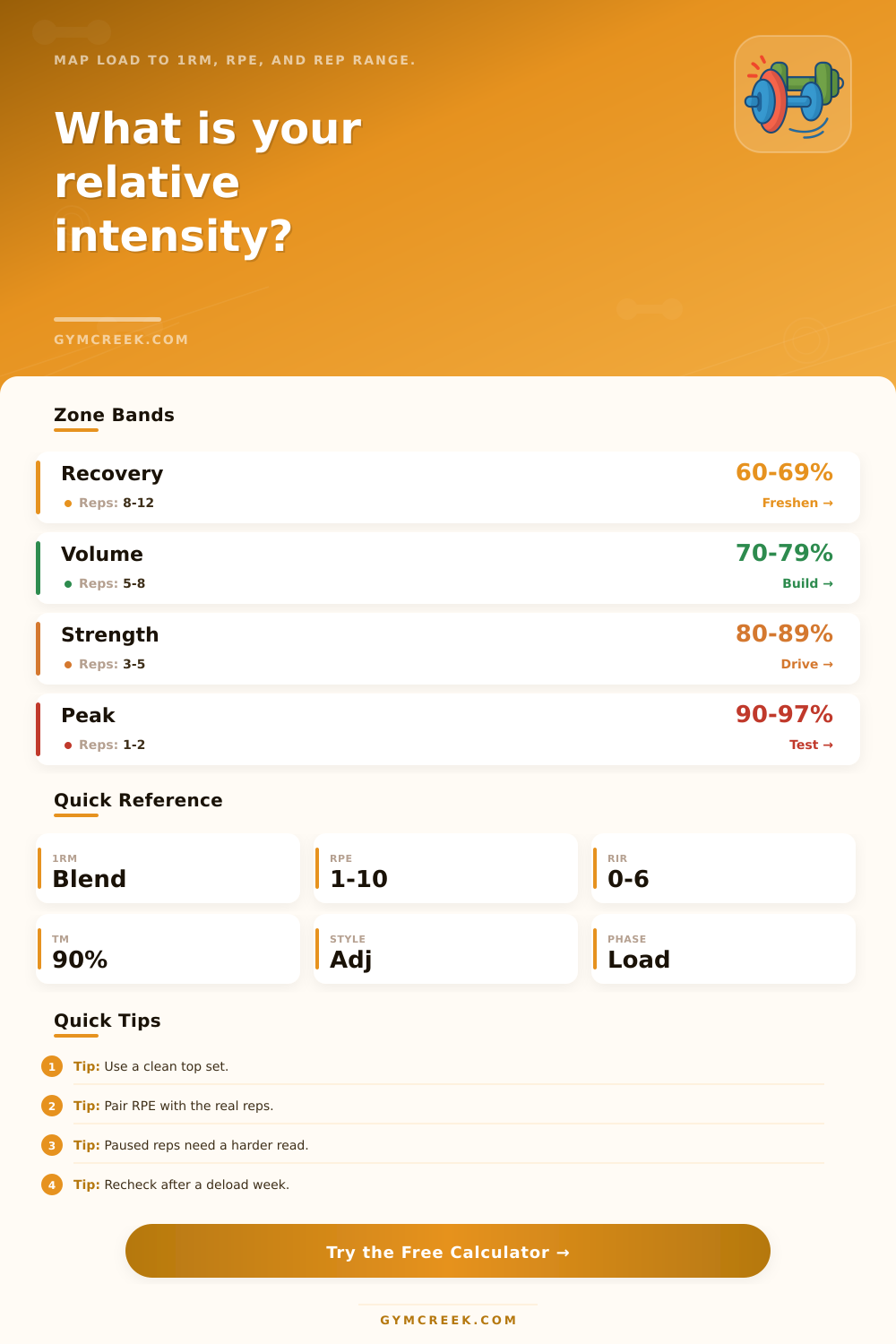
| Zone | Band | Reps | Use |
|---|---|---|---|
| Recovery | 60-69% | 8-12 | Freshen |
| Volume | 70-79% | 5-8 | Build |
| Strength | 80-89% | 3-5 | Drive |
| Peak | 90-97% | 1-2 | Test |
| Style | Adj reps | Bias | Read |
|---|---|---|---|
| Standard | 0.0 | Neutral | Base |
| Paused | +0.5 | Harder | Slower |
| Tempo | +1.0 | Strict | Hardest |
| Touch-go | -0.3 | Easier | Faster |
| Formula | Best range | Bias | Use |
|---|---|---|---|
| Epley | 1-10 | High | Top set |
| Brzycki | 1-12 | Low | Tight rep |
| Lombardi | 1-8 | Middle | Short set |
| O'Conner | 1-6 | Steady | Single |
| RPE | RIR | Effort | Note |
|---|---|---|---|
| 6-7 | 4-3 | Light | Practice |
| 8 | 2 | Moderate | Work set |
| 9 | 1 | Heavy | Near max |
| 10 | 0 | Max | All out |
💡Tips
Relative intensity is a method of determining how hard a specific set of exercises is for an person. Relative intensity measures a set as a percentage of a persons one-repetition maximum. Additionally, relative intensity also takes into account the effort that a person exert during a set and the specific style of the repetitions that person performed.
Relative intensity allow a person to understand whether a training program is meant to increase muscle volume or strength. If a person dont use relative intensity to train, they will not be able to progress as quickly with there training and may even experience burnout from performing to hard on there muscle. A one-repetition maximum for a specific exercise is the maximum amount of weight that a person can lift for one repetition of that exercise.
Relative Intensity: How Hard Your Workout Is
When performing repetitions with a pause, the weight will feel as if it is heavier for the person performing the exercises. This is because performed repetitions with a pause will remove the stretch reflex from the muscle being exercised. The one-repetition maximum calculator must be adjusted for sets that contain pause so that the estimate remains accurate.
Effort ratings is used in addition to the number of repetitions that a person completes during a training session. One popular effort rating is the rating of perceived exertion, or RPE for short. On a scale from one to ten, an RPE of ten means that a person has performed there set to the point of total failure.
An RPE of eight means that a person has two repetitions left in reserve. Repetitions in reserve are the number of repetitions that a person could of performed before they failed to complete another repetition. RPE and RIR must align with each other, or else a person may be tired or may be performing inconsistent training that does not allow for adequate development of strength.
Relative intensity allows for the placement of a training program into different zone. For relative intensity values between 70 and 79 percent, a person is working in a volume zone for the exercises that they are performing. Volume zones are used to develop muscle without overtiring the bodys central nervous system.
For relative intensity values between 80 and 89 percent, a person is working in a strength zone for there exercises. These types of training zones focuses on the development of neural drive for better performance of exercises. For relative intensity values above 90 percent, a person is either peaking in there strength or performing exercises to test there one-repetition maximum.
Not all exercises will have the same relative intensity scaling. For instance, exercises like deadlifts and leg presses will have a different scaling different than exercises like rows or presses. When focusing on relative intensity, many mistakes is made by focusing only on the raw numbers.
For instance, the quality of the sets that are performed are important. For instance, training age determine the consistency of the data that can be collected from an individual. An inexperienced exerciser may exhibit inconsistent form in there exercises; inconsistent form will result in inaccurate measurements of a one-repetition maximum.
The style of the sets that are performed also must be accounted for in the calculation of relative intensity for a specific group of exercises. For instance, sets that contain tempo and grinder repetitions have a higher relative intensity than sets that perform only the basic exercise of the muscle being trained. The transition between training blocks is part of the programming for an individuals training routine.
When training is in the volume block stage, after the completion of that block, the body should transition into a strength training block. During a strength training block, the weights that is lifted will be heavier and the number of repetitions will be reduced. During a deload period for an individuals training program, the relative intensity should be reduced to a seven.
Reducing the relative intensity to a seven allows the body to recover and to rest. Presets can be used to manage the transition between training blocks. Presets allow for adjustments to the weights that are lifted from pounds to kilogram or to account for body weight ratio.
There are different formulas that can be used to calculate the one-repetition maximum for an individual. One formula, the Epley formula, is best used for sets when an exerciser is lifting a top weight. The Brzycki formula is better for sets with fewer than twelve repetitions.
A variety of formulas should be used rather than relying on only one to calculate a one-repetition maximum. Using an average of the different formulas will allow for the data to be less biased. The same training routine should be used each week to calculate a one-repetition maximum.
The body should always use the same setup for the exercises and have the same path for the barbell for maximum accuracy. Body weight can also be measured as an additional measurement of relative intensity. An individual can use there body weight to compare the weight that they are lifting to there body weight to determine how heavy the weight is relative to there body.
This is an optional measurement; however, it can help an individual understand if there demand on the body are too high. Finally, a confidence score can be used in the calculation of relative intensity. This score balances the number of repetitions that are performed, the repetitions in reserve, and the style of the sets that are performed.
A high confidence score means that the individual has trust in the training plan. A low confidence score allow for the individual to adjust there form or to allow there body to rest.