❤️ Heart Rate Zone Calculator by Age
Find your personalized target heart rate zones for fat burn, cardio fitness, and peak performance training.
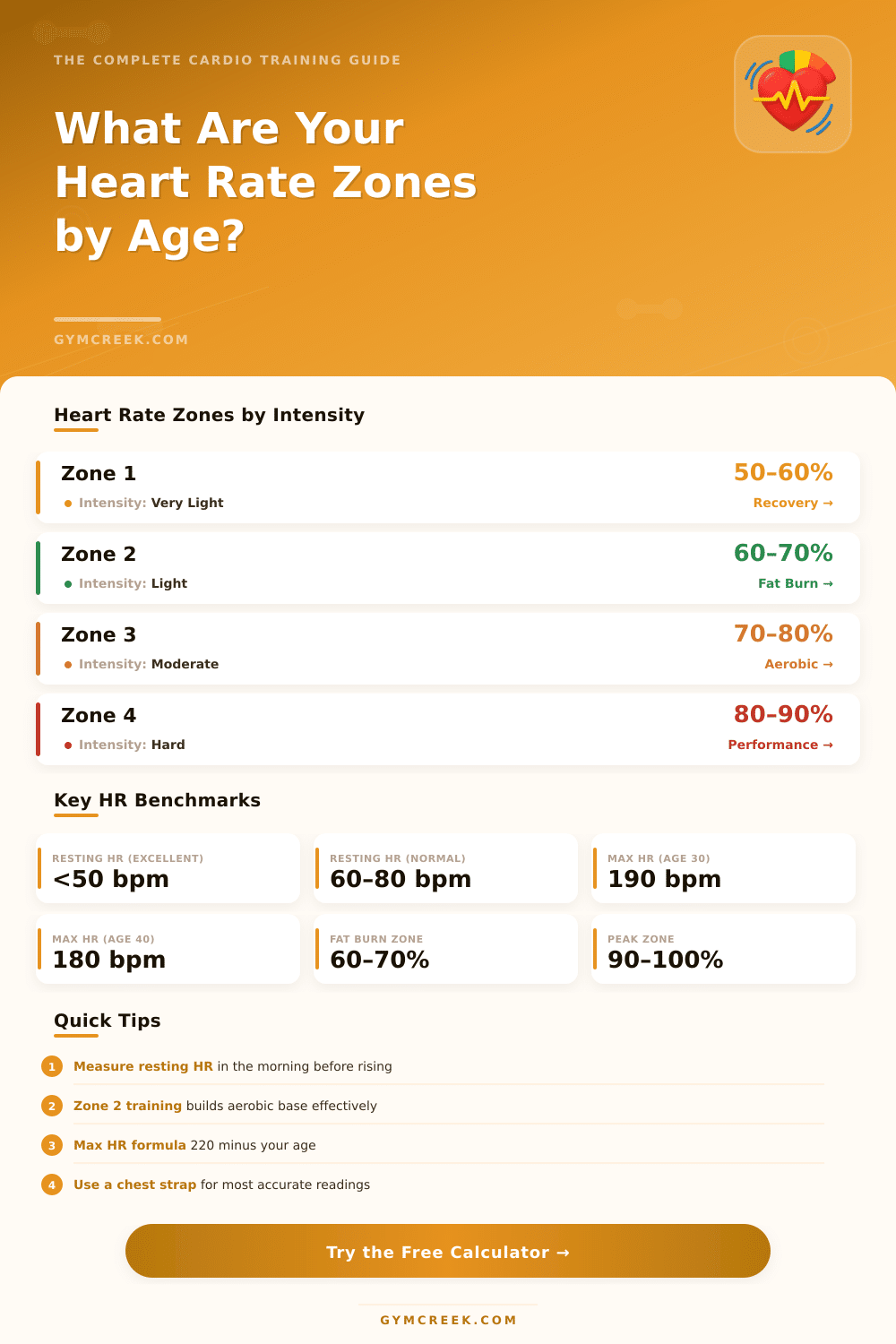
| Zone | % Max HR | Intensity | Primary Benefit | Example (Age 35) |
|---|---|---|---|---|
| Zone 1 | 50–60% | Very Light | Recovery, Warm-Up | 93–111 bpm |
| Zone 2 | 60–70% | Light / Fat Burn | Fat Oxidation, Aerobic Base | 111–130 bpm |
| Zone 3 | 70–80% | Moderate / Aerobic | Cardiovascular Fitness | 130–148 bpm |
| Zone 4 | 80–90% | Hard / Anaerobic Threshold | Speed, Lactate Threshold | 148–167 bpm |
| Zone 5 | 90–100% | Maximum / Peak | Max Power, VO2 Max | 167–185 bpm |
| Category | Men (bpm) | Women (bpm) | Fitness Level |
|---|---|---|---|
| Athlete | 40–50 | 40–53 | Elite |
| Excellent | 51–58 | 54–60 | Advanced |
| Good | 59–65 | 61–67 | Intermediate |
| Average | 66–73 | 68–75 | Beginner |
| Below Average | 74–81 | 76–83 | Sedentary |
| Poor | > 82 | > 84 | Very Low Fitness |
| Age Range | Max HR (Standard) | Max HR (Tanaka) | Zone 2 (60–70%) | Zone 4 (80–90%) |
|---|---|---|---|---|
| 20–25 | 195–200 bpm | 194–197 bpm | 117–140 bpm | 156–180 bpm |
| 26–30 | 190–194 bpm | 190–193 bpm | 114–136 bpm | 152–175 bpm |
| 31–35 | 185–189 bpm | 184–187 bpm | 111–132 bpm | 148–170 bpm |
| 36–40 | 180–184 bpm | 180–183 bpm | 108–129 bpm | 144–166 bpm |
| 41–45 | 175–179 bpm | 176–179 bpm | 105–125 bpm | 140–161 bpm |
| 46–50 | 170–174 bpm | 173–176 bpm | 102–122 bpm | 136–157 bpm |
| 51–55 | 165–169 bpm | 169–172 bpm | 99–118 bpm | 132–152 bpm |
| 56–60 | 160–164 bpm | 166–168 bpm | 96–115 bpm | 128–148 bpm |
| 61–65 | 155–159 bpm | 162–165 bpm | 93–111 bpm | 124–143 bpm |
| 66–70 | 150–154 bpm | 159–162 bpm | 90–108 bpm | 120–139 bpm |
Zone 2 – Fat Burn: Conversational pace jogging, light cycling. Burns the highest percentage of fat calories. Ideal for 30–90 min sessions.
Zone 3 – Aerobic: Moderately hard effort. Builds cardio endurance. You can speak in short sentences. Ideal for 20–60 min sessions.
Zone 4 – Threshold: Hard effort. Pushes your lactate threshold. Speaking is difficult. Keep sessions 10–30 min at this level.
Zone 5 – Peak: Maximum sprint effort. Unsustainable beyond 1–2 minutes. Used in HIIT intervals and racing.
Heart Rate Zone simply shows the intensity of your heart, that helps to estimate how hard your body works during physical activity. One counts them as percentages of your highest heart rate so the maximum speed that your heart actually reaches. When you know these zones, you can control and change the force of your exercise, what makes your training more efficient and focused.
DISCLOSURE: This post may contain affiliate links, meaning when you click the links and make a purchase, I receive a commission. As an Amazon Associate I earn from qualifying purchases.

There are five zones, and each of them reveals something different about the effort that you put in. Zone 1 sits between 50% and 60% of the maximum heart rate. It feels very easy.
What Are Heart Rate Zones?
You can talk freely without heavy sweat. Many folks reach this zone during warmups, cooldowns or those light rest days. Zone 2 involves around 60% to 70%, here happens fat burning and building of endurance.
When you run and can chat easily with someone, probably you are in Zone 2. Zone 3 gives middle intensity and helps improve the blood flow through your heart and muscles. Then lactic acid starts to build up.
Zone 5 is the most severe and requires long rest after it, so avoid too much time here in one session.
The easiest way to estimate the maximum heart rate? Take 220 and subtract your age. Women sometimes use 226 instead.
After you have that number, to count a zone, simply multiply it by the right percentage. There is also the Karvonen formula, that is more precise. It considers your resting heart rate.
It does that by subtracting the resting rate form the maximum, multiplied by the percentage of the zone, and later adding the resting rate again. That way usually moves your zones a bit higher than the simple calculation.
Here the key cause: Heart Rate Zone is very personal. Two runners in Zone 2 can go at totally different speeds. Someone that is home-sitting, maybe can not reach Zones 4 and 5 safely, but when fitness improves, that limit climbs.
For sports like running and cycling, around 80% of your training should happen in Zones 1 and 2. The other 20% belong to Zones 3 to 5. Building a strong aerobic base in Zone 2 makes your heart more efficient, when you push to more severe levels later.
Also, a better aerobic base allows your body to handle hard exercises and rest more quickly.
Zones 1 and 2 use mostly fat as fuel, mixed with a bit of glucose. When you enter Zones 3 to 5, your aerobic system reaches its limit, and you depend more on stored energy. Low Heart Rate Zone is ideal for fat burning, because you can do it long and rest easily.
To check your heart during training, simply lay a finger on the wrist, count pulses for 10 seconds, and multiply by 6. Your target zone usually sits between 55% and 85% of the maximum heart rate. If you are abeginning, aim for the bottom part…
Around 50%, and slowly improve from there.