🌡️ Dew Point Running Pace Calculator
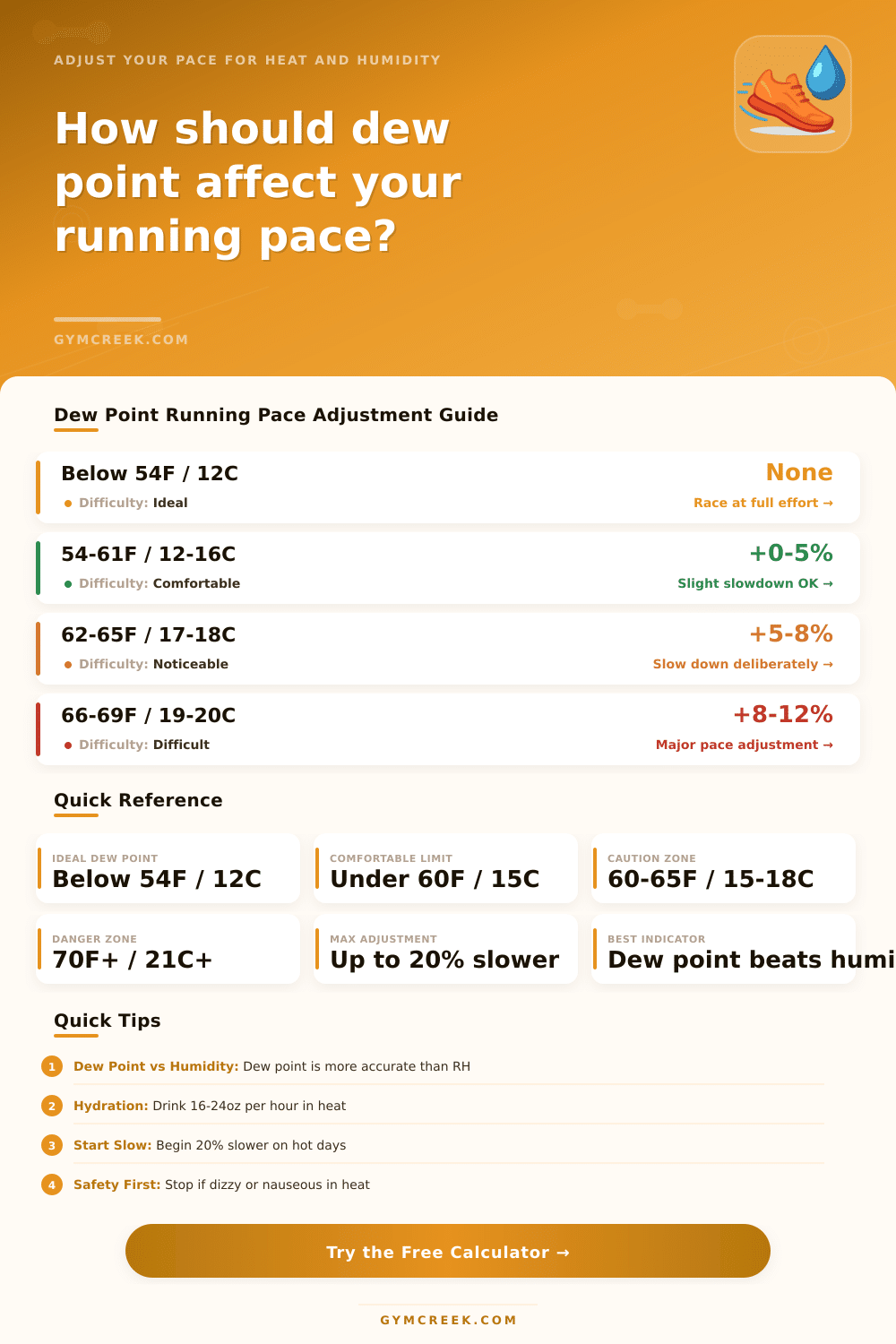
Adjust your running pace for heat and humidity using dew point — the most accurate measure of running discomfort
| Dew Point | Adjustment | Difficulty | Description | Recommendation |
|---|---|---|---|---|
| Below 54°F / 12°C | 0% | Ideal | Crisp and comfortable | Race at full effort |
| 54–57°F / 12–14°C | +0–2% | Very Good | Barely noticeable | Minor adjustment optional |
| 58–61°F / 14–16°C | +3–5% | Good | Slight discomfort | Slow 3-5% from goal pace |
| 62–65°F / 17–18°C | +5–8% | Moderate | Noticeably uncomfortable | Slow 5-8%, hydrate well |
| 66–69°F / 19–20°C | +8–12% | Difficult | Very humid, sweat won't cool | Major slowdown required |
| 70–73°F / 21–23°C | +12–15% | Very Hard | Oppressive heat stress | Survival mode pace only |
| 74°F+ / 23°C+ | +15–20% | Dangerous | Extreme heat stress risk | Consider not racing |
| Temp (°F) | Dew Point (°F) | Risk Level | Action |
|---|---|---|---|
| 55–65 | Below 45 | Ideal | Race at full effort |
| 65–75 | 45–55 | Low | Minimal adjustment |
| 70–80 | 55–60 | Moderate | Slow 3-5% |
| 75–85 | 60–65 | Caution | Slow 5-10% |
| 80–90 | 65–70 | High | Slow 10-15% |
| 85–95 | 70–75 | Very High | Slow 15-20% |
| 90+ | 75+ | Extreme | Do not race |
Your Running Pace shows simply how much time you need to cross a certain distance. The calculation itself is easy: you divide the whole duration by the distance that you ran. For instance, if you finish 5 kilometers in 30 minutes that averages to 6 minutes each kilometer.
If you turn that into speed, you find around 10 kilometers per hour. Most runners use that method to sort their exercise and check where they truly stand.
How to Find and Use Your Running Pace
You do not need expensive sporting devices to find this number, a normal watch works quite well. You measure the time for a distance that you know, and do the math. Even more handy, there are free online calculators that do everything for you.
You just need to enter two of the three elements (speed, time or distnace) and they give the missing one. They cover everything from 5-kilometer races to marathon runs and even longer.
There is not something like one “right” Running Pace. What seems comfortable depends on your age, gender, skills and weight of the body. A speed that was easy before could seem hard soon after that.
If you recently start, you can run slower then 15 minutes per mile, and that is most normal if that is your current level.
Light runs should feel relaxed, you know, those during which you can talk with someone. Usually that sits between 59 and 74 percent of your VO2max, although it changes based on your mood that day, the weather and the kind of ground you run on. For many runners the goal is 80 percent of the weekly distance in slow, easy rhythm and 20 percent for harder efforts.
Those portions show themselves more and more fit to build real fitness.
Your tactical pace beats a bit the level of your light run. You can keep it for around 3 to 4 miles, before you must slow down. Run at your 5k speed, and you enter almost anaerobic area, while the 10k speed stays more in the stable, middle to heavy aerobic zone.
Starting weak is often the smarter choice. Slow rhythm lets you reach the target without fully burning out. Adding each 500 metres to your long run weekly slowly builds you, without shocking your body.
The real secret comes from staying steady and balanced exercise. Especially newcomers should not care too much about fast sprints or too fast growth of their distance.
Starting slowly, even if your inner voice pushes you to go faster, is truly smart. Your mind wants to move hard, but that can leave you tired in the middle of the way. It takes discipline and practice to learn to start slow early.
Funny fact: amateur runners run on average 14 percent more slowly in self-paced efforts than when someone sets their rhythm for them.
Think about your training based on time used, instead of only the kilometers. A fast runner crosses more ground in one hour than a slow one. Both give the same time, but cover different distances.
Running Pace sits among the easiest ways to guess how hard you work, it is almost as good as heart data, but much more simple to follow. Running Pace and rhythm anddistance help you note progress and keep everything moving.