Starting Strength Calculator
Map novice starting weights, warm-up ramps, and weekly jumps for squat, bench, press, and deadlift while keeping progress conservative.
📌Preset Novice Paths
Each preset loads a realistic novice setup and recalculates the starting weights, jump sizes, and warm-up ladder immediately.
⚙Novice Profile
Starting Strength snapshot
Enter your anchors to map conservative starting loads, jump sizes, and warm-up ramps.
📊Program Metrics
📑Reference Tables
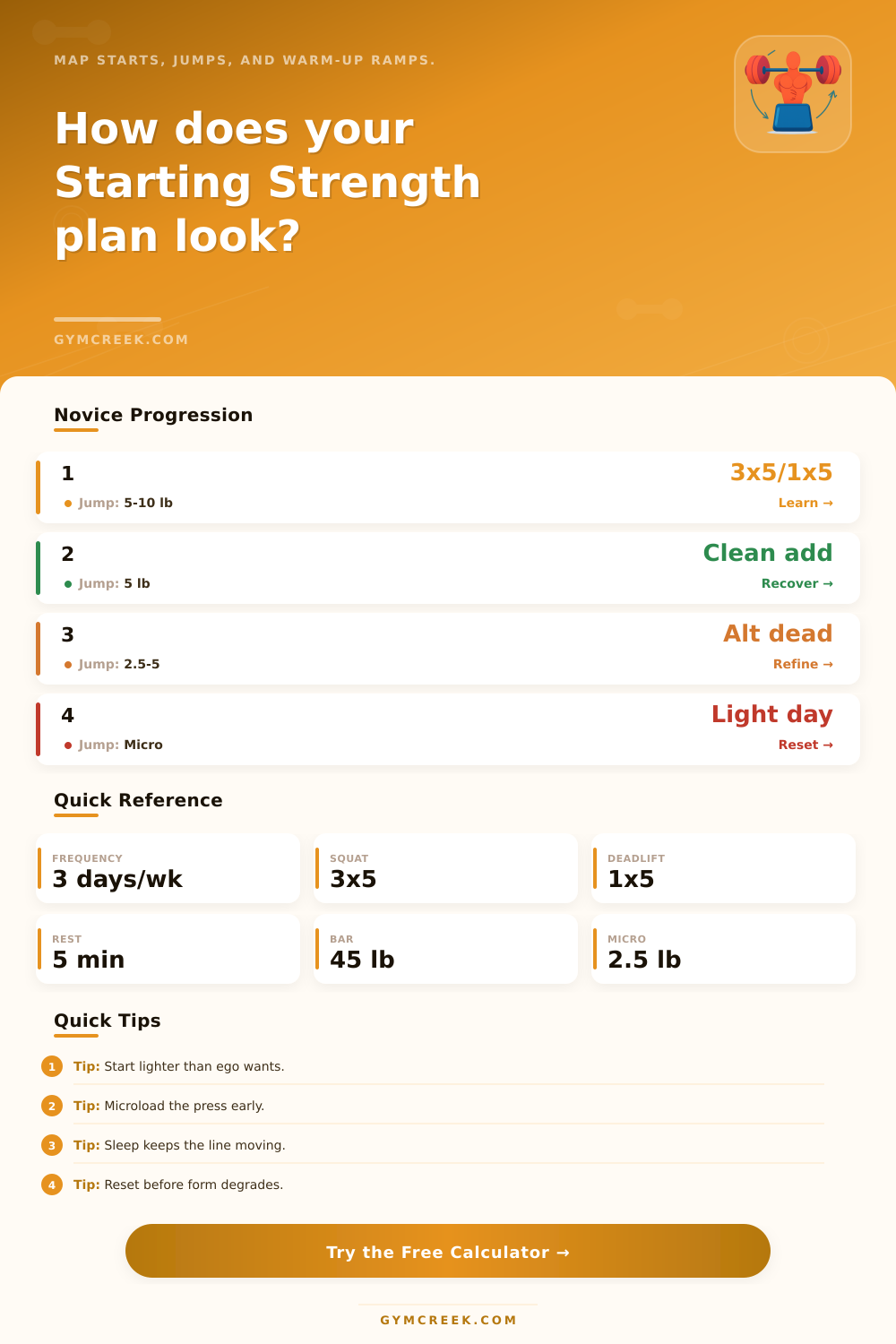
| Phase | Main work | Jump | Note |
|---|---|---|---|
| 1 | 3x5 / 1x5 | 5-10 lb | Learn |
| 2 | Clean add | 5 lb | Recover |
| 3 | Alt dead | 2.5-5 | Refine |
| 4 | Light day | Micro | Reset |
| Lift | First jump | Later jump | Microload |
|---|---|---|---|
| Squat | 10 lb | 5 lb | 2.5 |
| Bench | 5 lb | 2.5 lb | 1.25 |
| Press | 5 lb | 2.5 lb | 1.25 |
| Deadlift | 10 lb | 5 lb | 2.5 |
| Work set | Warm-up 1 | Warm-up 2 | Top ramp |
|---|---|---|---|
| Light | Bar x5 | Bar x5 | 3/2 |
| Medium | Bar x5 | 50% | 75% |
| Heavy | Bar x5 | 60% | 80% |
| Example | 45 x5 | 145 x3 | 195 x2 |
| Score | Read | Signal | Action |
|---|---|---|---|
| 85-100 | Green | Fresh | Add |
| 70-84 | Steady | Stable | Hold |
| 55-69 | Caution | Fatigue | Micro |
| <55 | Reset | Stall | Back off |
💡Tips
The Starting Strength program is an method of lifting weight in order to build strength within an individual. To start the program, an individual must select a weight that can be lifted for three sets of five repetitions. Three sets of five repetitions must be performed for each exercises in the program, and an individual must add a small amount of weight to the barbell during each training session.
By adding only a small amount of weight to the barbell during each training session, an individual can gradual and steadily develop there strength within the body; small increment of weight are easier for the body to recover from than large increments of weight. Many individuals will likely begin to overestimate the amount of weight that they are able to lift in the Starting Strength program. Individuals should select a weight that is 85 or 88 percent of an individual’s maximum weight for five repetitions.
How to Do the Starting Strength Program
By selecting a weight at this level, individuals ensures that they are able to complete the prescribed number of repetitions while maintaining their form with their exercises. Factors that influence the amount of weight that an individual can lift include age, body weight, and amount of sleep that the individual get. For instance, a 24-year-old individual that sleeps eight hours each night may have greater strength than a 45-year-old individual that only sleeps six hours each night.
Additionally, the activity of an individual outside of gym session may influence the strength and recovery of that individual; those that are sedentary may have different physical recovery need than those that is athletes. The Starting Strength program includes three exercises: the squat, the bench press (or overhead press), and the deadlift. The individual will perform squats during each training session in which they performs the exercises; the legs of an individual require little recovery time, and the squat exercise provides systemic benefits to the body.
The program will only require deadlifts once each week after the third stage; deadlifts is taxing to the nervous system. During the first phase of the program, 10 pounds of weight should be added to both the squat and deadlift exercises. However, only small amounts of weight, such as 5 or 2.5 pounds, should be added to upper body exercises, such as the bench or press exercises.
Each individual must perform a warm-up prior to performing the squat, bench, or press exercises. The warm-up exercise requires the individual to lift the empty barbells five times, then gradually add weight to the barbells until they reach 80% of the individual’s working weight for that exercise. Performing these warm-ups prior to the squat, bench, or press exercises allow the body to warm up for the heavy weights while conserving the bodys energy.
There are various ways to adjust the program according to the individual. For instance, an individual’s height and weight can be used to calculate their body mass index and their basal metabolic rate. The body mass and basal metabolic rate of an individual will help to determine how much food the individual needs to consume in order to recover from those workouts.
Additionally, an individual’s experience level in weight training will influence their ability to follow the program; new lifters will be able to gradually add more weight than an experienced lifter that may be recovering from an injury. Finally, the templates for the program can be adjusted to include “micro-loads” or “backoff percentages” to create a more conservative program that is realistically appropriate for that individual’s experience and abilities. A backoff percentage allows you to reduce the weight you are lifting if you are under high levels of stress.
By reducing the weight you lift, you are more likely to be consistent in your strength training program. The concept of progression cannot be a straight line in the Starting Strength program. In phase one, you will perform sets of movements with heavy weights.
In phase two, you will incorporate power cleans and perform smaller weight increments. In phase three, you will alternate between powerlifting stances. In phase four, you will incorporate light days and micro-loads into your program.
You can use the readiness score to determine whether you should add or decrease the weight that you load onto the barbell. If your readiness score is between 85 and 100 percent, you should add weight to the barbell. If your readiness score is below 55 percent, you should perform a deload where you reduce the weight that you lift by 10 percent.
Sleep is one of the primary factors that can influence your readiness score. If you are getting enough sleep, your muscles will feel recovered. If you are sleep deprived, your muscles will begin to feel fatigue.
A common mistake is in attempting to lift the maximum amount of weight with the barbell too early in your program. Avoid lifting one-rep maximums because it can prevent you from succeeding in your future workouts. By using lighter weights to lift, you will gain more strength.
Nutrition is required to succeed in the program. You will need to consume enough calories to fuel your workouts and approximately one gram of protein per pound of your body weight. You should also take five minute of rest in between sets.
Five minutes of rest will allow your bodies’ ATP levels to recharge so that you can produce the maximum strength with the barbell. Some adjustments must be made to the program if you are using a home gym for your workouts. You may have to use micro-loads when using a home gym for which there are fewer weight plates available.
The warm-up calculations may have to be adjusted for lighter barbells at the home gym. Women can use the programs, but women will have to adjust the inputs according to their body weight. Additionally, if women are cutting calories to lose weight, even smaller weight increments should be used to preserve muscle mass.
Finally, you must pay attention to your body and adjust your training if you feel that you are experiencing fatigue. Film each round of lifting to check your form. Pay close attention to the depth to which you squat and the path of the barbells that you press.
Checking your form will allow you to find any form mistake prior to them affecting your strength measurements. Consistency is the most important factor in the program. If you can perform three workouts per week, eat the proper amount of food and sleep well, you will be able to gradually increase the weight that you lift with the barbell.
Strength is gained by starting with light weights and slowly adding weight over a long period of time.