Workout Split Calculator
Turn training days, recovery, and goal into a split plan, weekly set target, session length, and frequency map.
📌Preset Training Weeks
Each preset loads a realistic weekly schedule and recalculates the split, sets, and session fit immediately.
⚙Split Inputs
Workout split snapshot
Enter your week and calculate the split pattern, weekly sets, and session fit.
📊Plan Metrics
📑Reference Tables
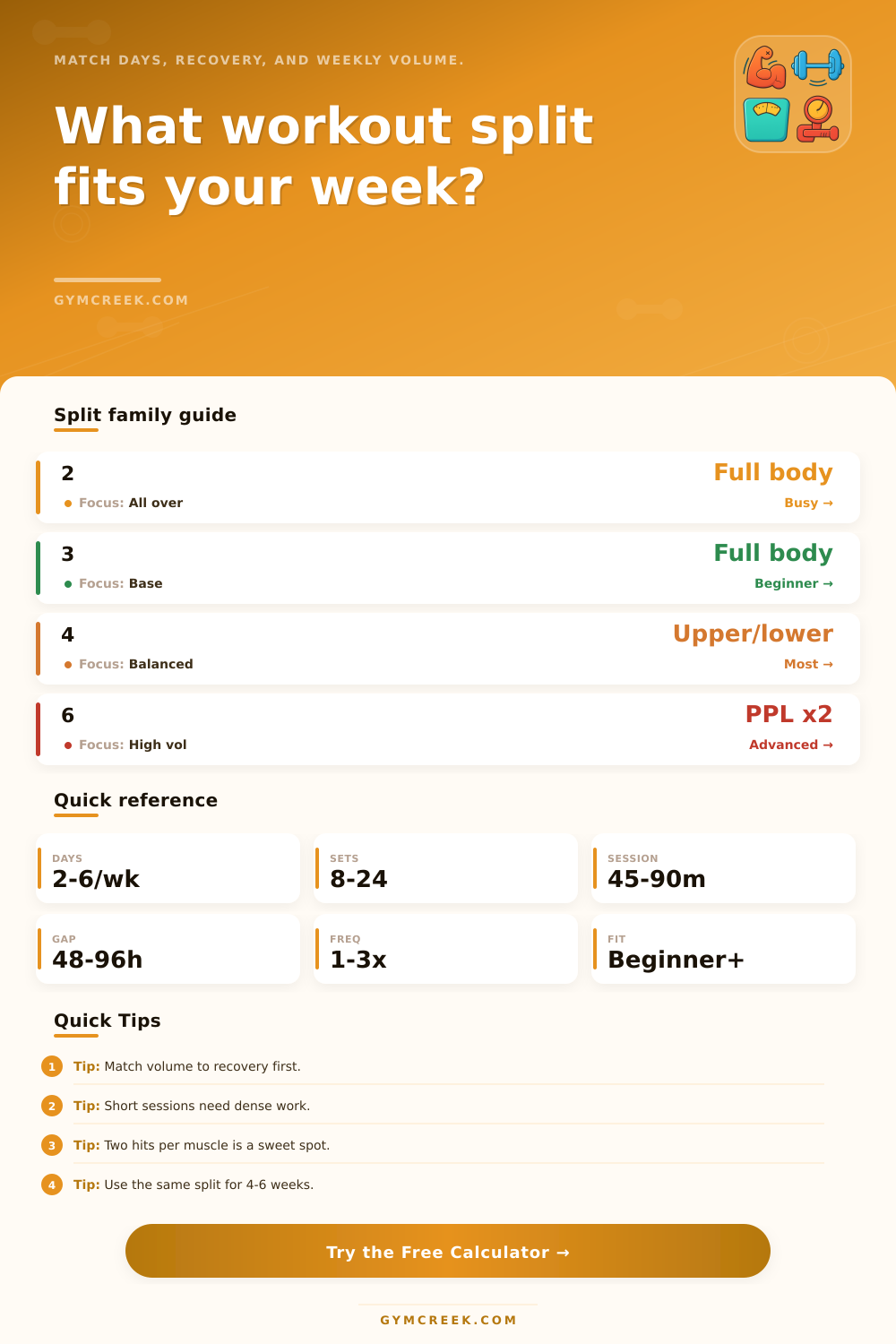
| Days | Split | Focus | Use |
|---|---|---|---|
| 2 | Full body | All over | Busy week |
| 3 | Full body | Base work | Beginner |
| 4 | Upper/lower | Balanced | Best fit |
| 6 | PPL x2 | High vol | Advanced |
| Goal | Sets | Reps | Cue |
|---|---|---|---|
| Strength | 8-14 | 3-6 | Heavy |
| Hypertrophy | 12-20 | 6-12 | Classic |
| Recomp | 10-14 | 6-10 | Steady |
| Specialization | 16-24 | 8-15 | Extra |
| Session | Time | Style | Note |
|---|---|---|---|
| 45-60m | Short | Dense | Fast work |
| 60-75m | Normal | Balanced | Most days |
| 75-90m | Long | Heavy | Big lifts |
| 90m+ | Very long | High vol | PPL x2 |
| Muscle | Freq | Gap | Bias |
|---|---|---|---|
| Full body | 3x | 48-72h | Even |
| Upper/lower | 2x | 60-84h | Balanced |
| PPL | 2x | 72h | More vol |
| Body-part | 1x | 96h | Local |
💡Practical Tips
A training split refers to a schedule that determine the specific muscles that an individual will train during a particular week. These splits are important for individuals who performs their workouts because they will be able to manage there energy levels. In addition, the splits will ensure that their muscles has time to recover properly.
However, if the training split is incorrect, then an individual will struggle to increase there strength. On the other hand, if the training split is correct for an individual, the energy and strength levels will increase over time. There are several training splits that an individual can follow.
A Simple Guide to Training Splits
A full-body split means that each individual will work every muscle group during each training session. This training split is used for individuals who has very few days to train. An individual can use a push-pull-legs split to give more focus to three specific muscle group to allow for increased strength without daily burnout.
The upper-lower split allows an individual to alternate training days between upper body and lower body muscles. This split has been found to be effective for many individual. Lastly, a body-part split allows individuals to dedicate certain days to specific body parts, such as the chest or the legs.
This split is for individuals who want to focus on increasing the size of a specific body part. Each training split includes certain elements that allow the body to recover from the exertion required of its muscles during exercise. Muscles do not grows during exercise.
Rather, they grow during the recovery period after each exercise session. An individual’s training split ensure that each muscle group rests every so often to encourage growth. If an individual trains a specific muscle group every day, that muscle will not have time to recover.
It is recommended that each muscle group rests for 48 to 96 hour between training sessions to encourage muscles to gain strength. Individuals just starting to exercise will require less training than more advanced lifters but will require more recovery after each session. The job and activity level of an individual will also impact there recovery from exercise.
A person should also consider there goal with there training split. An individual seeking to increase there strength will perform fewer repetitions with more weight and take longer rest periods between sets. An individual who desires to increase the size of there muscles will perform more sets in the 6 to 12 repetition range.
An individual looking to recompose there body will perform a more moderate exercise routine where they burn calories and build muscle at the same time. An athlete may seek more power and speed in there training split. An individual may even seek to specialize in a particular muscle group, such as the arms.
A training split involves several variables that an individual must consider. For instance, an individual may want to perform between 12 and 20 sets of each exercise each week. However, the number of days that an individual trains will factor into the number of sets that each muscle group performs.
Each session may have a time limit to ensure that an individual does not perform too many exercises during one session. An individual may have to limit each session to 75 minutes of exercise. Factors such as body weight will also impact the exercise split.
An individual with a lighter body weight will perform fewer sets than an individual with a heavier body weight. Finally, an individual can use there training split to focus more on specific muscle group that are lagging behind in strength. There are several metrics for individuals to track during there training split.
The number of hard sets that an individual performs each week will be tracked. The length of each training session will be tracked. The frequency of each exercise will be tracked to ensure that each muscle group has adequate time to recover after training.
An individual can also use a density index that calculates the number of sets they perform per pound or kilogram of there body weight. If an individual feels too tired in the middle of the week, this could mean that they need to take more time to recover from the muscle groups that they trained. If an individual feels bored by the exercises that they are performing, it could indicate an exercise split that is too stale for that individual.
Some of the mistake that many individuals make with there training splits involve there volume. Many individuals may attempt to perform 30 training sets per muscle group each week but may not allow there muscles time to recover between sessions. Other mistakes are performing training sessions six days a week without a high degree of recovery.
An individual should of stick with a particular training split for four to six week before attempting to change the split for that individual. If an individual is seeking to increase the strength of a specific muscle group, they should adjust the split to focus on that specific muscle group while continuing to strengthen other muscle groups of the body. An individual should adjust there training split according to there real-world situations.
If an individual is injured, they can substitute there exercises. If an individual does not have the appropriate training equipment, the full body split can be used at home instead. If an individual travels for work or other reasons, they can alter there training split to accommodate travel time.
If an individual does not eat enough meals or sleeps enough during the day, they will not be able to perform as many training sets as they would like. Sleep is more important than the number of training sets that are performed. Finally, an individuals training split should match the individuals weekly schedule so that they can have time to rest and allow there gains in strength to compound over time.